Irregular verbs in the French present tense are verbs that do not follow the regular pattern of -er verbs like parler. They include many of the verbs you need every day: être, avoir, aller, faire, prendre, venir, vouloir, pouvoir and devoir. You use them like any present-tense verb: for what is happening now, for habits and for facts.
When to use the present tense
The French present (le présent) covers both the English simple present (I go) and the present continuous (I am going).
- Actions happening now: Je fais mes devoirs. — I’m doing my homework.
- Habits and routines: On va au marché le samedi. — We go to the market on Saturdays.
- Facts and descriptions: Elle vient de Marseille. — She comes from Marseille.
- A planned near future, with a time word: Je pars demain. — I’m leaving tomorrow.
- Something that started in the past and continues, with depuis: J’apprends le français depuis un mois. — I’ve been learning French for a month.
There is no separate -ing form in French. Je vais means both I go and I’m going.
Patterns that make irregular verbs easier
Irregular verbs change their stem or have unusual endings, but they are not random. Look for these patterns:
- je, tu and il/elle/on usually sound the same. Je fais, tu fais, il fait are all pronounced the same way. The usual spelling is -s, -s, -t (or -x, -x, -t for vouloir and pouvoir).
- nous and vous often keep a stem close to the infinitive: venir → nous venons, vous venez.
- ils/elles often changes the stem again and ends in a silent -ent: ils viennent, ils prennent, ils doivent.
- Only three verbs have a vous form without -ez: vous êtes, vous faites, vous dites.
- Four verbs end in -ont with ils/elles: ils sont, ils ont, ils vont, ils font.
Être and avoir
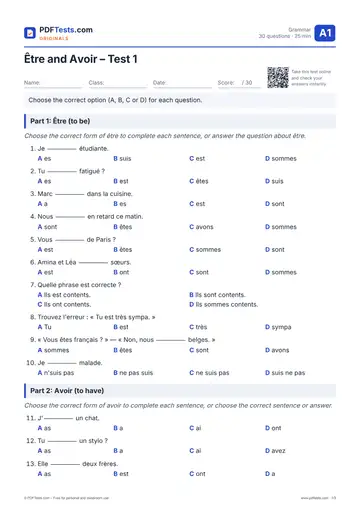
These two are the most important verbs in French. They have their own guide, Être and Avoir explained, so here is just a reminder.
| Subject | être (to be) | avoir (to have) |
|---|---|---|
| je / j’ | suis | ai |
| tu | es | as |
| il / elle / on | est | a |
| nous | sommes | avons |
| vous | êtes | avez |
| ils / elles | sont | ont |
J’ai vingt ans et je suis étudiant. — I’m twenty and I’m a student.
Aller (to go)
Although it ends in -er, aller is completely irregular.
| Affirmative | Negative | Question |
|---|---|---|
| je vais | je ne vais pas | Est-ce que je vais… ? |
| tu vas | tu ne vas pas | Tu vas… ? |
| il / elle / on va | il ne va pas | Va-t-il… ? |
| nous allons | nous n’allons pas | Allons-nous… ? |
| vous allez | vous n’allez pas | Allez-vous… ? |
| ils / elles vont | ils ne vont pas | Vont-ils… ? |
- Je vais au travail en métro. — I go to work by metro.
- Comment allez-vous ? — How are you?
- Ça va ? — How’s it going?
Notice the -t- in va-t-il: it is added between two vowels to make inversion easier to say.
Faire (to do / to make)
| Subject | faire |
|---|---|
| je | fais |
| tu | fais |
| il / elle / on | fait |
| nous | faisons |
| vous | faites |
| ils / elles | font |
Faire is used in many fixed expressions:
- Tu fais du sport ? — Do you do any sport?
- Nous faisons les courses le vendredi. — We do the shopping on Fridays.
- Il fait beau aujourd’hui. — The weather is nice today.
Pronunciation: in nous faisons, the ai sounds like the e in le: “fuh-ZON”.
Prendre (to take)
| Subject | prendre |
|---|---|
| je | prends |
| tu | prends |
| il / elle / on | prend |
| nous | prenons |
| vous | prenez |
| ils / elles | prennent |
The d disappears in the plural, and ils prennent has a double n. Apprendre (to learn) and comprendre (to understand) follow exactly the same pattern.
- Je prends un café, s’il vous plaît. — I’ll have a coffee, please.
- Ils prennent le bus à huit heures. — They take the bus at eight.
- Vous comprenez ? — Do you understand?
Pronunciation: il prend ends in a nasal sound, but ils prennent ends in a clear n sound. You can hear the difference between singular and plural.
Venir (to come)
| Subject | venir |
|---|---|
| je | viens |
| tu | viens |
| il / elle / on | vient |
| nous | venons |
| vous | venez |
| ils / elles | viennent |
Revenir (to come back) and devenir (to become) follow the same pattern.
- Tu viens avec nous ? — Are you coming with us?
- Mes parents viennent du Canada. — My parents come from Canada.
Vouloir, pouvoir and devoir
These three verbs are usually followed directly by an infinitive, with no preposition.
| Subject | vouloir (to want) | pouvoir (can) | devoir (must) |
|---|---|---|---|
| je | veux | peux | dois |
| tu | veux | peux | dois |
| il / elle / on | veut | peut | doit |
| nous | voulons | pouvons | devons |
| vous | voulez | pouvez | devez |
| ils / elles | veulent | peuvent | doivent |
- Je veux apprendre l’espagnol. — I want to learn Spanish.
- Tu peux fermer la fenêtre ? — Can you close the window?
- Nous devons partir tôt. — We have to leave early.
In the negative, ne … pas goes around the conjugated verb, not the infinitive: Je ne peux pas venir. — I can’t come. See our guide to negation with ne … pas for more.
Politeness tip: to order or ask for something, French speakers say je voudrais (I would like) rather than je veux, which can sound abrupt. Je voudrais une baguette. — I’d like a baguette.
Partir, sortir and dormir
These verbs share a pattern: in the singular, you drop the consonant before -ir.
| Subject | partir (to leave) | sortir (to go out) | dormir (to sleep) |
|---|---|---|---|
| je | pars | sors | dors |
| tu | pars | sors | dors |
| il / elle / on | part | sort | dort |
| nous | partons | sortons | dormons |
| vous | partez | sortez | dormez |
| ils / elles | partent | sortent | dorment |
Le train part à midi. — The train leaves at noon.
More useful verbs at a glance
If you know the je, nous and ils forms, you can usually work out the rest.
| Infinitive | je | nous | ils / elles |
|---|---|---|---|
| voir (to see) | vois | voyons | voient |
| dire (to say) | dis | disons | disent |
| mettre (to put) | mets | mettons | mettent |
| boire (to drink) | bois | buvons | boivent |
| lire (to read) | lis | lisons | lisent |
| écrire (to write) | écris | écrivons | écrivent |
| savoir (to know) | sais | savons | savent |
| connaître (to know) | connais | connaissons | connaissent |
Remember the vous form of dire: vous dites.
Signal words
These words often appear with the present tense:
- maintenant (now), aujourd’hui (today), en ce moment (at the moment)
- tous les jours (every day), d’habitude (usually), souvent (often), toujours (always)
- le lundi, le week-end (on Mondays, at weekends)
- ce soir, demain (tonight, tomorrow) for near-future plans
- depuis (for / since)
D’habitude, je sors le vendredi soir. — I usually go out on Friday evenings.
Irregular verbs vs regular -er verbs
Regular -er verbs keep the same stem and add the endings -e, -es, -e, -ons, -ez, -ent: je parle, nous parlons, ils parlent. Revise them in our guide to the present tense of -er verbs. Irregular verbs change the stem (je viens, nous venons, ils viennent) or use different endings (je veux, vous faites).
The biggest trap is aller. It looks like an -er verb, but you never say j’alle or ils allent.
Also keep apart aller + place and aller + infinitive:
- Je vais à Paris. — I’m going to Paris. (movement)
- Je vais manger. — I’m going to eat. (near future)
The second structure is the futur proche, explained in our guide to futur proche and futur simple.
Common mistakes
- ✗ J’alle au cinéma. → ✓ Je vais au cinéma. — Aller is irregular, not a regular -er verb.
- ✗ Vous faisez du yoga. → ✓ Vous faites du yoga. — Faites is one of only three vous forms without -ez.
- ✗ Ils prendent le train. → ✓ Ils prennent le train. — The plural stem is prenn-.
- ✗ Il viens demain. → ✓ Il vient demain. — The il/elle form ends in -t.
- ✗ Tu veut un thé ? → ✓ Tu veux un thé ? — The tu form of vouloir ends in -x.
- ✗ Je veux de partir. → ✓ Je veux partir. — No preposition between vouloir and the infinitive.
- ✗ Je peux nage. → ✓ Je peux nager. — The second verb stays in the infinitive.
- ✗ Je suis allant au travail. → ✓ Je vais au travail. — French has no -ing form; the present covers both meanings.
Quick check
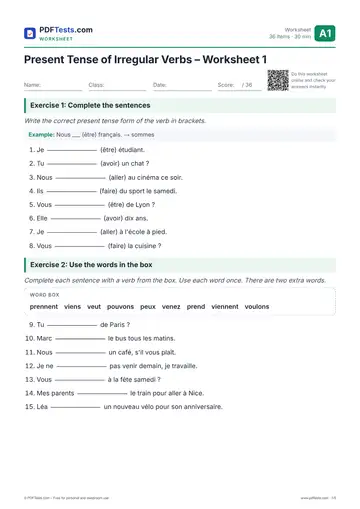
Complete each sentence with the correct present-tense form.
- Nous ___ (aller) à la plage.
- Vous ___ (faire) du sport ?
- Ils ___ (prendre) le bus.
- Je ne ___ (pouvoir) pas venir ce soir.
- Elle ___ (venir) de Lyon.
Answers
- allons
- faites
- prennent
- peux
- vient
Next step
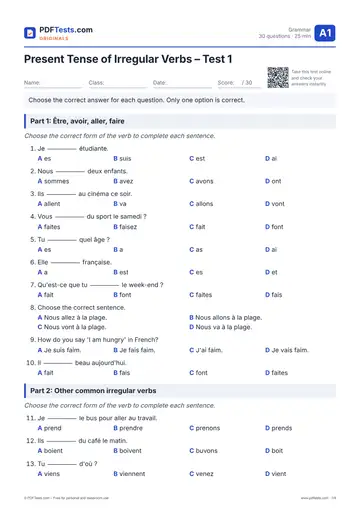
The best way to fix these forms in your memory is to use them in short sentences about your own day, then check yourself under test conditions. Try our A1 Present Tense of Irregular Verbs test, and pay special attention to the ils/elles forms and the vous forms êtes, faites and dites, where most mistakes happen.
Was this page helpful?
What was the problem?
Thank you for your feedback!