PDFTests Originals

Adjective Agreement – Worksheet 1

A1 Beginner WorksheetFrench

This worksheet practises French adjective agreement at A1 level: making adjectives masculine, feminine, singular or plural to match the noun. Learners also practise where to put adjectives, and use them in negative sentences and simple questions. It suits beginners in class or at home.
items
36
Time
30 min
PDF
5 pages
Answer key
Included
  • 100% free
  • No sign-up or email
  • Print-ready A4 PDF
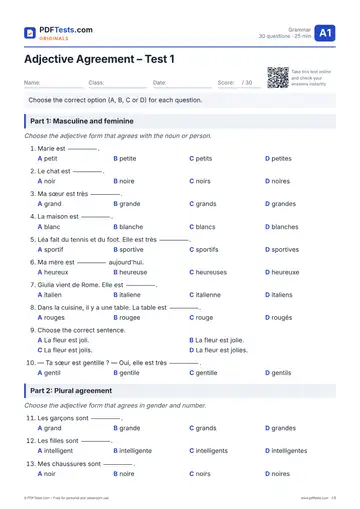
Preview of page 1 of Adjective Agreement – Worksheet 1 Open PDF
New to this topic? Read the guide first: French Adjective Agreement: Rules, Endings and Examples

Do the worksheet online

Type your answers, then press “Check my answers”. Alternative correct answers are accepted.

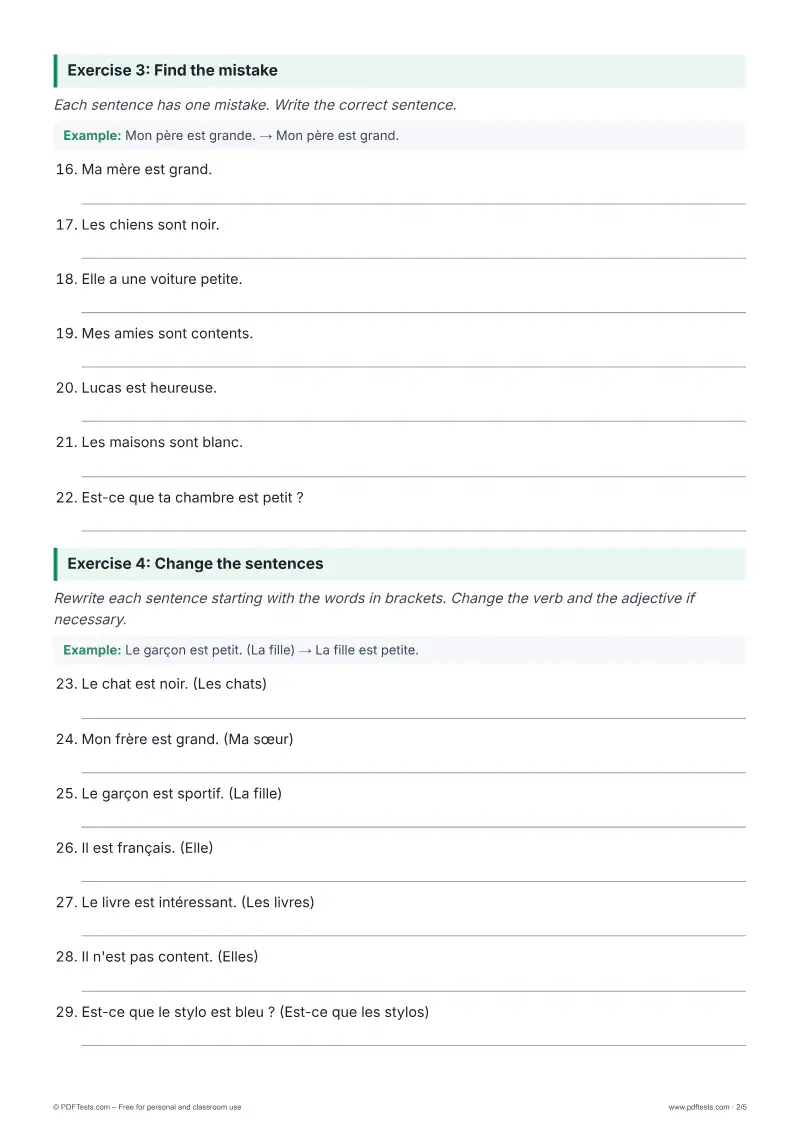
Exercise 1: Complete the sentences

Write the correct form of the adjective in brackets.

Example: Les maisons sont ___ (grand). → grandes

  1. Marie est (petit).

  2. Les garçons sont (grand).

  3. Ma voiture est (noir).

  4. Les fleurs sont (joli).

  5. Paul n'est pas (content).

  6. Elle est (heureux).

  7. La table est (rouge).

  8. Est-ce que la maison est (blanc) ?

Exercise 2: Choose from the box

Complete each sentence with a word from the box. There are two extra words.

Word box intelligentebleusvertegentilsbellenouveauxvieuxvertbelles

  1. Ma sœur est très . Elle a toujours de bonnes notes.

  2. Les yeux de Léo sont comme le ciel.

  3. La pomme n'est pas rouge, elle est .

  4. Mes voisins sont très . Ils m'aident toujours.

  5. Tu as une robe !

  6. J'ai deux amis à l'école. Ils arrivent cette année.

  7. Mon grand-père est . Il a 90 ans.

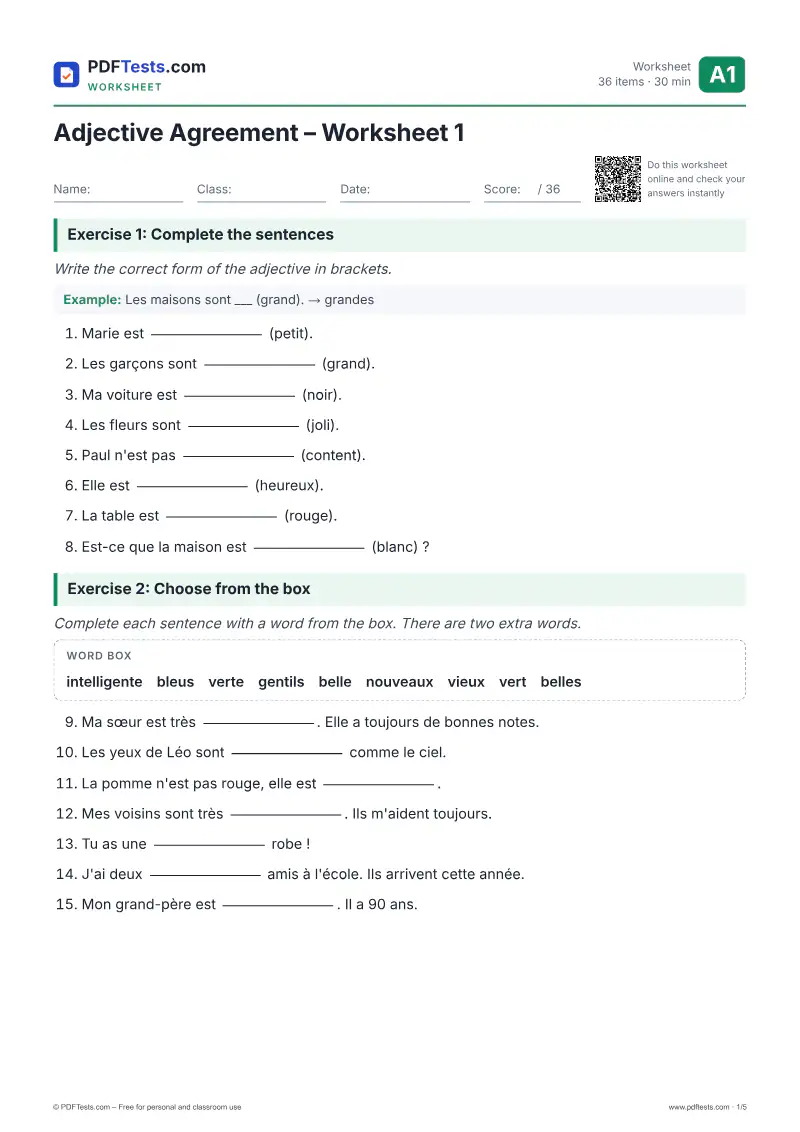
Exercise 3: Find the mistake

Each sentence has one mistake. Write the correct sentence.

Example: Mon père est grande. → Mon père est grand.

  1. Ma mère est grand.

  2. Les chiens sont noir.

  3. Elle a une voiture petite.

  4. Mes amies sont contents.

  5. Lucas est heureuse.

  6. Les maisons sont blanc.

  7. Est-ce que ta chambre est petit ?

Exercise 4: Change the sentences

Rewrite each sentence starting with the words in brackets. Change the verb and the adjective if necessary.

Example: Le garçon est petit. (La fille) → La fille est petite.

  1. Le chat est noir. (Les chats)

  2. Mon frère est grand. (Ma sœur)

  3. Le garçon est sportif. (La fille)

  4. Il est français. (Elle)

  5. Le livre est intéressant. (Les livres)

  6. Il n'est pas content. (Elles)

  7. Est-ce que le stylo est bleu ? (Est-ce que les stylos)

Exercise 5: Put the words in order

Put the words in the correct order to make a sentence. Think about where the adjective goes.

Example: un / blanc / J'ai / chat → J'ai un chat blanc.

  1. une / Elle / maison / a / grande

  2. pantalon / J' / un / ai / noir

  3. fatiguées / ne / Les / pas / filles / sont

  4. jolie / C' / une / est / ville

  5. blanc / Tu / chien / un / as / ?

  6. italienne / est / Sofia / une / étudiante

  7. robe / porte / Anna / belle / une / rouge

Was this page helpful?

Report a mistake

Spotted a wrong answer, a typo or an unclear explanation? Tell us and we will fix it.

Preview

About this test

Free printable A1 French worksheet on adjective agreement: masculine, feminine and plural forms, adjective position, negatives and questions. Answers included.

Topics covered

Adjective agreementMasculine and feminine adjectivesPlural adjectivesAdjective positionNegatives and questions

Notes for teachers

Start by reviewing the basic rule (add -e for feminine, -s for plural) and then the common irregular patterns (-eux → -euse, -if → -ive, blanc → blanche). Typical mistakes include forgetting agreement after être, adding an extra -e to adjectives that already end in -e (rouge), and putting colour adjectives before the noun. As a follow-up, ask learners to describe a family member or classmate using four adjectives, then change the description to talk about two people.

All French A1 tests →