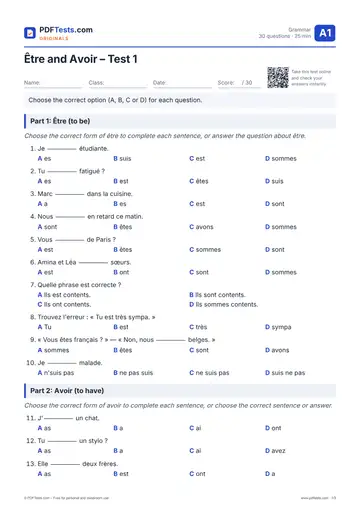
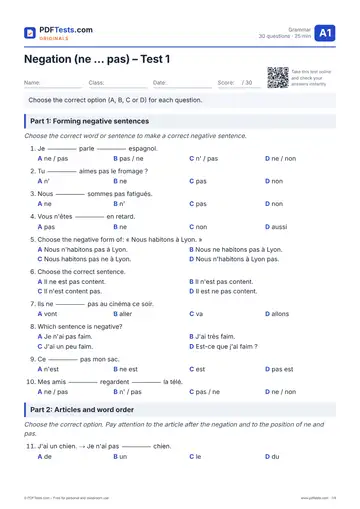
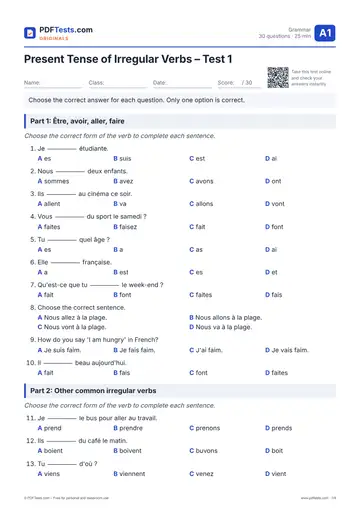
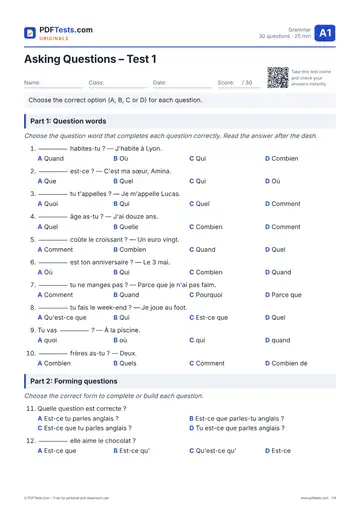
To form the French present tense of -er verbs, remove -er from the infinitive and add one of six endings: -e, -es, -e, -ons, -ez, -ent. You use it for habits, facts, actions happening right now and near-future plans. It covers both English I work and I am working. Most French verbs end in -er, so this one pattern gives you hundreds of verbs at once.
What counts as an -er verb
An -er verb is any verb whose infinitive (dictionary form) ends in -er. Here are some of the most useful ones at A1:
| Verb | Meaning | Verb | Meaning |
|---|---|---|---|
| parler | to speak | écouter | to listen (to) |
| aimer | to like, to love | regarder | to watch, to look at |
| habiter | to live (in a place) | jouer | to play |
| travailler | to work | chercher | to look for |
| manger | to eat | arriver | to arrive |
| étudier | to study | rester | to stay |
There is one big exception. Aller (to go) ends in -er but is completely irregular: je vais, tu vas, il va… You will find it in our guide to the present tense of irregular verbs.
Form: the six endings
Step 1: find the stem
Take the infinitive and remove -er. What is left is the stem:
- parler → parl-
- travailler → travaill-
- étudier → étudi-
Step 2: add the ending
| Subject | Ending | parler | English |
|---|---|---|---|
| je | -e | je parle | I speak |
| tu | -es | tu parles | you speak (informal) |
| il / elle / on | -e | il parle | he / she / one speaks |
| nous | -ons | nous parlons | we speak |
| vous | -ez | vous parlez | you speak (formal or plural) |
| ils / elles | -ent | ils parlent | they speak |
A few notes on the subjects:
- Tu is for one person you know well. Vous is for one person you address formally, or for more than one person.
- On literally means one or people, but in everyday French it usually means we. It always takes the il/elle form: On regarde un film ce soir. — We’re watching a film tonight.
- Ils is for a group of men or a mixed group. Elles is only for an all-female group.
Examples:
- Je travaille dans un bureau. — I work in an office.
- Tu parles très bien français. — You speak French very well.
- Nous étudions l’anglais à l’université. — We study English at university.
- Elles jouent au tennis le samedi. — They play tennis on Saturdays.
Je becomes j’ before a vowel or a silent h
When the verb starts with a vowel or a silent h, je drops its e and becomes j’:
| Subject | aimer | habiter |
|---|---|---|
| je | j’aime | j’habite |
| tu | tu aimes | tu habites |
| il / elle / on | elle aime | elle habite |
| nous | nous aimons | nous habitons |
| vous | vous aimez | vous habitez |
| ils / elles | ils aiment | ils habitent |
- J’habite à Marseille. — I live in Marseille.
- J’écoute un podcast. — I’m listening to a podcast.
Pronunciation: four forms, one sound
The endings -e, -es and -ent are silent. This means je parle, tu parles, il parle and ils parlent all sound exactly the same: like “parl”. Only two endings are pronounced:
- -ons sounds like a nasal “on”: nous parlons
- -ez sounds like “ay” (the same as é): vous parlez
Do not pronounce the -ent of ils parlent. It is one of the most common beginner errors.
Liaison: before a verb starting with a vowel or silent h, the s of nous, vous, ils, elles is pronounced as a z sound. Nous aimons sounds like “nou-z-aimons”, and ils habitent sounds like “il-z-habitent”. This z sound is often the only way to hear the difference between il aime (he likes) and ils aiment (they like).
Negative form
To make the verb negative, put ne before it and pas after it. Ne becomes n’ before a vowel or silent h.
| Affirmative | Negative | English |
|---|---|---|
| je parle | je ne parle pas | I don’t speak |
| tu travailles | tu ne travailles pas | you don’t work |
| il mange | il ne mange pas | he doesn’t eat |
| nous aimons | nous n’aimons pas | we don’t like |
| vous habitez | vous n’habitez pas | you don’t live |
| elles écoutent | elles n’écoutent pas | they don’t listen |
- Je n’aime pas le café. — I don’t like coffee.
- Ils ne travaillent pas le dimanche. — They don’t work on Sundays.
In casual speech, French speakers often drop ne: J’aime pas le café. Write the full form in tests and formal writing. For more detail, see our guide to negation with ne … pas.
Questions
There are three common ways to ask a yes/no question:
| Method | Example | Register |
|---|---|---|
| Rising intonation | Tu parles anglais ? | everyday, spoken |
| Est-ce que | Est-ce que tu parles anglais ? | neutral, all situations |
| Inversion | Parles-tu anglais ? | more formal, written |
All three mean Do you speak English? Two small rules:
- Est-ce que becomes est-ce qu’ before a vowel: Est-ce qu’il travaille aujourd’hui ? — Is he working today?
- With inversion, il / elle / on forms of -er verbs end in a vowel. French adds -t- between the verb and the pronoun: Parle-t-elle français ? — Does she speak French?
The guide to asking questions in French covers question words like où, quand and pourquoi.
Spelling changes in some -er verbs
The endings never change. However, some verbs make a small change to the stem to keep their pronunciation regular.
| Verb type | Example | Change | Forms |
|---|---|---|---|
| -ger | manger | add e before -ons | nous mangeons |
| -cer | commencer | c → ç before -ons | nous commençons |
| e + consonant + er | acheter | e → è | j’achète, nous achetons |
| é + consonant + er | préférer | é → è | je préfère, nous préférons |
| -eler / -eter (some) | appeler | double the consonant | j’appelle, nous appelons |
| -yer | envoyer | y → i | j’envoie, nous envoyons |
The first two changes affect only the nous form. They keep the soft g and soft c sounds. Nous mangons would be pronounced with a hard g, like in gone.
The last four changes affect je, tu, il/elle/on and ils/elles, but not nous or vous:
- Tu achètes du pain ? — Are you buying bread?
- Vous achetez des fruits. — You’re buying fruit.
- Je préfère le thé. — I prefer tea.
- Je m’appelle Léa. — My name is Léa.
When to use the present tense
Habits and routines
- Je travaille du lundi au vendredi. — I work from Monday to Friday.
- Nous mangeons à midi. — We eat at noon.
Actions happening now
French has no separate continuous tense, so the present describes what is happening at this moment.
- Chut, je téléphone à ma mère. — Shh, I’m phoning my mum.
- Les enfants regardent la télé. — The children are watching TV.
Facts and timetables
- Le magasin ferme à 19 heures. — The shop closes at 7 p.m.
- Le train arrive à 8 h 15. — The train arrives at 8:15.
Near-future plans
- Demain, je travaille à la maison. — Tomorrow I’m working from home.
Actions that started in the past and continue: depuis
Where English uses have been … for, French uses the present with depuis:
- J’étudie le français depuis six mois. — I have been studying French for six months.
Signal words
These words and phrases often appear with the present tense:
| French | English |
|---|---|
| tous les jours | every day |
| souvent | often |
| toujours | always |
| d’habitude | usually |
| le samedi | on Saturdays |
| maintenant | now |
| en ce moment | at the moment |
| depuis | since, for |
- D’habitude, je regarde les infos le soir. — I usually watch the news in the evening.
French present vs English present
English has several present forms, but French has just one.
| English | French |
|---|---|
| I play / I am playing / I do play | je joue |
| Do you work? / Are you working? | Tu travailles ? |
| She doesn’t live here. | Elle n’habite pas ici. |
There is no French equivalent of do / does in questions and negatives. There is also no être + verb structure for I am …ing. The single verb form does the whole job. For être itself, see the guide to être and avoir.
Common mistakes
- ✗ Je suis parle français. → ✓ Je parle français. — The present uses one verb. Do not add être to copy I am speaking.
- ✗ Je aime le chocolat. → ✓ J’aime le chocolat. — Je becomes j’ before a vowel or silent h.
- ✗ Tu parle anglais ? → ✓ Tu parles anglais ? — The tu form always ends in -s, even though you can’t hear it.
- ✗ Ils parlont. → ✓ Ils parlent. — The ils/elles ending for -er verbs is -ent. The -ont ending belongs to irregular verbs like ils ont and ils vont.
- ✗ Vous parlé. → ✓ Vous parlez. — The two sound the same, but the vous ending is -ez. Parlé is a past participle.
- ✗ Nous mangons. → ✓ Nous mangeons. — -ger verbs keep an e before -ons.
- ✗ J’achete. → ✓ J’achète. — Acheter takes è in every form except nous and vous.
- ✗ Je ne parle français. → ✓ Je ne parle pas français. — Negation needs both ne and pas.
- ✗ J’alle au cinéma. → ✓ Je vais au cinéma. — Aller is irregular and does not follow the -er pattern.
Quick check
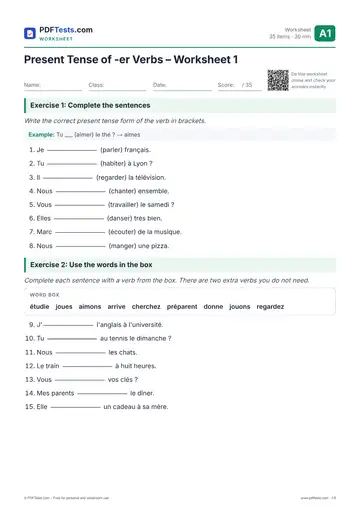
Put the verb in brackets into the correct present-tense form.
- Tu ___ (habiter) à Paris ?
- Nous ___ (manger) au restaurant ce soir.
- Elles ___ (écouter) la radio.
- ___ (je / aimer) le football.
- Vous ___ (acheter) des fruits.
Answers
- Tu habites à Paris ? — Do you live in Paris?
- Nous mangeons au restaurant ce soir. — We’re eating at a restaurant tonight. (Keep the e before -ons.)
- Elles écoutent la radio. — They’re listening to the radio. (The -ent is silent.)
- J’aime le football. — I like football. (Je becomes j’.)
- Vous achetez des fruits. — You’re buying fruit. (No accent in the vous form.)
Next step
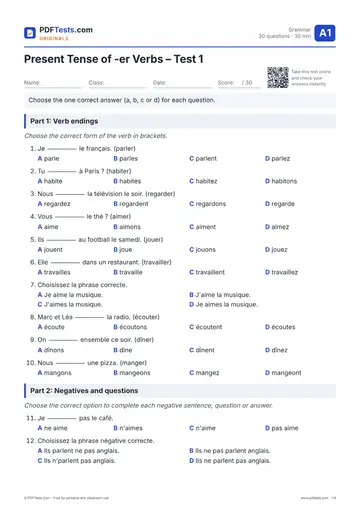
Now practise the endings until they become automatic. Test yourself with our A1 Present Tense of -er Verbs test, and review any items you miss using the tables above. Once you can conjugate regular -er verbs without hesitating, move on to the present tense of irregular verbs such as aller, faire and prendre. You can also browse all our French A1 tests to build your beginner grammar step by step.
Was this page helpful?
What was the problem?
Thank you for your feedback!