French nouns almost always come with an article. The definite article (le, la, l’, les) points to a specific thing or to something in general. The indefinite article (un, une, des) introduces one or several countable things. The partitive article (du, de la, de l’, des) expresses an unspecified amount of something you don’t count.
The right choice depends on two things: the noun’s gender and number, and what you want to say.
The three types at a glance
| Type | Masculine | Feminine | Before a vowel or mute h | Plural |
|---|---|---|---|---|
| Definite (the) | le | la | l’ | les |
| Indefinite (a, an, some) | un | une | un / une | des |
| Partitive (some, any) | du | de la | de l’ | des |
One big difference from English: French rarely leaves a noun without an article.
- Les enfants aiment le chocolat. — Children like chocolate.
- J’ai des questions. — I have questions.
In both sentences English uses no article, but French needs one.
Definite articles: le, la, l’, les
Form
| Article | Use | Example |
|---|---|---|
| le | masculine singular | le livre — the book |
| la | feminine singular | la table — the table |
| l’ | singular before a vowel or mute h | l’ami, l’école, l’hôtel — the friend, the school, the hotel |
| les | all plurals | les livres, les tables — the books, the tables |
When to use the definite article
1. A specific thing that both people know about
- Le pain est sur la table. — The bread is on the table.
- Tu as les clés ? — Do you have the keys?
2. Things in general
- Les chats sont mignons. — Cats are cute.
- La musique est importante pour moi. — Music is important to me.
3. After verbs of liking and disliking
With aimer, adorer, détester and préférer, use the definite article, because you are talking about the thing in general.
- J’adore le fromage. — I love cheese.
- Tu préfères le thé ou le café ? — Do you prefer tea or coffee?
4. Unique things, languages, countries and school subjects
- Le soleil brille. — The sun is shining.
- J’apprends le français. — I’m learning French.
- La France est belle. — France is beautiful.
- Elle aime les maths. — She likes maths.
After parler, the article is usually dropped: Je parle français. — I speak French.
5. Days of the week for habits
- Le samedi, je joue au foot. — On Saturdays, I play football.
- Samedi, je joue au foot. — On Saturday (this Saturday), I’m playing football.
Contractions with à and de
When à or de comes before le or les, the two words combine. La and l’ never contract.
| + le | + la | + l’ | + les | |
|---|---|---|---|---|
| à | au | à la | à l’ | aux |
| de | du | de la | de l’ | des |
- Je vais au cinéma. — I’m going to the cinema.
- Elle parle aux enfants. — She’s talking to the children.
- C’est le livre du professeur. — It’s the teacher’s book.
- Je rentre de la plage. — I’m coming back from the beach.
Here du means of the or from the. It looks like the partitive du, but the meaning is different.
Indefinite articles: un, une, des
Form
| Article | Use | Example |
|---|---|---|
| un | masculine singular | un stylo — a pen |
| une | feminine singular | une pomme — an apple |
| des | all plurals | des stylos, des pommes — (some) pens, (some) apples |
When to use the indefinite article
1. One thing, not a specific one
- J’ai un frère. — I have a brother.
- Il y a une pharmacie près d’ici ? — Is there a pharmacy near here?
2. First mention, then the definite article
- Il y a un chat dans le jardin. Le chat est noir. — There’s a cat in the garden. The cat is black.
3. Several things: des
Des is the plural of un and une. English often says some or nothing at all, but French cannot drop des.
- J’ai des amis à Lyon. — I have friends in Lyon.
- Elle achète des fleurs. — She’s buying some flowers.
When an adjective comes before a plural noun, des often becomes de: de belles fleurs — beautiful flowers. You’ll meet this more at A2.
No article with jobs after être
After être, jobs, nationalities and religions take no article.
- Elle est médecin. — She’s a doctor.
- Je suis étudiant. — I’m a student.
With c’est, you need the article: C’est un médecin. — He’s a doctor. Revise these patterns in our Être and Avoir guide.
Partitive articles: du, de la, de l’, des
Use the partitive for an unspecified amount of something you don’t count: food, drinks, materials and some activities. English says some, any or nothing.
| Article | Use | Example |
|---|---|---|
| du | masculine | du pain — (some) bread |
| de la | feminine | de la soupe — (some) soup |
| de l’ | before a vowel or mute h | de l’eau — (some) water |
| des | plural | des pâtes — (some) pasta |
- Je bois du café le matin. — I drink coffee in the morning.
- Tu veux de la soupe ? — Do you want some soup?
- Il y a de l’eau dans le frigo. — There’s water in the fridge.
- Ce soir, on mange des pâtes. — Tonight we’re eating pasta.
- Je fais du sport le week-end. — I do sport at the weekend.
Countable or not?
The same noun can take un or du depending on the meaning:
- Je mange une pizza. — I’m eating a (whole) pizza.
- Je mange de la pizza. — I’m eating some pizza.
- Un café, s’il vous plaît. — A coffee, please. (one cup)
Le, un or du? How to choose
| What you mean | Article | Example |
|---|---|---|
| a specific thing | le / la / les | Le gâteau est délicieux. — The cake is delicious. |
| something in general, likes and dislikes | le / la / les | J’aime le gâteau. — I like cake. |
| one whole countable thing | un / une | Je fais un gâteau. — I’m making a cake. |
| an amount of something | du / de la / de l’ | Je mange du gâteau. — I’m eating some cake. |
A useful rule of thumb: aimer, adorer, détester, préférer + le/la/les, but manger, boire, acheter, vouloir, prendre + du/de la/de l’.
- J’aime le lait, alors je bois du lait tous les jours. — I like milk, so I drink milk every day.
After negation: pas de
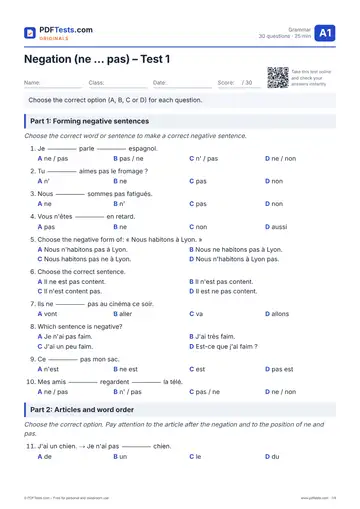
After ne … pas, the articles un, une, des, du, de la and de l’ all become de (or d’ before a vowel).
| Affirmative | Negative |
|---|---|
| J’ai un chien. — I have a dog. | Je n’ai pas de chien. — I don’t have a dog. |
| Il boit du lait. — He drinks milk. | Il ne boit pas de lait. — He doesn’t drink milk. |
| Il y a des œufs. — There are eggs. | Il n’y a pas d’œufs. — There aren’t any eggs. |
Two exceptions:
- Definite articles don’t change: Je n’aime pas le lait. — I don’t like milk.
- After être, the article stays: Ce n’est pas un chat, c’est un chien. — It’s not a cat, it’s a dog.
For more on this pattern, see our guide to negation with ne … pas.
After quantities: de
Words of quantity are followed by de / d’ with no article: beaucoup de, un peu de, trop de, assez de, un kilo de, une bouteille de, un verre de.
- Je voudrais un kilo de pommes. — I’d like a kilo of apples.
- Il a beaucoup d’amis. — He has lots of friends.
- Un verre d’eau, s’il vous plaît. — A glass of water, please.
Pronunciation and spelling notes
- Elision: le and la become l’ before a vowel or a mute h: l’arbre, l’heure. This doesn’t happen before an aspirated h: le haricot, le hamster.
- Liaison: the final s of les and des sounds like z before a vowel: les‿amis, des‿enfants. Un also links: un‿ami (sounds like un-nami).
- Le vs les: in speech, the article often tells you whether a noun is singular or plural, because livre and livres sound the same. Le sounds like luh, les like lay.
- Learn the gender: always learn new nouns with un or une (une maison, un vélo). Gender also controls adjectives, as you’ll see in our adjective agreement guide.
Common mistakes
- ✗ J’aime du chocolat. → ✓ J’aime le chocolat. Verbs of liking take the definite article.
- ✗ Je bois le café tous les matins. → ✓ Je bois du café tous les matins. An unspecified amount needs the partitive.
- ✗ J’ai amis à Paris. → ✓ J’ai des amis à Paris. French can’t drop des before a plural noun.
- ✗ Je n’ai pas un chien. → ✓ Je n’ai pas de chien. Un, une and des become de after pas.
- ✗ Je n’aime pas de fromage. → ✓ Je n’aime pas le fromage. Definite articles stay the same after a negative.
- ✗ Il est un professeur. → ✓ Il est professeur. No article with jobs after être.
- ✗ Je vais à le marché. → ✓ Je vais au marché. À + le always contracts to au.
- ✗ le école → ✓ l’école. Le and la become l’ before a vowel.
- ✗ beaucoup des amis → ✓ beaucoup d’amis. Quantity words take de with no article.
Quick check
Fill in the gap with the correct article.
- J’adore ___ musique classique.
- Tu veux ___ eau ?
- Nous n’avons pas ___ voiture.
- Il y a ___ livres sur la table.
- Le dimanche, je vais ___ parc.
Answers
- la — aimer/adorer + definite article; musique is feminine.
- de l’ — an amount of water; eau starts with a vowel.
- de — une becomes de after pas.
- des — several countable things, not specific.
- au — à + le parc contracts to au.
Next step
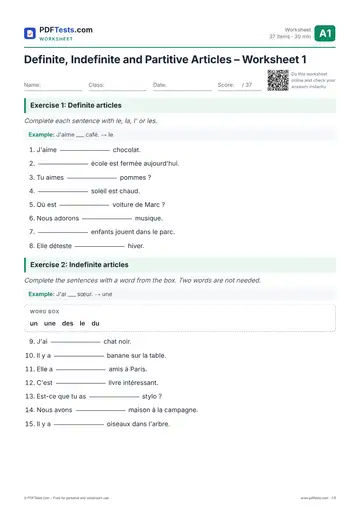
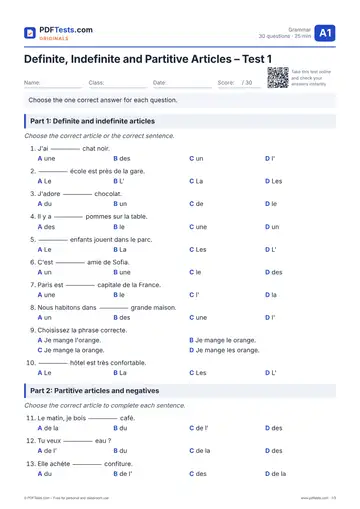
Now put the rules into practice: test yourself with our A1 Definite, Indefinite and Partitive Articles test, then try the A1 Negation test to check your pas de sentences. When you feel confident, browse all our French A1 tests to combine articles with verbs, adjectives and everyday vocabulary.
Was this page helpful?
What was the problem?
Thank you for your feedback!