The concordance des temps (sequence of tenses) is the set of rules that links the tense of a subordinate clause to the tense of the main clause. It matters most when the main verb is in a past tense: the verb in the que-clause then shifts to show whether its action happens before, at the same time as, or after the main action. You need it for reported speech, for indirect questions, for subjunctive clauses and for formal and literary written French.
The core idea: three time relationships
Every subordinate verb expresses one of three relationships with the main verb:
- Simultaneity (simultanéité): the two actions happen at the same time.
- Anteriority (antériorité): the subordinate action happens before the main one.
- Posteriority (postériorité): the subordinate action happens after the main one.
The tense you choose for the subordinate verb depends on this relationship and on the tense of the main verb.
Main clause in the present or future
When the main verb is in the present, the future or the imperative, there is no mechanical shift. You simply use the tense that matches the real time of the action.
| Relationship | Subordinate tense | Example |
|---|---|---|
| Simultaneity | présent | Je sais qu’elle travaille chez Airbus. I know she works at Airbus. |
| Anteriority | passé composé / imparfait | Je sais qu’elle a travaillé à Toulouse. I know she worked in Toulouse. |
| Posteriority | futur simple | Je sais qu’elle travaillera à Berlin. I know she will work in Berlin. |
The same applies after a future main verb: Il dira qu’il n’a rien vu. — He will say he saw nothing.
Main clause in a past tense (indicative)
When the main verb is in the passé composé, imparfait, plus-que-parfait or passé simple, the subordinate verb moves into the past system. This is the heart of the concordance des temps.
| Relationship | Subordinate tense | Example |
|---|---|---|
| Simultaneity | imparfait | Il a dit qu’il était épuisé. He said he was exhausted. |
| Anteriority | plus-que-parfait | Il a dit qu’il avait mal dormi. He said he had slept badly. |
| Posteriority | conditionnel présent | Il a dit qu’il prendrait un jour de congé. He said he would take a day off. |
| Posteriority, completed before another future point | conditionnel passé | Il a dit qu’il aurait fini avant midi. He said he would have finished before noon. |
In other words, the conditional works as a future in the past. If you need a refresher on that form, see our guide to the past conditional, and for the tense of anteriority, the plus-que-parfait guide.
Tenses that shift and tenses that don’t
| Original tense | After a past main verb |
|---|---|
| présent | imparfait |
| passé composé | plus-que-parfait |
| futur simple | conditionnel présent |
| futur antérieur | conditionnel passé |
| futur proche (aller + inf.) | allait + infinitive |
| passé récent (venir de + inf.) | venait de + infinitive |
| imparfait, plus-que-parfait, conditionnel | no change |
« Je vais démissionner. » → Elle nous a annoncé qu’elle allait démissionner. — She told us she was going to resign.
« Le train vient de partir. » → On m’a expliqué que le train venait de partir. — I was told the train had just left.
« J’aimerais venir. » → Il a dit qu’il aimerait venir. — He said he would like to come.
The same rules apply to time clauses
After quand, lorsque, dès que, aussitôt que, French uses the future where English uses the present. In a past context, that future becomes a conditional:
Elle m’a promis qu’elle m’appellerait dès qu’elle arriverait. — She promised she would call me as soon as she arrived.
Il a juré qu’il partirait quand il aurait terminé son rapport. — He swore he would leave when he had finished his report.
When you can keep the present
The shift is not automatic in every register. You may keep the present or future after a past main verb when:
- the statement is a general truth: Le professeur a rappelé que l’eau bout à 100 °C. — The teacher reminded us that water boils at 100 °C.
- the situation is still true when you speak: Elle m’a dit hier qu’elle habite à Lille. — She told me yesterday that she lives in Lille. (She still does.)
- the future event is still in the future now: Il a annoncé que le magasin fermera en mars. — He announced that the shop will close in March. (March has not arrived yet.)
In careful written French, and especially in exam answers, the shifted tense is the safe choice unless you clearly want to stress that something is still valid.
Indirect questions
Indirect questions follow exactly the same pattern, whether introduced by si, ce que, où, quand, pourquoi or comment.
« Tu viendras ? » → Il m’a demandé si je viendrais. — He asked me whether I would come.
« Qu’est-ce que tu as fait ? » → Elle voulait savoir ce que j’avais fait. — She wanted to know what I had done.
Note the contrast: si meaning whether can be followed by the conditional, but si meaning if in a hypothesis cannot (see below). For the full picture of pronoun and time changes, read our guide to reported speech (discours indirect).
Shifting time expressions
When the reference point moves to the past, time markers usually change too.
| Direct speech | Reported in the past |
|---|---|
| aujourd’hui | ce jour-là |
| hier | la veille |
| demain | le lendemain |
| maintenant | à ce moment-là |
| ce soir | ce soir-là |
| la semaine prochaine | la semaine suivante |
| il y a trois jours | trois jours plus tôt / auparavant |
| dans deux jours | deux jours plus tard |
Elle a précisé qu’elle signerait le contrat le lendemain. — She specified that she would sign the contract the next day.
The subjunctive sequence
The subjunctive has its own concordance, and here modern usage differs from literary usage.
Modern standard French
In speech and in most contemporary writing, only two subjunctive tenses are used, whatever the tense of the main verb:
| Relationship | Subjunctive tense | Example |
|---|---|---|
| Simultaneity or posteriority | subjonctif présent | Je voulais qu’il vienne à la réunion. I wanted him to come to the meeting. |
| Anteriority | subjonctif passé | Je regrettais qu’il soit parti si tôt. I was sorry he had left so early. |
So Il faut que tu partes and Il fallait que tu partes both use the present subjunctive.
Literary French
In classical literature and some very formal writing, a past or conditional main verb triggers the imperfect and pluperfect subjunctive:
| Relationship | Subjunctive tense | Example |
|---|---|---|
| Simultaneity or posteriority | subjonctif imparfait | Il fallait qu’il vînt. He had to come. |
| Anteriority | subjonctif plus-que-parfait | Je doutais qu’elle eût compris. I doubted she had understood. |
The imperfect subjunctive is built on the passé simple stem. You will mostly meet the third person singular: qu’il fût, qu’il eût, qu’il fît, qu’il vînt, qu’il parlât, qu’il finît. At C1 you should recognise these forms and understand why a writer uses them, but you are not expected to produce them in everyday writing; using them in a casual email would sound affected. Our advanced subjunctive guide covers these forms in more detail.
Concordance vs. si clauses
Learners often mix up the sequence of tenses with the rules for hypothetical si clauses. They are separate systems. In a hypothesis, si is never followed by the future or the conditional:
| Si clause | Main clause | Example |
|---|---|---|
| si + présent | futur / présent / impératif | S’il pleut, on restera ici. If it rains, we’ll stay here. |
| si + imparfait | conditionnel présent | Si j’avais le temps, je lirais plus. If I had time, I would read more. |
| si + plus-que-parfait | conditionnel passé | Si tu m’avais prévenu, je serais venu. If you had told me, I would have come. |
When a whole hypothetical sentence is reported in the past, the si + présent pattern shifts to si + imparfait / conditionnel:
« Si tu insistes, je viendrai. » → Il a dit que si j’insistais, il viendrait. — He said that if I insisted, he would come.
The other two patterns stay unchanged. Revise them with our guide to si clauses.
Common mistakes
✗ Je pensais qu’il a déjà fini. → ✓ Je pensais qu’il avait déjà fini. — An action before a past main verb needs the plus-que-parfait.
✗ Elle m’avait assuré qu’elle finira avant lundi dernier. → ✓ Elle m’avait assuré qu’elle finirait avant lundi dernier. — A future seen from the past is expressed with the conditional.
✗ Il m’a demandé si je viendrai le lendemain. → ✓ Il m’a demandé si je viendrais le lendemain. — In a past indirect question, the future becomes the conditional.
✗ Si j’aurais su, je serais resté. → ✓ Si j’avais su, je serais resté. — Hypothetical si is never followed by the conditional.
✗ Elle a dit qu’elle va partir. → ✓ Elle a dit qu’elle allait partir. — Aller in the futur proche shifts to the imparfait.
✗ Il voulait que je viens. → ✓ Il voulait que je vienne. — A past main verb does not remove the need for the subjunctive.
✗ Il m’a promis qu’il m’écrirait quand il arrivera. → ✓ …quand il arriverait. — Both verbs refer to the same future-in-the-past, so both take the conditional.
Quick check
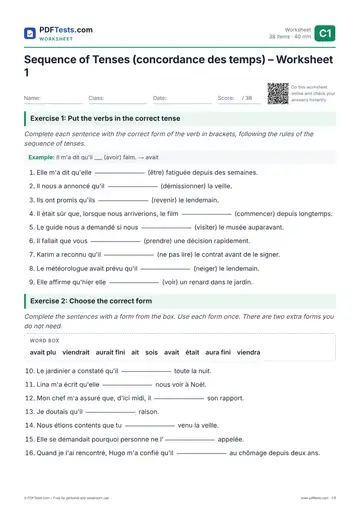
Put the verb in brackets into the correct tense.
- Elle m’a dit qu’elle ___ (être) fatiguée ce jour-là.
- Nous pensions que vous ___ (partir) déjà la veille.
- Je savais qu’il ___ (réussir) son examen la semaine suivante.
- Il m’a demandé si je ___ (pouvoir) l’aider le lendemain.
- Il fallait que tu ___ (venir) plus tôt. (modern French)
Answers
- était — simultaneity in the past → imparfait.
- étiez partis — anteriority in the past → plus-que-parfait.
- réussirait — posteriority in the past → conditionnel présent.
- pourrais — future in a past indirect question → conditionnel.
- viennes — modern French keeps the present subjunctive after a past main verb (literary: vinsses).
Next step
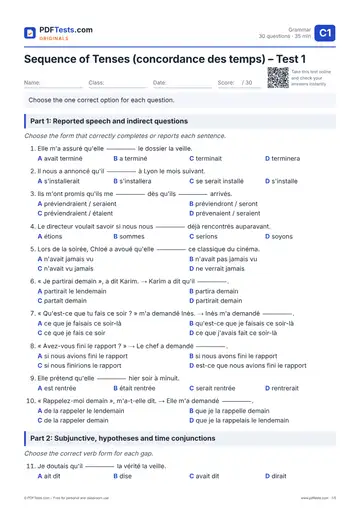
The concordance des temps becomes automatic only through practice with full sentences, so apply the tables above to real contexts: reported conversations, indirect questions and subjunctive clauses. When you feel ready, test yourself with our C1 Sequence of Tenses test, check every answer against the three time relationships, and return to the tables for any tense you got wrong.
Was this page helpful?
What was the problem?
Thank you for your feedback!