PDFTests Originals

Accusative Case (Akkusativ) – Worksheet 1

A1 Beginner WorksheetGerman

This worksheet practises the German accusative case at A1 level. Learners use definite and indefinite articles, kein and possessives after verbs like haben, kaufen and brauchen, and form negatives and questions with wen and was. It suits beginners in class or for self-study at home.
items
36
Time
30 min
PDF
5 pages
Answer key
Included
  • 100% free
  • No sign-up or email
  • Print-ready A4 PDF
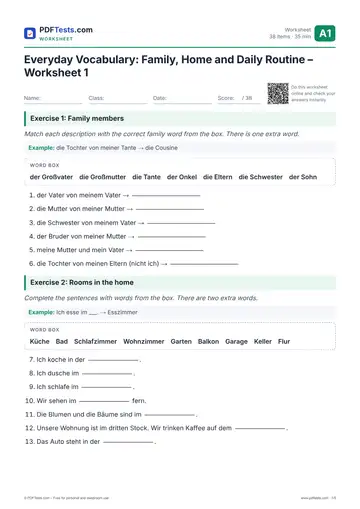
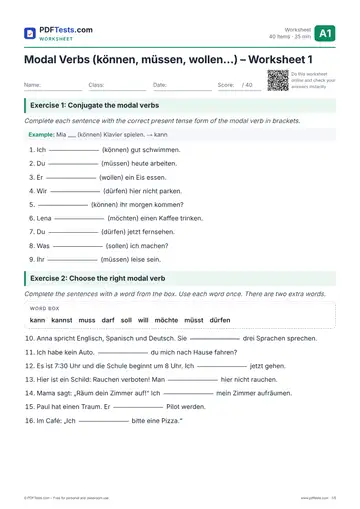
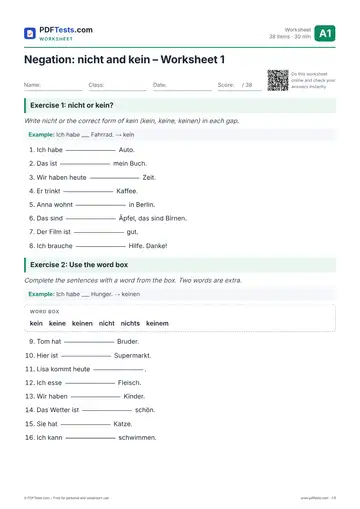
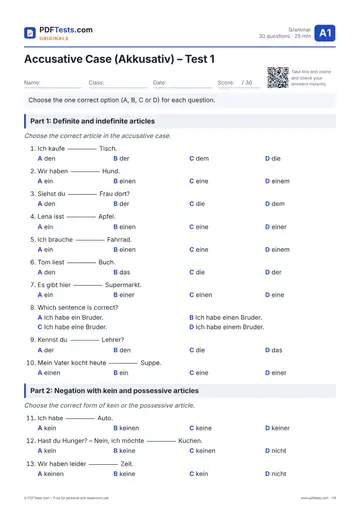
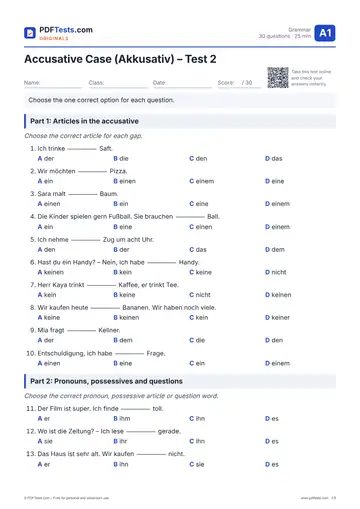
Preview of page 1 of Accusative Case (Akkusativ) – Worksheet 1 Open PDF
New to this topic? Read the guide first: Accusative Case in German (Akkusativ): Rules, Endings and Examples

Do the worksheet online

Type your answers, then press “Check my answers”. Alternative correct answers are accepted.

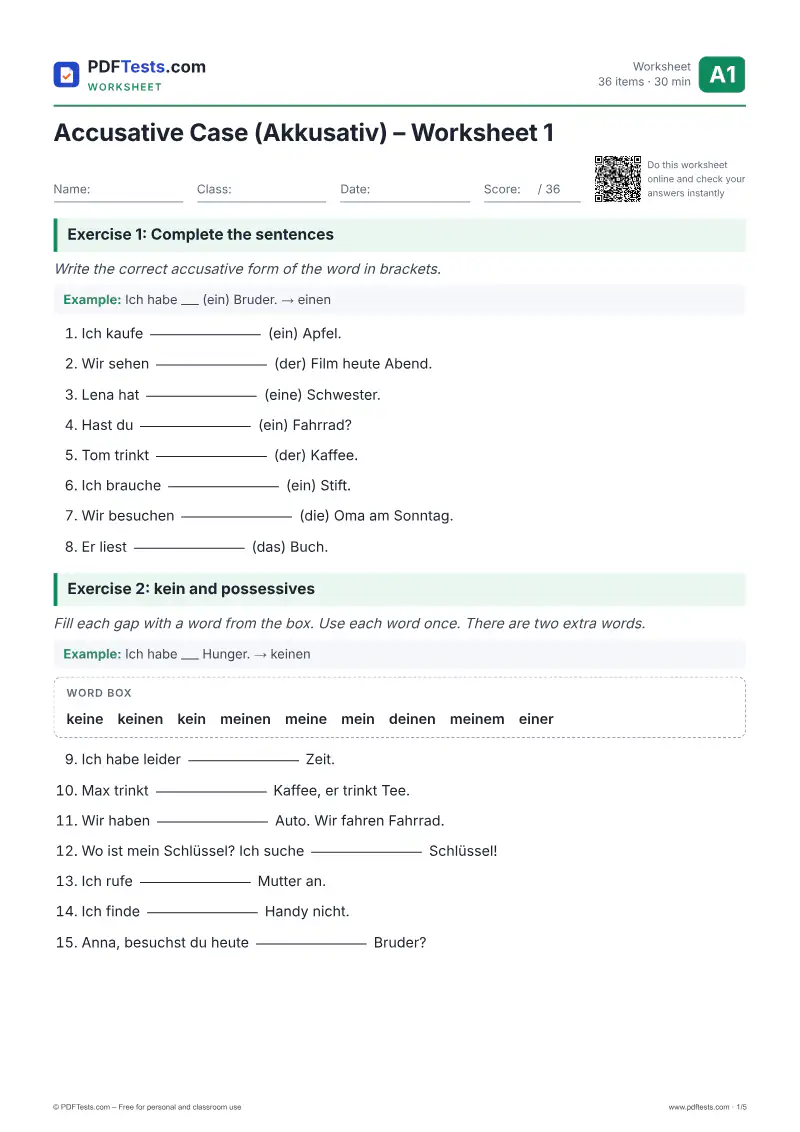
Exercise 1: Complete the sentences

Write the correct accusative form of the word in brackets.

Example: Ich habe ___ (ein) Bruder. → einen

  1. Ich kaufe (ein) Apfel.

  2. Wir sehen (der) Film heute Abend.

  3. Lena hat (eine) Schwester.

  4. Hast du (ein) Fahrrad?

  5. Tom trinkt (der) Kaffee.

  6. Ich brauche (ein) Stift.

  7. Wir besuchen (die) Oma am Sonntag.

  8. Er liest (das) Buch.

Exercise 2: kein and possessives

Fill each gap with a word from the box. Use each word once. There are two extra words.

Example: Ich habe ___ Hunger. → keinen

Word box keinekeinenkeinmeinenmeinemeindeinenmeinemeiner

  1. Ich habe leider Zeit.

  2. Max trinkt Kaffee, er trinkt Tee.

  3. Wir haben Auto. Wir fahren Fahrrad.

  4. Wo ist mein Schlüssel? Ich suche Schlüssel!

  5. Ich rufe Mutter an.

  6. Ich finde Handy nicht.

  7. Anna, besuchst du heute Bruder?

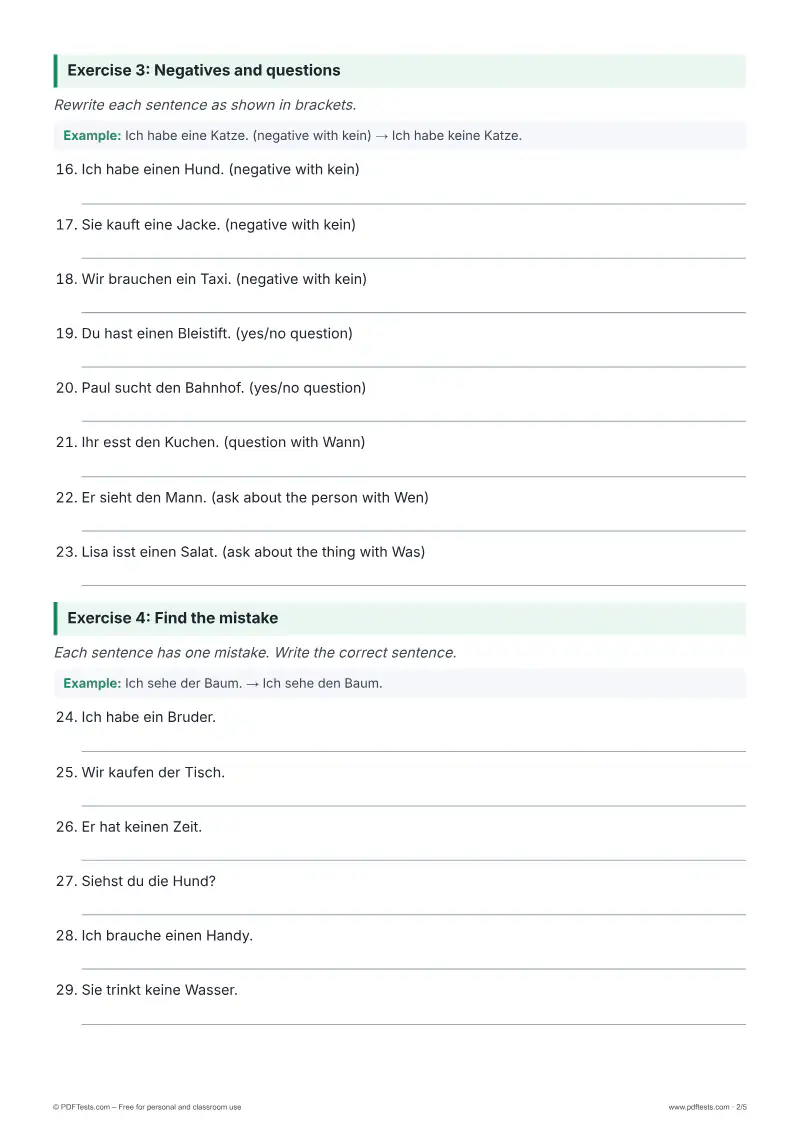
Exercise 3: Negatives and questions

Rewrite each sentence as shown in brackets.

Example: Ich habe eine Katze. (negative with kein) → Ich habe keine Katze.

  1. Ich habe einen Hund. (negative with kein)

  2. Sie kauft eine Jacke. (negative with kein)

  3. Wir brauchen ein Taxi. (negative with kein)

  4. Du hast einen Bleistift. (yes/no question)

  5. Paul sucht den Bahnhof. (yes/no question)

  6. Ihr esst den Kuchen. (question with Wann)

  7. Er sieht den Mann. (ask about the person with Wen)

  8. Lisa isst einen Salat. (ask about the thing with Was)

Exercise 4: Find the mistake

Each sentence has one mistake. Write the correct sentence.

Example: Ich sehe der Baum. → Ich sehe den Baum.

  1. Ich habe ein Bruder.

  2. Wir kaufen der Tisch.

  3. Er hat keinen Zeit.

  4. Siehst du die Hund?

  5. Ich brauche einen Handy.

  6. Sie trinkt keine Wasser.

  7. Wer besuchst du?

Exercise 5: Make sentences

Put the words in the correct order to make a sentence or question.

Example: ich / einen / habe / Ball → Ich habe einen Ball.

  1. einen / ich / Kaffee / trinke

  2. du / hast / Hund / einen / ?

  3. keine / Anna / hat / Katze

  4. den / wir / Film / sehen / heute

  5. wen / du / fragst / ?

  6. Lehrer / ich / den / kenne / nicht

Was this page helpful?

Report a mistake

Spotted a wrong answer, a typo or an unclear explanation? Tell us and we will fix it.

Preview

About this test

Printable A1 German worksheet on the accusative case: den/einen/keinen, possessives, negatives and questions with wen and was. Answers included.

Topics covered

Accusative articles (den, einen)Negation with keinPossessives (meinen, deinen)Questions with wen and wasWord order

Notes for teachers

Start by writing der/die/das next to den/die/das on the board so learners notice that only masculine nouns change. The most common mistakes are using ein or der with masculine objects and using wer instead of wen. Learners also confuse kein and nicht, and forget that kein follows the ein pattern. As a follow-up, learners can interview a partner with 'Hast du einen/eine/ein …?' and report back with 'Sie hat keinen Hund.'

All German A1 tests →