The accusative case (der Akkusativ) marks the direct object of a sentence, the person or thing that the action happens to. You use it after most everyday verbs like haben, kaufen and sehen, and after a small group of prepositions such as für and ohne. The good news for A1 learners: only masculine words change their form.
What the accusative does
Every German sentence has a subject in the nominative case. That is the person or thing doing the action. Many sentences also have a direct object, and that object goes into the accusative.
- Der Mann kauft den Tisch. The man buys the table.
- Ich sehe einen Hund. I see a dog.
- Wir besuchen unseren Onkel. We visit our uncle.
To find the accusative object, ask Wen? (Whom?) for people or Was? (What?) for things:
- Ich kaufe einen Apfel. → Was kaufe ich? → einen Apfel
- Ich liebe meinen Partner. → Wen liebe ich? → meinen Partner
If you are still learning the genders, review our guide to German articles der, die, das first. You need to know the gender to choose the correct accusative form.
Form: accusative articles
The key rule: masculine singular changes, everything else stays the same. Feminine, neuter and plural look exactly like the nominative.
Definite article (the)
| Masculine | Feminine | Neuter | Plural | |
|---|---|---|---|---|
| Nominative | der | die | das | die |
| Accusative | den | die | das | die |
- Ich nehme den Bus. I take the bus.
- Ich nehme die U-Bahn. I take the underground.
- Ich nehme das Fahrrad. I take the bike.
- Ich nehme die Schuhe. I take the shoes.
Indefinite article (a/an) and kein (no, not a)
| Masculine | Feminine | Neuter | Plural | |
|---|---|---|---|---|
| Nominative | ein / kein | eine / keine | ein / kein | – / keine |
| Accusative | einen / keinen | eine / keine | ein / kein | – / keine |
- Ich habe einen Bruder. I have a brother.
- Ich habe eine Schwester. I have a sister.
- Ich habe ein Kind. I have a child.
- Ich habe keinen Hund. I don’t have a dog.
There is no plural of ein: Ich kaufe Äpfel. I’m buying apples. For more on kein, see our guide to negation with nicht and kein.
Possessive articles (my, your…)
Possessive articles follow the same pattern as kein. Masculine gets -en:
| Masculine | Feminine | Neuter | Plural | |
|---|---|---|---|---|
| Nominative | mein | meine | mein | meine |
| Accusative | meinen | meine | mein | meine |
- Ich suche meinen Schlüssel. I’m looking for my key.
- Kennst du deine Nachbarin? Do you know your neighbour?
- Sie ruft ihren Vater an. She calls her father.
The same endings work for dein, sein, ihr, unser, euer, Ihr. Note: euer loses an e when it gets an ending: eure, euren. Our possessive articles guide covers all forms.
Form: accusative personal pronouns
Pronouns also change in the accusative. Learn this table well; you will use it all the time.
| Nominative | Accusative | English |
|---|---|---|
| ich | mich | me |
| du | dich | you |
| er | ihn | him / it |
| sie | sie | her / it |
| es | es | it |
| wir | uns | us |
| ihr | euch | you (plural) |
| sie / Sie | sie / Sie | them / you (formal) |
- Ich liebe dich. I love you.
- Kannst du mich hören? Can you hear me?
- Der Film? Ich finde ihn super. The film? I think it’s great.
- Wir besuchen euch am Wochenende. We’re visiting you at the weekend.
Remember: er replaces any masculine noun, not only people. Der Kaffee → Ich trinke ihn schwarz. I drink it black.
Weak masculine nouns
A small group of masculine nouns also add -n or -en to the noun itself in the accusative. At A1 the most common are:
| Nominative | Accusative |
|---|---|
| der Junge | den Jungen |
| der Herr | den Herrn |
| der Mensch | den Menschen |
| der Student | den Studenten |
| der Kollege | den Kollegen |
- Ich kenne den Studenten nicht. I don’t know the student.
- Wir fragen den Kollegen. We ask the colleague.
Verbs that take the accusative
Most German verbs with an object take the accusative. These are very common at A1:
| Verb | Example |
|---|---|
| haben | Ich habe einen Termin. I have an appointment. |
| brauchen | Wir brauchen einen Tisch. We need a table. |
| kaufen | Er kauft den Mantel. He buys the coat. |
| möchten | Ich möchte einen Kaffee. I’d like a coffee. |
| essen / trinken | Sie isst einen Salat. She’s eating a salad. |
| sehen | Siehst du den Mann? Do you see the man? |
| suchen / finden | Ich finde meinen Pass nicht. I can’t find my passport. |
| kennen | Kennst du ihn? Do you know him? |
| besuchen | Ich besuche meinen Opa. I’m visiting my grandpa. |
| nehmen | Ich nehme den Zug. I’ll take the train. |
Es gibt + accusative
The phrase es gibt (there is / there are) always takes the accusative:
- In meiner Straße gibt es einen Supermarkt. There’s a supermarket in my street.
- Gibt es hier keinen Parkplatz? Is there no car park here?
Prepositions with the accusative
Five prepositions always take the accusative. A popular way to remember them is FUDGO:
| Preposition | Meaning | Example |
|---|---|---|
| für | for | Das Geschenk ist für dich. The present is for you. |
| um | at (time), around | Der Kurs beginnt um acht Uhr. The course starts at eight. |
| durch | through | Wir gehen durch den Park. We walk through the park. |
| gegen | against | Ich habe nichts gegen den Plan. I have nothing against the plan. |
| ohne | without | Ich trinke Kaffee ohne Zucker. I drink coffee without sugar. |
After these prepositions, use the accusative even if the noun is not a direct object:
- Ich kaufe Blumen für meinen Vater. I’m buying flowers for my father.
- Sie kommt ohne ihren Mann. She’s coming without her husband.
Word order: the accusative can come first
In German, the case ending shows who does what, so the object can move to the front for emphasis. The verb stays in position 2.
- Den Film finde ich langweilig. I find the film boring.
- Den Hund sieht der Mann. The man sees the dog.
That is why the endings matter: Der Hund sieht den Mann and Den Hund sieht der Mann mean different things.
Accusative vs nominative: watch out for sein
The biggest source of confusion is the verb sein (to be). Sein does not take an object, so the noun after it stays in the nominative. The same is true for heißen and werden.
| Nominative (after sein) | Accusative (after haben) |
|---|---|
| Das ist ein Hund. That’s a dog. | Ich habe einen Hund. I have a dog. |
| Er ist mein Bruder. He’s my brother. | Ich besuche meinen Bruder. I visit my brother. |
| Das ist der Bus. That’s the bus. | Ich nehme den Bus. I’m taking the bus. |
Also note the question words: Wer? asks about the subject, Wen? asks about the accusative object.
- Wer ruft an? Who’s calling? (nominative)
- Wen rufst du an? Who are you calling? (accusative)
Later, at A2, you will meet the dative case for indirect objects (Ich gebe dem Mann den Schlüssel). See our dative case guide when you are ready.
Common mistakes
- ✗ Ich habe ein Bruder. → ✓ Ich habe einen Bruder. Bruder is masculine, so ein becomes einen.
- ✗ Ich kaufe den Lampe. → ✓ Ich kaufe die Lampe. Only masculine nouns change; die Lampe stays die.
- ✗ Das ist einen Tisch. → ✓ Das ist ein Tisch. Sein takes the nominative, not the accusative.
- ✗ Ich sehe er. → ✓ Ich sehe ihn. The object pronoun for er is ihn.
- ✗ Das ist für mein Vater. → ✓ Das ist für meinen Vater. Für always takes the accusative.
- ✗ Ich habe keine Hund. → ✓ Ich habe keinen Hund. Masculine kein gets -en in the accusative.
- ✗ Es gibt ein Park hier. → ✓ Es gibt einen Park hier. Es gibt is followed by the accusative.
- ✗ Wer siehst du? → ✓ Wen siehst du? Use wen when asking about the object.
Quick check
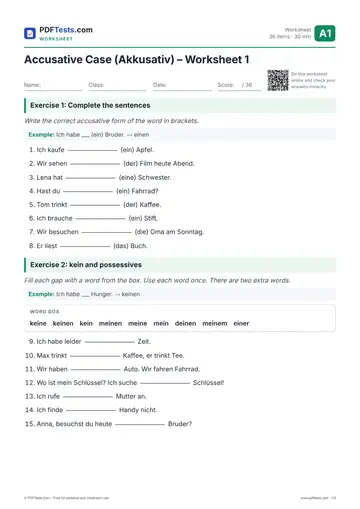
Complete the sentences with the correct form.
- Ich trinke ___ Tee. (ein, masculine)
- Kennst du ___ Frau? (die)
- Das ist ___ Computer. (mein, masculine)
- Der Kuchen ist für ___. (du)
- Wir brauchen ___ Stuhl. (kein, masculine)
Answers
- einen – der Tee is masculine and the object of trinken.
- die – feminine does not change in the accusative.
- mein – after sein we use the nominative.
- dich – für + accusative.
- keinen – masculine object, so kein takes -en.
Next step
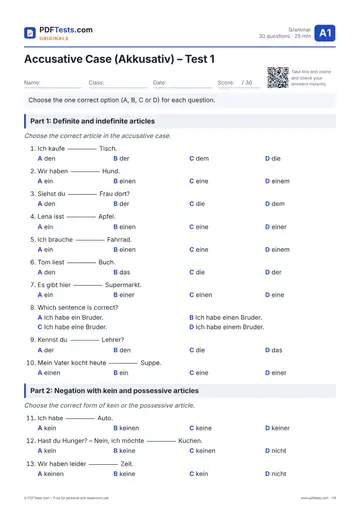
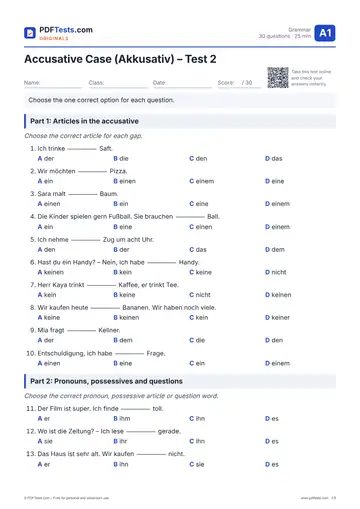
Now put the rules into practice: test yourself with our A1 Accusative Case test 1, which focuses on articles and pronouns after common verbs. Check any mistakes against the tables above, then move on to Accusative Case test 2 for more practice with prepositions like für and ohne and the contrast with sein. Once you score well on both, you are ready to start on the dative at A2.
Was this page helpful?
What was the problem?
Thank you for your feedback!