PDFTests Originals

Possessive Articles (mein, dein…) – Worksheet 1

A1 Beginner WorksheetGerman

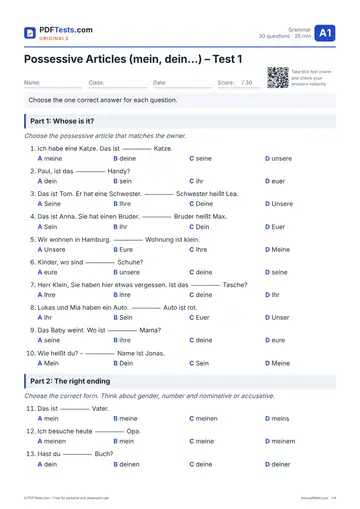
This A1 worksheet practises German possessive articles: mein, dein, sein, ihr, unser, euer and Ihr. Learners choose the right form for the owner, add the right ending for the noun's gender and case, and use the forms in questions and negative sentences. It suits beginners in class or at home.
items
40
Time
30 min
PDF
5 pages
Answer key
Included
  • 100% free
  • No sign-up or email
  • Print-ready A4 PDF
Preview of page 1 of Possessive Articles (mein, dein…) – Worksheet 1 Open PDF
New to this topic? Read the guide first: German Possessive Articles (mein, dein…): Forms, Endings and Examples

Do the worksheet online

Type your answers, then press “Check my answers”. Alternative correct answers are accepted.

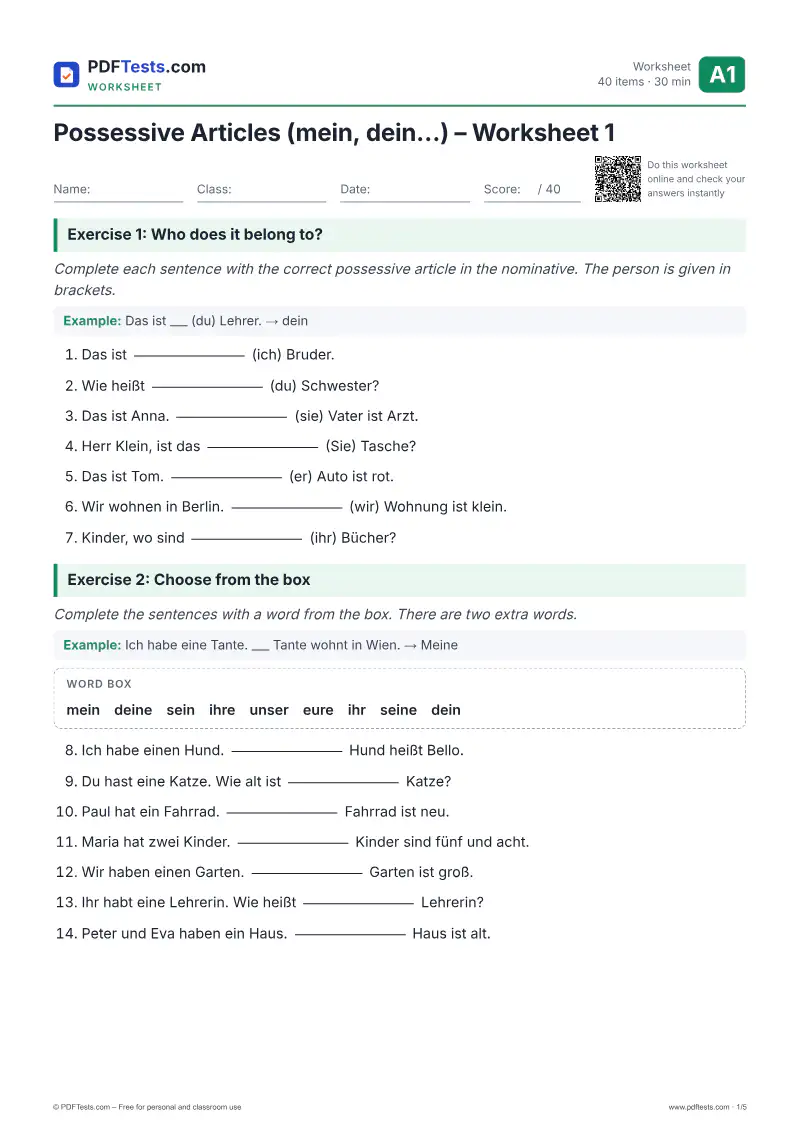
Exercise 1: Who does it belong to?

Complete each sentence with the correct possessive article in the nominative. The person is given in brackets.

Example: Das ist ___ (du) Lehrer. → dein

  1. Das ist (ich) Bruder.

  2. Wie heißt (du) Schwester?

  3. Das ist Anna. (sie) Vater ist Arzt.

  4. Herr Klein, ist das (Sie) Tasche?

  5. Das ist Tom. (er) Auto ist rot.

  6. Wir wohnen in Berlin. (wir) Wohnung ist klein.

  7. Kinder, wo sind (ihr) Bücher?

Exercise 2: Choose from the box

Complete the sentences with a word from the box. There are two extra words.

Example: Ich habe eine Tante. ___ Tante wohnt in Wien. → Meine

Word box meindeineseinihreunsereureihrseinedein

  1. Ich habe einen Hund. Hund heißt Bello.

  2. Du hast eine Katze. Wie alt ist Katze?

  3. Paul hat ein Fahrrad. Fahrrad ist neu.

  4. Maria hat zwei Kinder. Kinder sind fünf und acht.

  5. Wir haben einen Garten. Garten ist groß.

  6. Ihr habt eine Lehrerin. Wie heißt Lehrerin?

  7. Peter und Eva haben ein Haus. Haus ist alt.

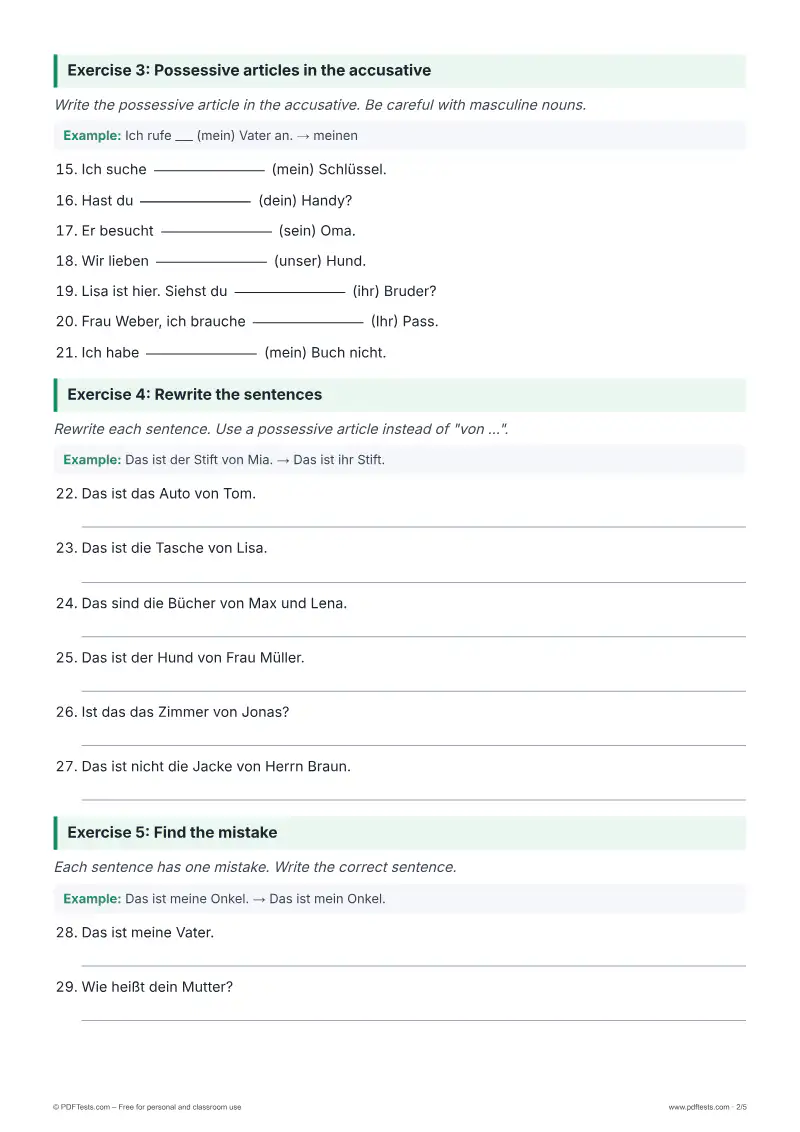
Exercise 3: Possessive articles in the accusative

Write the possessive article in the accusative. Be careful with masculine nouns.

Example: Ich rufe ___ (mein) Vater an. → meinen

  1. Ich suche (mein) Schlüssel.

  2. Hast du (dein) Handy?

  3. Er besucht (sein) Oma.

  4. Wir lieben (unser) Hund.

  5. Lisa ist hier. Siehst du (ihr) Bruder?

  6. Frau Weber, ich brauche (Ihr) Pass.

  7. Ich habe (mein) Buch nicht.

Exercise 4: Rewrite the sentences

Rewrite each sentence. Use a possessive article instead of "von …".

Example: Das ist der Stift von Mia. → Das ist ihr Stift.

  1. Das ist das Auto von Tom.

  2. Das ist die Tasche von Lisa.

  3. Das sind die Bücher von Max und Lena.

  4. Das ist der Hund von Frau Müller.

  5. Ist das das Zimmer von Jonas?

  6. Das ist nicht die Jacke von Herrn Braun.

Exercise 5: Find the mistake

Each sentence has one mistake. Write the correct sentence.

Example: Das ist meine Onkel. → Das ist mein Onkel.

  1. Das ist meine Vater.

  2. Wie heißt dein Mutter?

  3. Anna sucht ihr Brille.

  4. Ich sehe mein Bruder.

  5. Kinder, wo ist euer Lehrerin?

  6. Wir besuchen unser Oma.

Exercise 6: Make sentences

Put the words in the correct order to make sentences and questions.

Example: heißt / mein / Ben / Freund → Mein Freund heißt Ben.

  1. ist / mein / das / Lehrer

  2. deine / wo / Tasche / ist / ?

  3. Bruder / heißt / sein / Leon

  4. nicht / das / ist / Handy / mein

  5. unsere / wir / Freunde / besuchen

  6. suchst / deinen / du / Schlüssel / ?

  7. ist / eure / Wohnung / groß / ?

Was this page helpful?

Report a mistake

Spotted a wrong answer, a typo or an unclear explanation? Tell us and we will fix it.

Preview

About this test

Free printable A1 German worksheet on possessive articles (mein, dein, sein, ihr, unser, euer, Ihr) in the nominative and accusative, with answers.

Topics covered

Possessive articlesNominative endingsAccusative endingsFormal Ihr vs. ihrQuestions and negatives

Notes for teachers

Start by revising the personal pronouns and matching each one to its possessive article on the board (ich → mein, du → dein, and so on). Common mistakes are using sein instead of ihr for a female owner, forgetting -e with feminine and plural nouns, missing -en with masculine nouns in the accusative, and writing euere instead of eure. As a follow-up, learners can bring photos of their family or belongings and present them in pairs: "Das ist meine Schwester. Ihr Hund heißt Max."

All German A1 tests →