PDFTests Originals

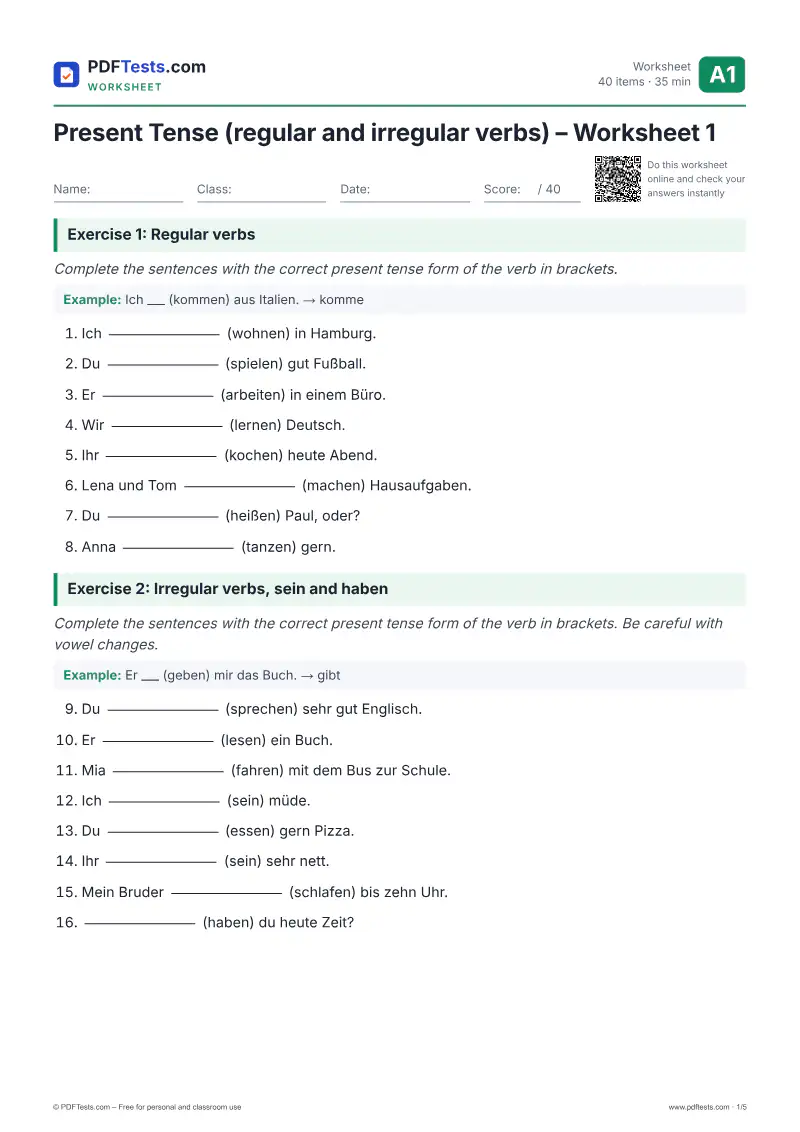
Present Tense (regular and irregular verbs) – Worksheet 1

A1 Beginner WorksheetGerman

This A1 worksheet practises the German present tense (Präsens) with regular verbs, verbs with a vowel change (e → i/ie, a → ä), and the key verbs sein and haben. Learners also form negative sentences with nicht and yes/no and W-questions. It suits beginners in class or for self-study at home.
items
40
Time
35 min
PDF
5 pages
Answer key
Included
  • 100% free
  • No sign-up or email
  • Print-ready A4 PDF
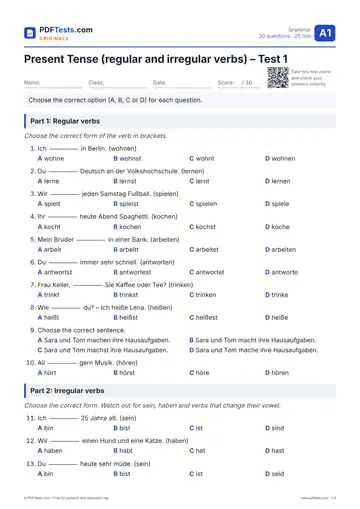
Preview of page 1 of Present Tense (regular and irregular verbs) – Worksheet 1 Open PDF
New to this topic? Read the guide first: German Present Tense: Regular and Irregular Verbs

Do the worksheet online

Type your answers, then press “Check my answers”. Alternative correct answers are accepted.

Exercise 1: Regular verbs

Complete the sentences with the correct present tense form of the verb in brackets.

Example: Ich ___ (kommen) aus Italien. → komme

  1. Ich (wohnen) in Hamburg.

  2. Du (spielen) gut Fußball.

  3. Er (arbeiten) in einem Büro.

  4. Wir (lernen) Deutsch.

  5. Ihr (kochen) heute Abend.

  6. Lena und Tom (machen) Hausaufgaben.

  7. Du (heißen) Paul, oder?

  8. Anna (tanzen) gern.

Exercise 2: Irregular verbs, sein and haben

Complete the sentences with the correct present tense form of the verb in brackets. Be careful with vowel changes.

Example: Er ___ (geben) mir das Buch. → gibt

  1. Du (sprechen) sehr gut Englisch.

  2. Er (lesen) ein Buch.

  3. Mia (fahren) mit dem Bus zur Schule.

  4. Ich (sein) müde.

  5. Du (essen) gern Pizza.

  6. Ihr (sein) sehr nett.

  7. Mein Bruder (schlafen) bis zehn Uhr.

  8. (haben) du heute Zeit?

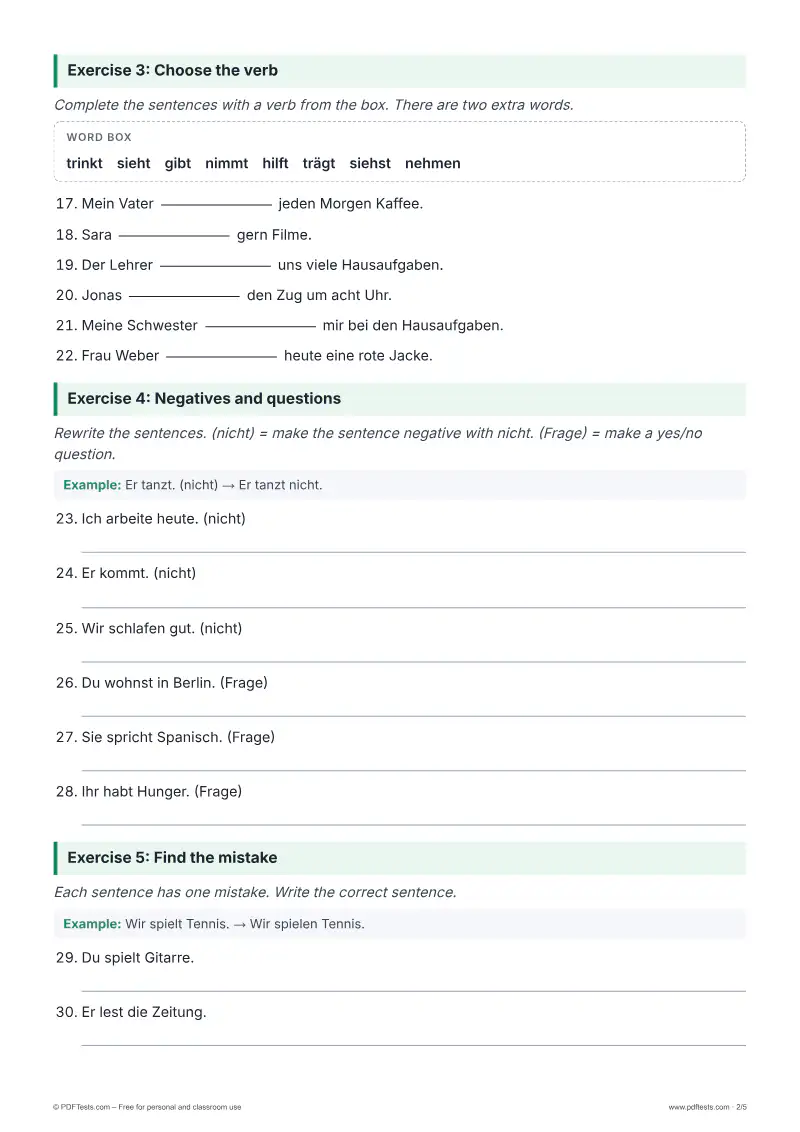
Exercise 3: Choose the verb

Complete the sentences with a verb from the box. There are two extra words.

Word box trinktsiehtgibtnimmthilftträgtsiehstnehmen

  1. Mein Vater jeden Morgen Kaffee.

  2. Sara gern Filme.

  3. Der Lehrer uns viele Hausaufgaben.

  4. Jonas den Zug um acht Uhr.

  5. Meine Schwester mir bei den Hausaufgaben.

  6. Frau Weber heute eine rote Jacke.

Exercise 4: Negatives and questions

Rewrite the sentences. (nicht) = make the sentence negative with nicht. (Frage) = make a yes/no question.

Example: Er tanzt. (nicht) → Er tanzt nicht.

  1. Ich arbeite heute. (nicht)

  2. Er kommt. (nicht)

  3. Wir schlafen gut. (nicht)

  4. Du wohnst in Berlin. (Frage)

  5. Sie spricht Spanisch. (Frage)

  6. Ihr habt Hunger. (Frage)

Exercise 5: Find the mistake

Each sentence has one mistake. Write the correct sentence.

Example: Wir spielt Tennis. → Wir spielen Tennis.

  1. Du spielt Gitarre.

  2. Er lest die Zeitung.

  3. Ich bist Lehrerin.

  4. Anna fahrt nach München.

  5. Wohnst ihr in Wien?

  6. Mein Freund hast ein Auto.

Exercise 6: Word order

Put the words in the correct order to make sentences or questions.

Example: kommst / du / woher / ? → Woher kommst du?

  1. heißt / wie / du / ?

  2. Deutsch / sprichst / du / ?

  3. ihr / am Wochenende / was / macht / ?

  4. Lukas / gern / trinkt / Tee

  5. heute / ich / nicht / arbeite

  6. liest / Buch / ein / Emma

Was this page helpful?

Report a mistake

Spotted a wrong answer, a typo or an unclear explanation? Tell us and we will fix it.

Preview

About this test

Free printable A1 German worksheet on the present tense: regular and irregular verbs, sein and haben, negatives with nicht and questions. Answers included.

Topics covered

Present tense (Präsens)Regular verb endingsIrregular verbs with vowel changesein and habenNegation with nichtQuestions and word order

Notes for teachers

Start by drilling the endings -e, -st, -t, -en, -t, -en on the board, then show how stem-changing verbs change only in the du and er/sie/es forms. Typical mistakes include *du spielt*, *er lest* or *er fahrt*, and forgetting the extra -e- in *arbeitet*. Learners also often put the verb in the wrong place in questions. As a follow-up, pairs can interview each other with questions such as *Was isst du gern?* and *Fährst du mit dem Bus?*, then report back using the er/sie form.

All German A1 tests →