PDFTests Originals

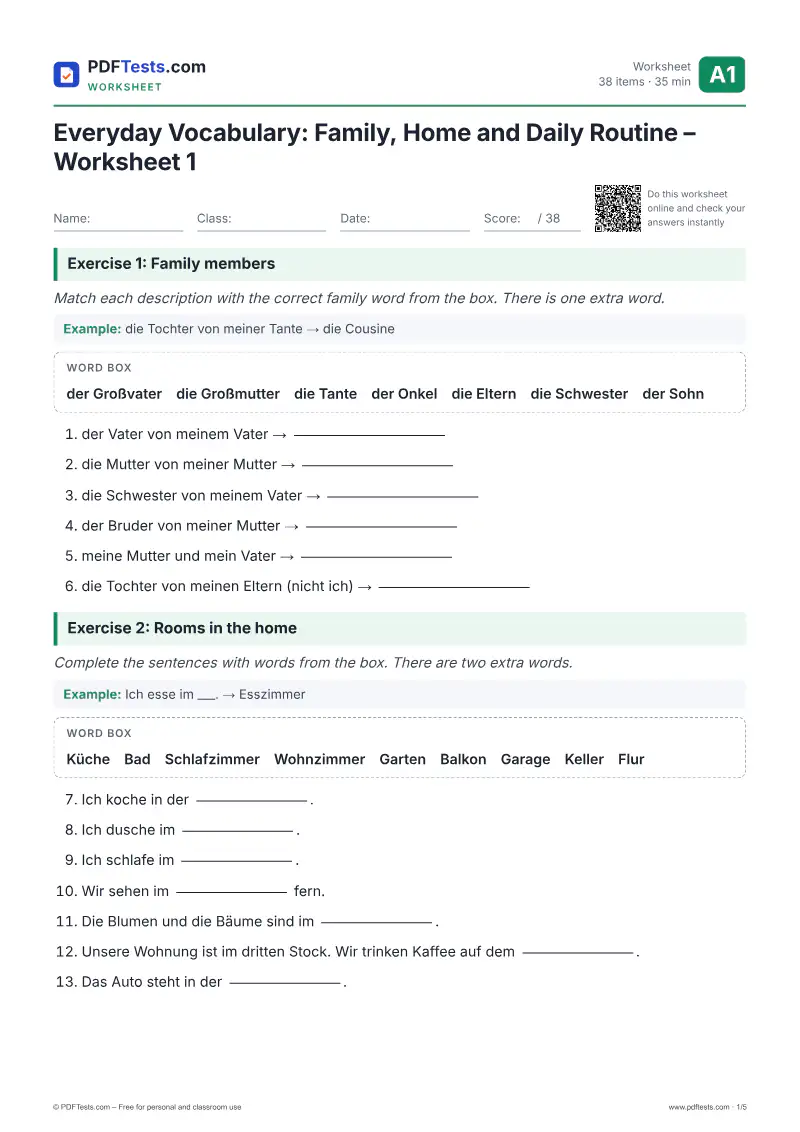
Everyday Vocabulary: Family, Home and Daily Routine – Worksheet 1

A1 Beginner WorksheetGerman

This worksheet practises everyday German vocabulary for family members, rooms in the home and daily routines. Learners use the words in context, match common verb-noun pairs, form plurals and build simple sentences. It is for A1 beginners in class or at home.
items
38
Time
35 min
PDF
5 pages
Answer key
Included
  • 100% free
  • No sign-up or email
  • Print-ready A4 PDF
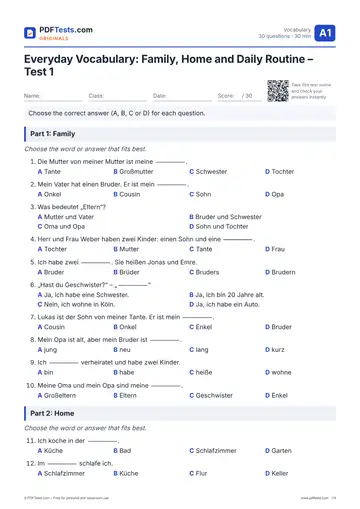
Preview of page 1 of Everyday Vocabulary: Family, Home and Daily Routine – Worksheet 1 Open PDF

Do the worksheet online

Type your answers, then press “Check my answers”. Alternative correct answers are accepted.

Exercise 1: Family members

Match each description with the correct family word from the box. There is one extra word.

Example: die Tochter von meiner Tante → die Cousine

Word box der Großvaterdie Großmutterdie Tanteder Onkeldie Elterndie Schwesterder Sohn

  1. der Vater von meinem Vater

  2. die Mutter von meiner Mutter

  3. die Schwester von meinem Vater

  4. der Bruder von meiner Mutter

  5. meine Mutter und mein Vater

  6. die Tochter von meinen Eltern (nicht ich)

Exercise 2: Rooms in the home

Complete the sentences with words from the box. There are two extra words.

Example: Ich esse im ___. → Esszimmer

Word box KücheBadSchlafzimmerWohnzimmerGartenBalkonGarageKellerFlur

  1. Ich koche in der .

  2. Ich dusche im .

  3. Ich schlafe im .

  4. Wir sehen im fern.

  5. Die Blumen und die Bäume sind im .

  6. Unsere Wohnung ist im dritten Stock. Wir trinken Kaffee auf dem .

  7. Das Auto steht in der .

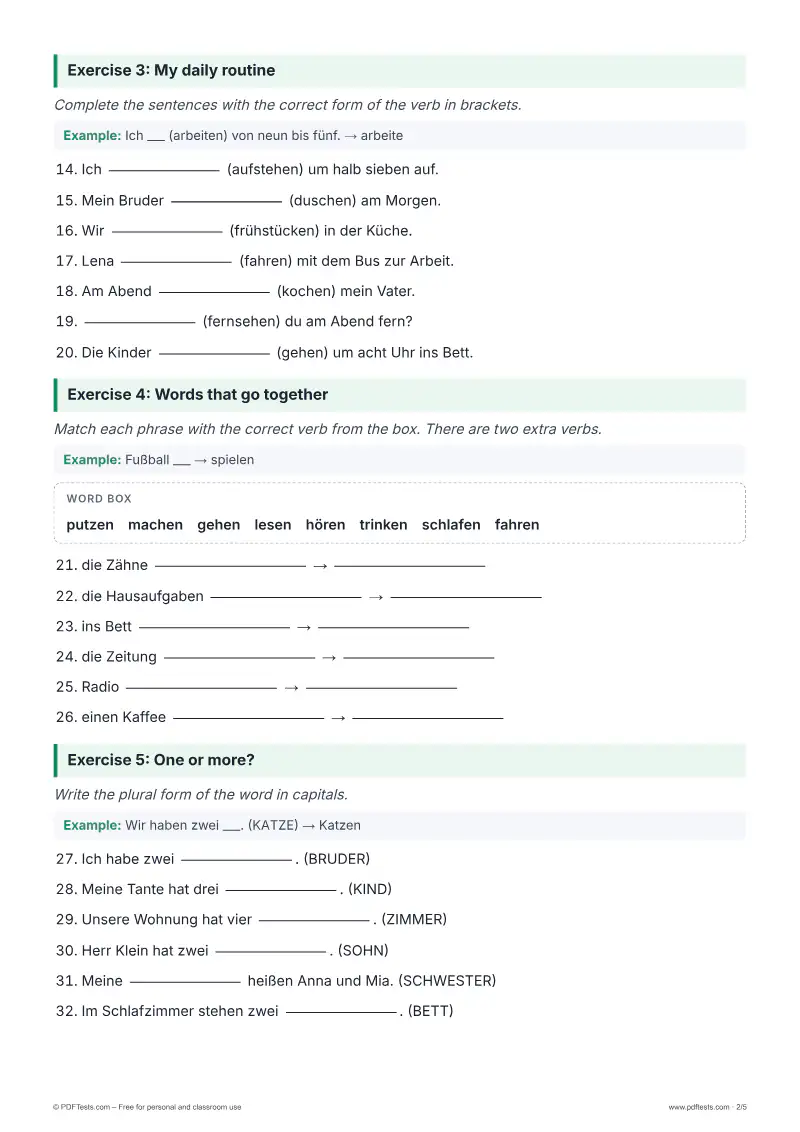
Exercise 3: My daily routine

Complete the sentences with the correct form of the verb in brackets.

Example: Ich ___ (arbeiten) von neun bis fünf. → arbeite

  1. Ich (aufstehen) um halb sieben auf.

  2. Mein Bruder (duschen) am Morgen.

  3. Wir (frühstücken) in der Küche.

  4. Lena (fahren) mit dem Bus zur Arbeit.

  5. Am Abend (kochen) mein Vater.

  6. (fernsehen) du am Abend fern?

  7. Die Kinder (gehen) um acht Uhr ins Bett.

Exercise 4: Words that go together

Match each phrase with the correct verb from the box. There are two extra verbs.

Example: Fußball ___ → spielen

Word box putzenmachengehenlesenhörentrinkenschlafenfahren

  1. die Zähne

  2. die Hausaufgaben

  3. ins Bett

  4. die Zeitung

  5. Radio

  6. einen Kaffee

Exercise 5: One or more?

Write the plural form of the word in capitals.

Example: Wir haben zwei ___. (KATZE) → Katzen

  1. Ich habe zwei . (BRUDER)

  2. Meine Tante hat drei . (KIND)

  3. Unsere Wohnung hat vier . (ZIMMER)

  4. Herr Klein hat zwei . (SOHN)

  5. Meine heißen Anna und Mia. (SCHWESTER)

  6. Im Schlafzimmer stehen zwei . (BETT)

Exercise 6: Make sentences

Put the words in the correct order to make sentences.

Example: um zwölf Uhr / ich / esse → Ich esse um zwölf Uhr.

  1. steht / um sieben Uhr / auf / Paul

  2. frühstücke / ich / in der Küche

  3. wohnt / meine Familie / in einem Haus

  4. sieht / am Abend / meine Mutter / fern

  5. ihr / wann / ins Bett / geht / ?

  6. putzen / die Kinder / die Zähne / im Bad

Was this page helpful?

Report a mistake

Spotted a wrong answer, a typo or an unclear explanation? Tell us and we will fix it.

Preview

About this test

Printable A1 German worksheet on family, home and daily routine vocabulary: family members, rooms, routine verbs, collocations and plurals.

Topics covered

Family membersRooms in the homeDaily routine verbsCollocationsNoun pluralsWord order

Notes for teachers

Start with Exercises 1 and 2 as a warm-up, perhaps with a family tree or a floor plan on the board. Watch for common mistakes: learners forget the separable prefix at the end of the sentence (aufstehen, fernsehen), miss the stem change in fährt and siehst, and leave out umlauts in plurals such as Brüder and Söhne. For a follow-up, ask learners to draw their own family tree or home and write five sentences about their daily routine.

All German A1 tests →