PDFTests Originals

Modal Verbs (können, müssen, wollen…) – Worksheet 1

A1 Beginner WorksheetGerman

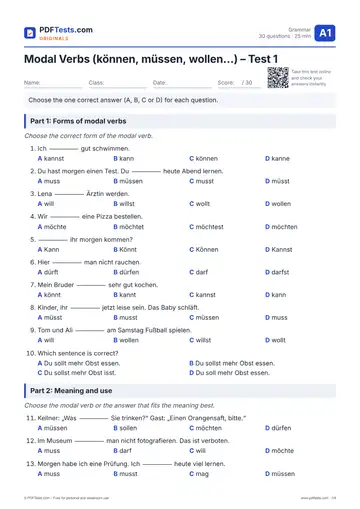
This A1 worksheet practises the German modal verbs können, müssen, wollen, dürfen, sollen and möchten. Learners conjugate them in the present tense, choose the right verb for the meaning, and put the infinitive at the end of the sentence. It also covers negatives and questions. It suits beginners in class or at home.
items
40
Time
35 min
PDF
5 pages
Answer key
Included
  • 100% free
  • No sign-up or email
  • Print-ready A4 PDF
Preview of page 1 of Modal Verbs (können, müssen, wollen…) – Worksheet 1 Open PDF
New to this topic? Read the guide first: German Modal Verbs (können, müssen, wollen…): Forms, Word Order and Common Mistakes

Do the worksheet online

Type your answers, then press “Check my answers”. Alternative correct answers are accepted.

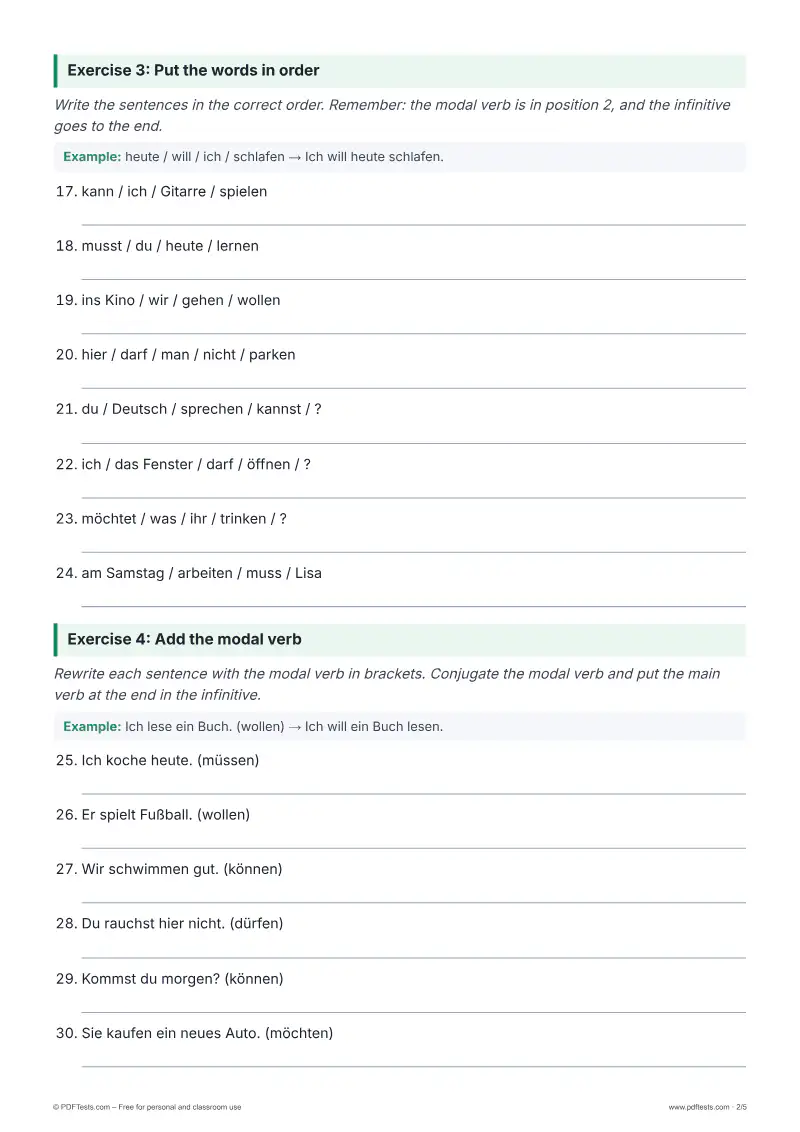
Exercise 1: Conjugate the modal verbs

Complete each sentence with the correct present tense form of the modal verb in brackets.

Example: Mia ___ (können) Klavier spielen. → kann

  1. Ich (können) gut schwimmen.

  2. Du (müssen) heute arbeiten.

  3. Er (wollen) ein Eis essen.

  4. Wir (dürfen) hier nicht parken.

  5. (können) ihr morgen kommen?

  6. Lena (möchten) einen Kaffee trinken.

  7. Du (dürfen) jetzt fernsehen.

  8. Was (sollen) ich machen?

  9. Ihr (müssen) leise sein.

Exercise 2: Choose the right modal verb

Complete the sentences with a word from the box. Use each word once. There are two extra words.

Word box kannkannstmussdarfsollwillmöchtemüsstdürfen

  1. Anna spricht Englisch, Spanisch und Deutsch. Sie drei Sprachen sprechen.

  2. Ich habe kein Auto. du mich nach Hause fahren?

  3. Es ist 7:30 Uhr und die Schule beginnt um 8 Uhr. Ich jetzt gehen.

  4. Hier ist ein Schild: Rauchen verboten! Man hier nicht rauchen.

  5. Mama sagt: „Räum dein Zimmer auf!“ Ich mein Zimmer aufräumen.

  6. Paul hat einen Traum. Er Pilot werden.

  7. Im Café: „Ich bitte eine Pizza.“

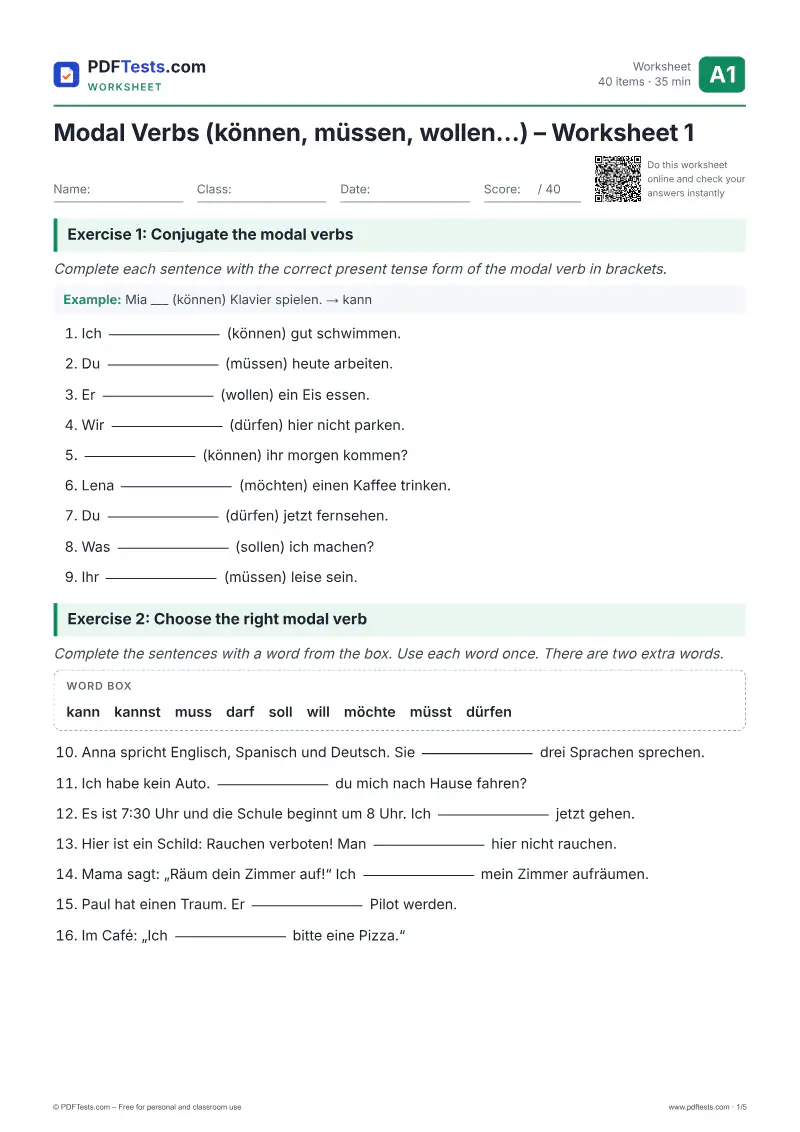
Exercise 3: Put the words in order

Write the sentences in the correct order. Remember: the modal verb is in position 2, and the infinitive goes to the end.

Example: heute / will / ich / schlafen → Ich will heute schlafen.

  1. kann / ich / Gitarre / spielen

  2. musst / du / heute / lernen

  3. ins Kino / wir / gehen / wollen

  4. hier / darf / man / nicht / parken

  5. du / Deutsch / sprechen / kannst / ?

  6. ich / das Fenster / darf / öffnen / ?

  7. möchtet / was / ihr / trinken / ?

  8. am Samstag / arbeiten / muss / Lisa

Exercise 4: Add the modal verb

Rewrite each sentence with the modal verb in brackets. Conjugate the modal verb and put the main verb at the end in the infinitive.

Example: Ich lese ein Buch. (wollen) → Ich will ein Buch lesen.

  1. Ich koche heute. (müssen)

  2. Er spielt Fußball. (wollen)

  3. Wir schwimmen gut. (können)

  4. Du rauchst hier nicht. (dürfen)

  5. Kommst du morgen? (können)

  6. Sie kaufen ein neues Auto. (möchten)

  7. Ihr räumt das Zimmer auf. (sollen)

  8. Lernt Tom Englisch? (müssen)

Exercise 5: Find and correct the mistake

Each sentence has one mistake. Write the correct sentence.

Example: Er kann gut singt. → Er kann gut singen.

  1. Ich kannst gut tanzen.

  2. Er muss heute arbeitet.

  3. Wir wollen spielen Tennis.

  4. Du darf hier nicht essen.

  5. Kann du mir helfen?

  6. Maria möchtet einen Tee trinken.

  7. Ich muss heute zu lernen.

  8. Ihr müssen leise sein.

Was this page helpful?

Report a mistake

Spotted a wrong answer, a typo or an unclear explanation? Tell us and we will fix it.

Preview

About this test

Free printable A1 German worksheet on modal verbs (können, müssen, wollen, dürfen, sollen, möchten): forms, meaning, word order, negatives and questions.

Topics covered

Modal verbsPresent tense conjugationWord order with infinitiveNegatives with nichtYes/no and W-questions

Notes for teachers

Start by reviewing the irregular singular forms (ich kann, du kannst, er kann). Point out that ich and er/sie/es have the same form and no -t ending. Typical mistakes are conjugating the second verb (*Er muss arbeitet*), leaving the infinitive in the middle of the sentence, and adding 'zu' after a modal. As a follow-up, pairs can interview each other with 'Kannst du …? / Musst du …? / Willst du …?' and report back to the class.

All German A1 tests →