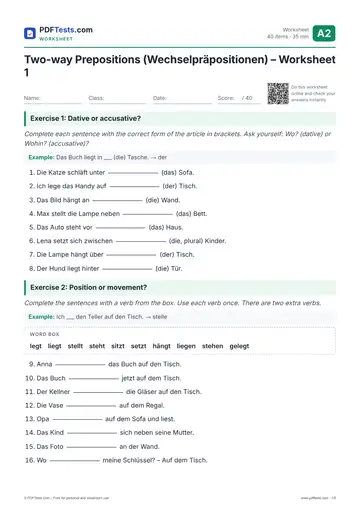
Two-way prepositions (Wechselpräpositionen) are nine German prepositions that can take either the dative or the accusative case. Use the dative when something is in a place and answers the question Wo? (where?). Use the accusative when something moves to a new place and answers Wohin? (where to?).
If you can ask yourself these two questions, most sentences become simple.
The nine two-way prepositions
| Preposition | Meaning | Wo? + dative | Wohin? + accusative |
|---|---|---|---|
| an | at, on (a vertical surface), by | an der Wand on the wall | an die Wand onto the wall |
| auf | on (a horizontal surface) | auf dem Tisch on the table | auf den Tisch onto the table |
| hinter | behind | hinter dem Haus behind the house | hinter das Haus (to) behind the house |
| in | in, into | in der Küche in the kitchen | in die Küche into the kitchen |
| neben | next to | neben dem Sofa next to the sofa | neben das Sofa (to) next to the sofa |
| über | above, over | über dem Bett above the bed | über das Bett (to) above the bed |
| unter | under | unter dem Stuhl under the chair | unter den Stuhl (to) under the chair |
| vor | in front of | vor der Tür in front of the door | vor die Tür (to) in front of the door |
| zwischen | between | zwischen den Häusern between the houses | zwischen die Häuser (to) between the houses |
A quick tip: an is for vertical surfaces and edges (walls, windows, the sea, a lake), while auf is for horizontal surfaces you can put things on (tables, floors, shelves).
Wo? or Wohin? The basic rule
Look at the verb and ask: is there a change of place, from A to B?
- No change of place → dative (Wo?)
- Change of place → accusative (Wohin?)
Compare these pairs:
- Ich bin in der Küche. I’m in the kitchen.
- Ich gehe in die Küche. I’m going into the kitchen.
- Der Hund liegt auf dem Sofa. The dog is lying on the sofa.
- Der Hund springt auf das Sofa. The dog jumps onto the sofa.
- Mein Auto steht vor dem Supermarkt. My car is parked in front of the supermarket.
- Ich fahre mein Auto vor den Supermarkt. I drive my car up in front of the supermarket.
Movement inside one place
A moving verb does not automatically mean accusative. If the movement stays inside the same place, you still use the dative:
- Die Kinder laufen im Park. The children are running (around) in the park.
- Die Kinder laufen in den Park. The children are running into the park.
- Wir schwimmen im See. We’re swimming in the lake.
- Wir springen in den See. We’re jumping into the lake.
The question is always about the destination, not about whether something moves.
Form: how the articles change
The preposition stays the same; only the article (and sometimes the noun) changes. If you need a refresher on the cases themselves, see our guides to the dative case and the accusative case.
Definite articles
| Masculine | Feminine | Neuter | Plural | |
|---|---|---|---|---|
| Dative (Wo?) | dem Tisch | der Tür | dem Bett | den Stühlen |
| Accusative (Wohin?) | den Tisch | die Tür | das Bett | die Stühle |
Indefinite and possessive articles
| Masculine | Feminine | Neuter | |
|---|---|---|---|
| Dative (Wo?) | einem / meinem Schrank | einer / meiner Tasche | einem / meinem Zimmer |
| Accusative (Wohin?) | einen / meinen Schrank | eine / meine Tasche | ein / mein Zimmer |
Remember that in the dative plural, the noun usually adds -n: in den Häusern, auf den Bänken, zwischen den Bäumen. Nouns that already end in -n or -s do not add another: in den Gärten, in den Autos.
Contractions
Some combinations are almost always shortened:
| Full form | Contraction | Example |
|---|---|---|
| in + dem | im | Ich wohne im Zentrum. I live in the centre. |
| in + das | ins | Gehen wir ins Kino? Shall we go to the cinema? |
| an + dem | am | Wir treffen uns am Bahnhof. We’re meeting at the station. |
| an + das | ans | Wir fahren ans Meer. We’re going to the seaside. |
In spoken German you will also hear aufs, übers, unters, vors and hinters (auf das, über das and so on).
Verb pairs: position vs. movement
German has pairs of verbs that describe either a position (dative) or the action of putting something somewhere (accusative). These pairs are where two-way prepositions matter most.
| Position – Wo? (dative) | Movement – Wohin? (accusative) |
|---|---|
| liegen – hat gelegen to lie | legen – hat gelegt to lay, put (flat) |
| stehen – hat gestanden to stand | stellen – hat gestellt to put (upright) |
| sitzen – hat gesessen to sit, be seated | (sich) setzen – hat gesetzt to sit down, seat |
| hängen – hat gehangen to hang, be hanging | hängen – hat gehängt to hang (something) up |
| stecken – hat gesteckt to be (inside) | stecken – hat gesteckt to put (inside) |
Examples:
- Ich lege das Buch auf den Tisch. Jetzt liegt es auf dem Tisch. I put the book on the table. Now it’s lying on the table.
- Sie stellt die Flasche in den Kühlschrank. Die Flasche steht im Kühlschrank. She puts the bottle in the fridge. The bottle is in the fridge.
- Er setzt sich auf den Stuhl. Er sitzt auf dem Stuhl. He sits down on the chair. He’s sitting on the chair.
- Ich hänge die Jacke an die Garderobe. Die Jacke hängt an der Garderobe. I hang my jacket on the coat rack. The jacket is hanging on the coat rack.
The movement verbs (legen, stellen, setzen) are regular and take an object. The position verbs (liegen, stehen, sitzen) are irregular and have no object. For the past forms, see our Perfect Tense guide. In southern Germany, Austria and Switzerland, liegen, stehen and sitzen often form the Perfekt with sein: Ich bin gesessen.
Two-way prepositions in time expressions
When an, in, vor and zwischen talk about time, they take the dative. There is no Wo?/Wohin? question here.
- Am Montag habe ich frei. I’m off on Monday.
- Im Sommer fahren wir nach Italien. In summer we’re going to Italy.
- Der Zug kommt in einer Stunde. The train arrives in an hour.
- Vor dem Frühstück gehe ich joggen. I go jogging before breakfast.
- Ich war vor zwei Jahren in Berlin. I was in Berlin two years ago.
- Zwischen den Kursen trinken wir Kaffee. We have coffee between classes.
Signal words
These verbs usually point to one case, but always check whether there is a change of place.
| Usually Wo? → dative | Usually Wohin? → accusative |
|---|---|
| sein, wohnen, bleiben, arbeiten, warten, liegen, stehen, sitzen, hängen (hat gehangen) | gehen, fahren, fliegen, bringen, legen, stellen, setzen, hängen (hat gehängt), werfen |
One verb surprises many learners: ankommen takes the dative, because you arrive at a point rather than move into it.
- Wir kommen um acht Uhr am Bahnhof an. We arrive at the station at eight.
- Wann kommst du in der Schweiz an? When do you arrive in Switzerland?
Two-way prepositions vs. fixed-case prepositions
Many mistakes happen because learners apply the Wo?/Wohin? rule to prepositions that always take one case.
Always dative: aus, bei, mit, nach, seit, von, zu – even with movement.
- Ich gehe zum Arzt. I’m going to the doctor.
- Ich fahre mit dem Bus zu meiner Oma. I’m taking the bus to my grandma’s.
Always accusative: durch, für, gegen, ohne, um – even without movement.
- Das Geschenk ist für meinen Bruder. The present is for my brother.
in, zu or nach for destinations
- in + accusative: places you go inside, and countries with an article – in die Stadt, ins Büro, in die Schweiz, in die USA
- zu + dative: people, shops, events and places you go to but not necessarily into – zu Anna, zum Bäcker, zur Bushaltestelle
- nach: cities, most countries, directions and home – nach Wien, nach Spanien, nach links, nach Hause
For location, zu Hause means at home: Ich bin zu Hause. I’m at home.
Verbs with fixed prepositions
When an, auf or vor belong to a verb and do not describe a place, the case is fixed and you learn it with the verb: warten auf + accusative (Ich warte auf den Bus. I’m waiting for the bus.), denken an + accusative (Ich denke an dich. I’m thinking of you.), Angst haben vor + dative (Sie hat Angst vor dem Hund. She’s afraid of the dog.).
Common mistakes
- ✗ Ich lege das Handy auf dem Tisch. → ✓ Ich lege das Handy auf den Tisch. Legen is a movement to a new place, so it needs the accusative.
- ✗ Das Handy liegt auf den Tisch. → ✓ Das Handy liegt auf dem Tisch. Liegen describes position, so it needs the dative.
- ✗ Wir gehen heute in dem Kino. → ✓ Wir gehen heute ins Kino. Going to the cinema is a change of place (Wohin?), so use in das → ins.
- ✗ Das Bild hängt an die Wand. → ✓ Das Bild hängt an der Wand. Irregular hängen (hat gehangen) is a position verb and takes the dative.
- ✗ Er setzt sich neben mir. → ✓ Er setzt sich neben mich. Sich setzen is movement, so the pronoun is accusative.
- ✗ Ich gehe in den Arzt. → ✓ Ich gehe zum Arzt. For people and their practices, use zu + dative.
- ✗ Ich komme morgen in den Bahnhof an. → ✓ Ich komme morgen am Bahnhof an. Ankommen always takes the dative.
Quick check
Fill in the gap.
- Ich lege den Schlüssel auf ___ Tisch. (der Tisch)
- Das Fahrrad steht vor ___ Haus. (das Haus)
- Am Samstag gehen wir ___ Kino. (in + article)
- Hängst du bitte die Jacke an ___ Garderobe? (die Garderobe)
- Die Zeitung ___ unter dem Sofa. (liegen or legen?)
Answers
- den – legen is movement (Wohin?), so masculine accusative.
- dem – stehen is position (Wo?), so neuter dative.
- ins – going to the cinema is a change of place: in das → ins.
- die – regular hängen here means putting it there (Wohin?), so feminine accusative.
- liegt – dem Sofa is dative, so you need the position verb liegen.
Next step
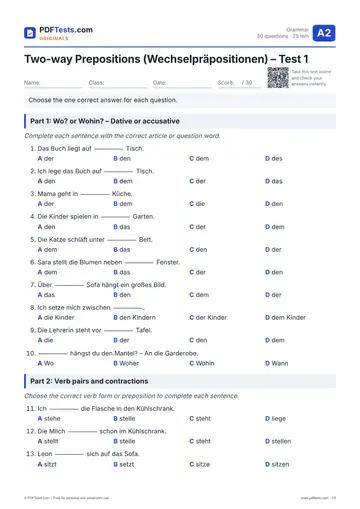
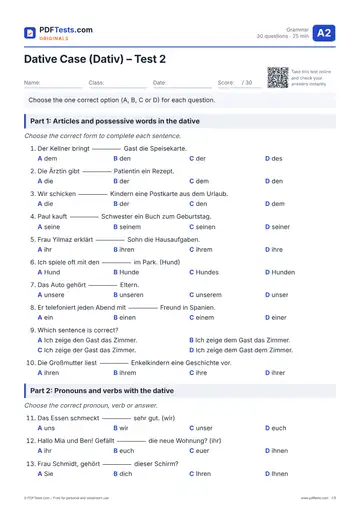
Now put the rule into practice with our A2 Two-way Prepositions test, which mixes Wo? and Wohin? sentences, verb pairs and contractions. If the dative endings still slow you down, try the A2 Dative Case test first, then come back to this guide and check any mistakes against the tables above.
Was this page helpful?
What was the problem?
Thank you for your feedback!