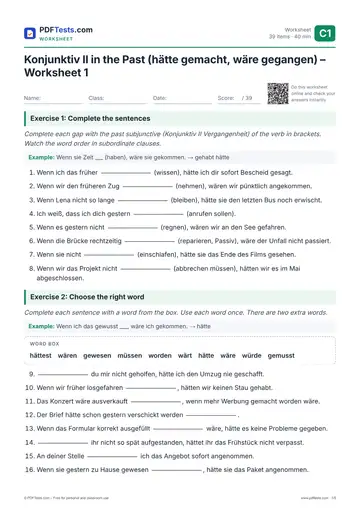
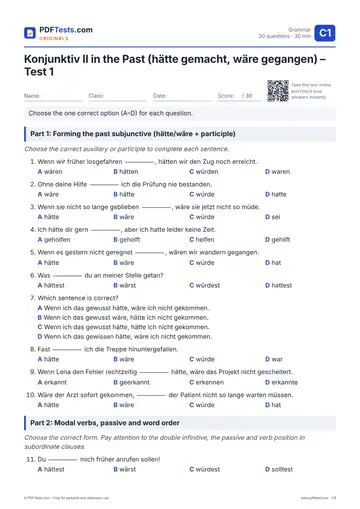
The Konjunktiv II of the past (Konjunktiv II der Vergangenheit) expresses things that did not happen: unreal conditions, regrets, missed chances and imagined comparisons about the past. It is formed with hätte or wäre + past participle, as in Ich hätte angerufen (I would have called) or Ich wäre gekommen (I would have come). At C1 you also need to handle modal verbs (the double infinitive), the passive and word order in subordinate clauses.
Form: hätte or wäre + Partizip II
The choice between haben and sein follows exactly the same rules as the Perfekt. Verbs of movement and change of state, plus sein, bleiben and werden, take sein. Everything else takes haben. If you are unsure, review our guide to the Perfekt.
| Person | haben → hätte | sein → wäre |
|---|---|---|
| ich | hätte gearbeitet | wäre gefahren |
| du | hättest gearbeitet | wär(e)st gefahren |
| er/sie/es | hätte gearbeitet | wäre gefahren |
| wir | hätten gearbeitet | wären gefahren |
| ihr | hättet gearbeitet | wär(e)t gefahren |
| sie/Sie | hätten gearbeitet | wären gefahren |
hätte gearbeitet = would have worked; wäre gefahren = would have driven/gone
| Type | Example | Translation |
|---|---|---|
| Affirmative | Wir hätten den Zug erreicht. | We would have caught the train. |
| Negative | Sie wäre nicht gekommen. | She wouldn’t have come. |
| Yes/no question | Hättest du das gemacht? | Would you have done that? |
| W-question | Was hättet ihr an meiner Stelle gesagt? | What would you have said in my place? |
German has only one past form of the Konjunktiv II. It covers both English would have done and had done (in if-clauses). Haben and sein themselves work normally: Wir hätten mehr Zeit gehabt (We would have had more time), Ich wäre gern dabei gewesen (I would have liked to be there).
When to use the Konjunktiv II in the past
Unreal conditions in the past
The classic use: a condition that was not fulfilled and its imagined result. Use wenn, not falls, for unreal conditions.
- Wenn ich das gewusst hätte, wäre ich früher gekommen. — If I had known that, I would have come earlier.
- Wenn es nicht geregnet hätte, hätten wir draußen gegessen. — If it hadn’t rained, we would have eaten outside.
In writing and careful speech you can drop wenn and start with the verb. The main clause often begins with dann or so:
- Hätte ich das gewusst, (dann) wäre ich früher gekommen. — Had I known that, I would have come earlier.
Mixed time references
Past and present can combine when a past cause has a present result, or vice versa:
- Wenn du gestern nicht so lange gefeiert hättest, wärst du jetzt nicht so müde. — If you hadn’t partied so late yesterday, you wouldn’t be so tired now.
- Wenn sie besser Englisch könnte, hätte sie die Stelle bekommen. — If she spoke better English, she would have got the job.
Wishes and regrets
Unfulfilled wishes about the past use doch, nur or bloß, with or without wenn:
- Wenn ich doch nur mehr gelernt hätte! — If only I had studied more.
- Hätte ich bloß nichts gesagt! — If only I hadn’t said anything.
- Ich wünschte, ich wäre mitgefahren. — I wish I had gone along.
- Ich wäre lieber zu Hause geblieben. — I would rather have stayed at home.
Missed chances and criticism
With modal verbs you express what was possible, necessary or advisable but did not happen (see the double infinitive below):
- Du hättest mich anrufen sollen. — You should have called me.
- Das hätten wir auch selbst machen können. — We could have done that ourselves.
Comparisons with als ob / als
After als ob, als wenn and als, the Konjunktiv II past describes an imagined earlier event. After als alone, the verb comes directly after it.
- Er tut so, als ob er nichts gehört hätte. — He acts as if he hadn’t heard anything.
- Sie sah mich an, als hätte sie einen Geist gesehen. — She looked at me as if she had seen a ghost.
Things that almost happened: beinahe, fast
English uses the simple past here, but German typically uses the Konjunktiv II, because the event did not actually happen:
- Beinahe hätte ich den Termin vergessen. — I almost forgot the appointment.
- Fast wäre er vom Fahrrad gefallen. — He nearly fell off his bike.
Fixed clause patterns: sonst, ohne dass, zu … als dass
- Gut, dass du mich erinnert hast, sonst hätte ich es vergessen. — Good thing you reminded me, otherwise I would have forgotten.
- Sie verließ den Raum, ohne dass es jemand bemerkt hätte. — She left the room without anyone noticing. (The indicative bemerkte is also possible; the Konjunktiv sounds more formal.)
- Die Zeit war zu knapp, als dass wir noch etwas hätten ändern können. — Time was too short for us to change anything.
Tentative statements
The form also softens a past opinion or expresses surprise:
- Das hätte ich nicht gedacht. — I wouldn’t have thought so.
- Ich hätte gedacht, dass das Meeting länger dauert. — I would have thought the meeting would last longer.
Modal verbs: the double infinitive
With a modal verb plus another verb, you do not use the participle of the modal. Instead, use hätte + infinitive + modal infinitive. The auxiliary is always hätte, even when the main verb normally takes sein: Ich hätte gehen müssen (I would have had to go), not wäre gehen müssen.
| Clause type | Example | Translation |
|---|---|---|
| Main clause | Ich hätte länger bleiben können. | I could have stayed longer. |
| Question | Hätten wir früher buchen sollen? | Should we have booked earlier? |
| dass-clause | Ich weiß, dass ich ihn hätte fragen sollen. | I know that I should have asked him. |
| wenn-clause | Wenn er hätte bleiben dürfen, wäre er geblieben. | If he had been allowed to stay, he would have stayed. |
The key C1 rule: in subordinate clauses, hätte comes before the double infinitive, not at the very end. In southern German and Austrian speech you may hear other orders, but standard written German puts hätte first.
Lassen, and often sehen and hören, behave the same way: Ich hätte das Auto reparieren lassen. — I would have had the car repaired.
Meaning nuances:
- hätte … sollen — should have (criticism, advice): Du hättest früher losfahren sollen. — You should have set off earlier.
- hätte … müssen — would have had to / ought to have: Er hätte das Formular unterschreiben müssen. — He ought to have signed the form.
- hätte … können — could have: Das hätte schiefgehen können. — That could have gone wrong.
- nicht hätte … dürfen — shouldn’t have: Das hättest du nicht sagen dürfen. — You shouldn’t have said that.
Do not confuse with subjective modals
Two very similar-looking structures mean different things:
- Er hätte es wissen müssen. — He should have known it. (criticism)
- Er müsste es gewusst haben. — He must have known it. (the speaker’s assumption)
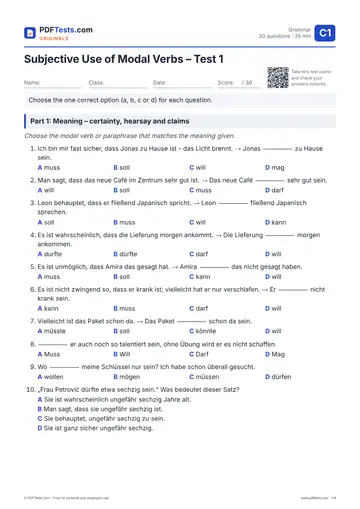
The second pattern is covered in our guide to the subjective use of modal verbs.
The passive in the Konjunktiv II past
The passive uses wäre + Partizip II + worden:
- Das Projekt wäre früher abgeschlossen worden, wenn wir mehr Personal gehabt hätten. — The project would have been completed earlier if we had had more staff.
With a modal verb, combine hätte with the passive infinitive and the modal infinitive:
- Der Fehler hätte vermieden werden können. — The mistake could have been avoided.
- Es ist klar, dass der Antrag hätte geprüft werden müssen. — It is clear that the application should have been checked.
Past vs present Konjunktiv II and other forms
The present Konjunktiv II (Ich würde kommen, Ich hätte Zeit — I would come, I would have time) refers to now or the future. For a refresher, see our Konjunktiv II guide.
A form with würde + perfect infinitive exists (Ich würde das gemacht haben — I would have done that), but it is rare and sounds heavy. Use hätte/wäre + participle instead.
In indirect speech, the Konjunktiv II past replaces the Konjunktiv I when the Konjunktiv I looks identical to the indicative, typically in the plural:
- Sie sagten, sie hätten nichts davon gewusst. — They said they hadn’t known anything about it. (Konjunktiv I sie haben gewusst = indicative)
More on this in the Konjunktiv I guide.
Signal words
- wenn (unreal condition), or an inverted verb-first clause
- doch, nur, bloß (wishes), ich wünschte
- als ob, als wenn, als (comparisons)
- beinahe, fast (almost happened)
- sonst, ohne dass, zu … als dass
- an deiner Stelle, lieber, eigentlich: An deiner Stelle hätte ich abgesagt. — In your place I would have cancelled.
Common mistakes
- ✗ Wenn ich hätte das gewusst, … → ✓ Wenn ich das gewusst hätte, … — In a wenn-clause the conjugated verb goes to the end.
- ✗ Ich hätte nach Hause gegangen. → ✓ Ich wäre nach Hause gegangen. — Verbs of movement take sein, as in the Perfekt.
- ✗ Du hättest mich anrufen gesollt. → ✓ Du hättest mich anrufen sollen. — With a dependent infinitive, the modal stays in the infinitive.
- ✗ …, weil er nicht kommen können hätte. → ✓ …, weil er nicht hätte kommen können. — Hätte comes before the double infinitive.
- ✗ Ich wäre länger bleiben müssen. → ✓ Ich hätte länger bleiben müssen. — The modal construction always uses haben.
- ✗ Er tut so, als ob er nichts gehört hat. → ✓ Er tut so, als ob er nichts gehört hätte. — Als ob needs the subjunctive (Konjunktiv I habe is possible in formal writing).
- ✗ Ich hätte das schon gemacht gehabt. → ✓ Ich hätte das schon gemacht. — There is no extra gehabt in standard German.
- ✗ Wenn ich Zeit gehabt hätte, würde ich dir geholfen haben. → ✓ …, hätte ich dir geholfen. — Use hätte/wäre in both clauses; würde + perfect infinitive is clumsy.
Quick check
- Fill in: Wenn wir ein Taxi genommen ___, ___ wir pünktlich gewesen.
- Put in order: Ich bereue, dass ich … (fragen / hätte / müssen / sie).
- Correct the sentence: Ich hätte gestern gekommen, aber ich war krank.
- Rewrite without wenn: Wenn er mich gefragt hätte, hätte ich ihm geholfen.
- Make a passive sentence with können: der Unfall / verhindern.
Answers
- hätten, wären — Wenn wir ein Taxi genommen hätten, wären wir pünktlich gewesen. If we had taken a taxi, we would have been on time.
- Ich bereue, dass ich sie hätte fragen müssen. Better meaning: Ich bereue, dass ich sie nicht gefragt habe, but the target structure is …, dass ich sie hätte fragen müssen. I regret that I should have asked her.
- Ich wäre gestern gekommen, aber ich war krank. I would have come yesterday, but I was ill.
- Hätte er mich gefragt, hätte ich ihm geholfen. Had he asked me, I would have helped him.
- Der Unfall hätte verhindert werden können. The accident could have been prevented.
Next step
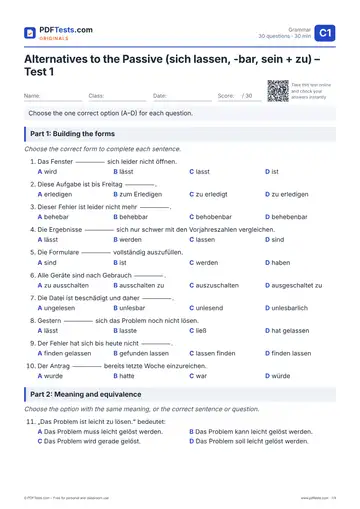
Now apply the rules under exam-style conditions: test yourself with our C1 Konjunktiv II in the Past test, paying special attention to word order with the double infinitive and the choice between hätte and wäre. When you are confident, move on to the other German C1 tests to combine this structure with passive alternatives, nominalisation and subjective modal verbs.
Practise this topic: Konjunktiv II in the Past (hätte gemacht, wäre gegangen)
Was this page helpful?
What was the problem?
Thank you for your feedback!