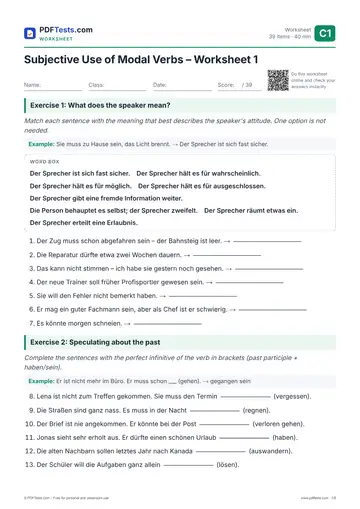
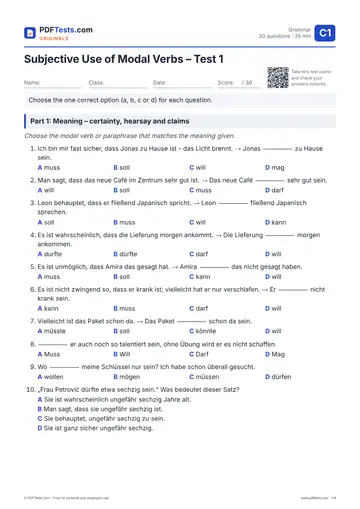
German modal verbs have two jobs. In their objective use they describe ability, obligation, permission or wishes. In their subjective (epistemic) use they show how certain the speaker is that something is true, or they report a claim made by someone else. Er muss krank sein means He must be ill, not He is obliged to be ill. You will meet this use constantly in news reports, academic texts and careful spoken argument.
Objective vs subjective use
The same modal verb can do either job. Context and, in the past, the verb form tell you which meaning is intended. If you need a refresher on the basic meanings, see our guide to German modal verbs (können, müssen, wollen…).
| Sentence | Use | Meaning |
|---|---|---|
| Sie muss heute lange arbeiten. | objective | She has to work late today. |
| Sie muss sehr müde sein. | subjective | She must be very tired (I conclude). |
| Er kann gut Spanisch. | objective | He can speak Spanish well. |
| Das kann stimmen. | subjective | That may be true. |
| Sie will Ärztin werden. | objective | She wants to become a doctor. |
| Sie will nichts gewusst haben. | subjective | She claims not to have known anything. |
The subjective meaning is about the speaker’s assessment or a second-hand claim, not about the subject’s abilities, duties or wishes.
The certainty scale
German speakers choose the modal according to how sure they are. From most to least certain:
| Form | Degree of certainty | Example |
|---|---|---|
| muss | almost certain (logical conclusion) | Das Licht ist an. Er muss zu Hause sein. The light is on. He must be at home. |
| wird (wohl) | confident assumption | Sie wird wohl im Stau stehen. She’ll probably be stuck in traffic. |
| müsste | strong expectation | Das Paket müsste morgen ankommen. The parcel should arrive tomorrow. |
| dürfte | probable | Das dürfte das Problem sein. That is probably the problem. |
| kann | possible | Das kann ein Fehler im System sein. That may be a fault in the system. |
| könnte | possible, tentative | Es könnte heute noch regnen. It could still rain today. |
| mag | possible, conceded | Das mag sein, aber … That may be so, but … |
muss: a conclusion from evidence
Muss signals that the speaker has drawn a logical conclusion. There is usually some evidence in the context.
- Die Straßen sind nass. Es muss geregnet haben. — The streets are wet. It must have rained.
müsste and dürfte: probability
Müsste expresses an expectation based on reasoning or plans. Dürfte (Konjunktiv II of dürfen) means probably and is very common in journalism and formal speech. Note that only dürfte has this meaning; darf never does.
- Die Kosten dürften bei etwa zwei Millionen Euro liegen. — The costs are likely to be around two million euros.
- Sie müsste schon gelandet sein. — She should have landed by now.
kann and könnte: possibility
Kann presents a realistic possibility; könnte is more tentative and more polite when you suggest an explanation.
- Du könntest dich geirrt haben. — You could have made a mistake.
mag: conceding a point
Subjective mag is mainly formal or written. It often concedes a point before a counter-argument, or gives a rough estimate.
- Das mag stimmen, trotzdem halte ich den Plan für riskant. — That may be true, but I still think the plan is risky.
- Er mag etwa sechzig sein. — He may be about sixty.
werden + wohl: an assumption, not the future
Werden + infinitive often expresses a present assumption, especially with wohl, schon or sicher.
- Das wird schon stimmen. — That’s probably right.
- Er wird den Termin wohl vergessen haben. — He has probably forgotten the appointment.
Negation changes the meaning
Negated modals do not mirror English must not:
| German | Meaning |
|---|---|
| Das kann nicht stimmen. | That can’t be true. (impossible) |
| Das muss nicht stimmen. | That isn’t necessarily true. |
| Das dürfte kaum stimmen. | That is hardly likely to be true. |
Reported claims: sollen and wollen
Two modals do not express the speaker’s own judgement but repeat what others say.
| Modal | Who makes the claim | Typical nuance |
|---|---|---|
| sollen | other people, rumours, the media | neutral distance: reportedly, allegedly |
| wollen | the subject about themselves | doubt: claims to |
- Der Täter soll über die Grenze geflohen sein. — The suspect is reported to have fled across the border.
- Das Restaurant soll sehr gut sein. — The restaurant is supposed to be very good.
- Der Zeuge will nichts gehört haben. — The witness claims not to have heard anything.
With wollen, the subject of the sentence and the source of the claim are the same person, and the speaker usually sounds sceptical. With sollen, the source is someone else. News reports combine sollen with indirect speech; see our guide to Konjunktiv I in indirect speech for the other half of that style.
Form
Present: modal + infinitive
For a statement about the present, use the modal plus a plain infinitive at the end of the clause.
- Sie dürfte jetzt im Büro sein. — She is probably in the office now.
Past: modal + perfect infinitive
This is the key point at C1. To talk about the past, keep the modal in the present (or Konjunktiv II) and put the main verb into the past using the perfect infinitive: past participle + haben or sein.
| Main verb | Perfect infinitive | Example |
|---|---|---|
| vergessen | vergessen haben | Er muss es vergessen haben. He must have forgotten it. |
| gehen | gegangen sein | Sie kann schon gegangen sein. She may have left already. |
| sein | gewesen sein | Das dürfte ein Missverständnis gewesen sein. That was probably a misunderstanding. |
| sehen | gesehen haben | Er will den Unfall gesehen haben. He claims to have seen the accident. |
The choice of haben or sein follows the same rules as in the Perfekt; our Perfect Tense guide covers them.
Compare the objective past, which uses the Perfekt of the modal with a double infinitive:
- Er hat gestern arbeiten müssen. — He had to work yesterday. (objective)
- Er muss gestern gearbeitet haben. — He must have worked yesterday. (subjective)
The same contrast exists in Konjunktiv II: Er hätte kommen müssen (He should have come) vs Er müsste gekommen sein (He should have arrived by now). The first pattern is explained in our guide to Konjunktiv II in the past.
Passive
In the passive, the perfect infinitive becomes participle + worden sein.
- Das Gemälde soll 1890 gemalt worden sein. — The painting is said to have been painted in 1890.
- Die Daten könnten manipuliert worden sein. — The data could have been manipulated.
Word order in subordinate clauses
In a subordinate clause the conjugated modal goes to the very end, after the perfect infinitive.
- Ich bin sicher, dass sie die Nachricht gelesen haben muss. — I’m sure she must have read the message.
- Sie fragte, ob der Brief verloren gegangen sein könnte. — She asked whether the letter could have got lost.
Präteritum of the modal in narratives
In a past-tense story, the modal itself can appear in the Präteritum to show the narrator’s conclusion at that time.
- Er war blass. Er musste die Nacht nicht geschlafen haben. — He was pale. He must not have slept that night.
Paraphrasing with adverbs
Exam tasks often ask you to rewrite a sentence with or without a modal. These equivalents are close enough for most purposes:
| Adverb or phrase | Modal |
|---|---|
| bestimmt, sicher, zweifellos | muss |
| wahrscheinlich | dürfte, wird wohl |
| vermutlich | wird (wohl), dürfte |
| möglicherweise, vielleicht | kann, könnte |
| es ist unmöglich, dass … | kann nicht |
| angeblich, man sagt, dass … | soll |
| er behauptet, dass … | will |
- Angeblich hat die Firma Insolvenz angemeldet. → Die Firma soll Insolvenz angemeldet haben. — The company is said to have filed for insolvency.
Common mistakes
- ✗ Er hat den Zug verpassen müssen. (meaning he must have missed) → ✓ Er muss den Zug verpasst haben. — The Perfekt of the modal gives the objective meaning he had to miss the train.
- ✗ Sie muss nicht zu Hause sein. (meaning she can’t be at home) → ✓ Sie kann nicht zu Hause sein. — Muss nicht means not necessarily; impossibility needs kann nicht.
- ✗ Er soll nichts gesehen haben. (when he himself says so) → ✓ Er will nichts gesehen haben. — Use wollen when the subject makes the claim about himself.
- ✗ Sie muss gestern angekommen haben. → ✓ Sie muss gestern angekommen sein. — The auxiliary in the perfect infinitive follows the main verb.
- ✗ Die Brücke soll 1920 gebaut haben. → ✓ Die Brücke soll 1920 gebaut worden sein. — A bridge does not build anything; you need the passive perfect infinitive.
- ✗ …, dass er krank muss gewesen sein. → ✓ …, dass er krank gewesen sein muss. — In subordinate clauses the modal goes last.
- ✗ Es darf schon spät sein. → ✓ Es dürfte schon spät sein. — Only Konjunktiv II dürfte expresses probability.
Quick check
Rewrite each sentence with a subjective modal verb.
- Angeblich ist der Minister zurückgetreten.
- Er behauptet, dass er das Geld nicht genommen hat.
- Ich bin fast sicher, dass sie den Schlüssel verloren hat.
- Es ist unmöglich, dass er das allein geschafft hat.
- Wahrscheinlich ist das Paket schon angekommen.
Answers
- Der Minister soll zurückgetreten sein. — The minister is said to have resigned.
- Er will das Geld nicht genommen haben. — He claims not to have taken the money.
- Sie muss den Schlüssel verloren haben. — She must have lost the key.
- Er kann das nicht allein geschafft haben. — He can’t have managed that on his own.
- Das Paket dürfte schon angekommen sein. — The parcel has probably arrived already.
Next step
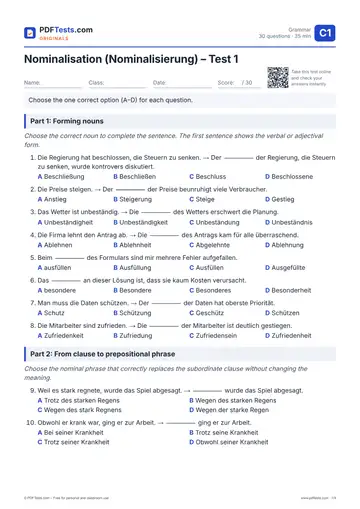
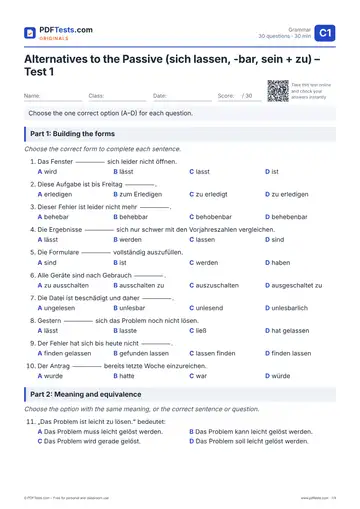
The fastest way to make these forms automatic is to practise choosing between objective and subjective meanings and building perfect infinitives under time pressure. Test yourself with our C1 Subjective Use of Modal Verbs test, then browse the other German C1 tests to see how these modals appear alongside nominalisation, passive alternatives and formal vocabulary in real C1 texts.
Was this page helpful?
What was the problem?
Thank you for your feedback!