Konjunktiv II is the German form for things that are not real: wishes, imagined situations and unreal conditions. It is also the standard way to make polite requests and give advice. At B1 you mainly need four tools: würde + infinitive, hätte, wäre and the modal forms such as könnte and sollte.
When to use Konjunktiv II
1. Polite requests and offers
Konjunktiv II softens a request, much like could or would in English.
- Könnten Sie mir bitte helfen? Could you help me, please?
- Würdest du das Fenster aufmachen? Would you open the window?
- Ich hätte gern einen Kaffee. I’d like a coffee.
- Wäre es möglich, morgen zu kommen? Would it be possible to come tomorrow?
2. Wishes
Use gern, lieber or am liebsten for preferences, and wenn … nur or doch for strong wishes.
- Ich wäre gern reich. I’d like to be rich.
- Ich würde lieber zu Hause bleiben. I’d rather stay at home.
- Wenn ich nur mehr Zeit hätte! If only I had more time.
- Hätte ich doch einen Regenschirm! If only I had an umbrella.
3. Unreal conditions (wenn-clauses)
When a condition is imaginary or unlikely, both parts of the sentence use Konjunktiv II.
- Wenn ich mehr Geld hätte, würde ich eine Weltreise machen. If I had more money, I would travel around the world.
- Wenn es nicht so kalt wäre, könnten wir draußen essen. If it weren’t so cold, we could eat outside.
4. Advice and suggestions
- An deiner Stelle würde ich zum Arzt gehen. If I were you, I’d go to the doctor.
- Du solltest mehr Wasser trinken. You should drink more water.
- Wir könnten heute Abend ins Kino gehen. We could go to the cinema tonight.
5. Unreal comparisons with als ob
- Er tut so, als ob er alles wüsste. He acts as if he knew everything.
- Sie sieht aus, als ob sie müde wäre. She looks as if she were tired.
Form
würde + infinitive
For most verbs, Konjunktiv II is formed with würde plus the infinitive at the end of the clause.
| Person | würde | Example |
|---|---|---|
| ich | würde | Ich würde gern kommen. I’d like to come. |
| du | würdest | Du würdest das verstehen. You would understand that. |
| er / sie / es | würde | Sie würde nie lügen. She would never lie. |
| wir | würden | Wir würden gern helfen. We’d like to help. |
| ihr | würdet | Ihr würdet es lieben. You’d love it. |
| sie / Sie | würden | Würden Sie warten? Would you wait? |
| Sentence type | Example |
|---|---|
| Affirmative | Ich würde das Auto kaufen. I would buy the car. |
| Negative | Ich würde das Auto nicht kaufen. I wouldn’t buy the car. |
| Question | Würdest du das Auto kaufen? Would you buy the car? |
hätte and wäre
With haben and sein, use the one-word forms hätte and wäre, not würde haben or würde sein. They come from the Präteritum forms hatte and war, with an umlaut added.
| Person | haben → hätte | sein → wäre |
|---|---|---|
| ich | hätte | wäre |
| du | hättest | wärst (wärest) |
| er / sie / es | hätte | wäre |
| wir | hätten | wären |
| ihr | hättet | wärt (wäret) |
| sie / Sie | hätten | wären |
- Ich hätte jetzt Zeit. I would have time now.
- Das wäre toll. That would be great.
- Hättest du morgen Lust auf Tennis? Would you feel like playing tennis tomorrow?
Modal verbs
Modal verbs also use one-word forms. Add an umlaut where the infinitive has one. If you need a refresher on the basic meanings, see our guide to German modal verbs.
| Infinitive | Konjunktiv II (ich / er / sie / es) | Meaning |
|---|---|---|
| können | könnte | could |
| müssen | müsste | would have to |
| dürfen | dürfte | would be allowed to |
| sollen | sollte | should |
| wollen | wollte | would want to |
| mögen | möchte | would like |
Note that sollte and wollte look exactly like the Präteritum. The context tells you which one is meant.
- Du solltest früher ins Bett gehen. You should go to bed earlier.
- Ich müsste eigentlich noch arbeiten. I really ought to keep working.
Other common one-word forms
A few frequent verbs are often used in their one-word form, especially in writing. They are built from the Präteritum stem, plus an umlaut where possible, plus -e.
| Infinitive | Präteritum | Konjunktiv II |
|---|---|---|
| wissen | wusste | wüsste |
| geben | gab | gäbe |
| kommen | kam | käme |
| gehen | ging | ginge |
| brauchen | brauchte | bräuchte |
- Ich wüsste gern, wie das funktioniert. I’d like to know how that works.
- Es wäre schön, wenn es mehr Parks gäbe. It would be nice if there were more parks.
With almost all other verbs, würde + infinitive is the safe, natural choice in modern German.
Word order
In a main clause, the conjugated verb (würde, hätte, könnte …) is in position 2 and any infinitive goes to the end.
- Ich würde am Wochenende gern ans Meer fahren. I’d like to go to the seaside at the weekend.
In a wenn-clause, the conjugated verb goes to the end. This is the normal rule for subordinate clauses, explained in our guide to subordinate clauses with weil, dass and wenn.
- …, wenn ich mehr Zeit hätte. …if I had more time.
- …, wenn du mir helfen würdest. …if you helped me.
If the wenn-clause comes first, it counts as position 1, so the main clause starts with the verb:
- Wenn ich du wäre, würde ich das Angebot annehmen. If I were you, I’d accept the offer.
Real vs unreal conditions
Learners often mix up conditions that are possible with conditions that are imagined.
| Type | Mood | Example |
|---|---|---|
| Real / likely | Indicative | Wenn ich Zeit habe, komme ich. If I have time, I’ll come. |
| Unreal / unlikely | Konjunktiv II | Wenn ich Zeit hätte, würde ich kommen. If I had time, I would come. |
The first sentence suggests you might really have time. The second suggests you probably don’t. Keep both clauses in the same mood.
Konjunktiv II vs Präteritum
Because hätte and wäre come from the Präteritum, the forms look similar. The umlaut changes the meaning completely:
- Ich hatte keine Zeit. I had no time. (past fact)
- Ich hätte keine Zeit. I wouldn’t have time. (hypothetical)
- Es war kalt. It was cold.
- Es wäre kalt. It would be cold.
You can review the past forms in our guide to the German simple past (Präteritum).
Also note that the forms in this guide refer to the present or future. To talk about unreal situations in the past (I would have gone), German uses hätte / wäre + past participle: Ich wäre gekommen. I would have come. This is covered in detail in our guide to Konjunktiv II in the past.
Signal words
These words and phrases often appear with Konjunktiv II:
- wenn (unreal condition): Wenn ich Zeit hätte … If I had time …
- gern / lieber / am liebsten: Ich würde am liebsten schlafen. I’d most like to sleep.
- an deiner / Ihrer Stelle: An Ihrer Stelle würde ich warten. If I were you, I’d wait.
- eigentlich: Ich müsste eigentlich lernen. I really ought to study.
- wenn … nur / doch: Wenn er doch anrufen würde! If only he would call.
- als ob / als wenn: Er redet, als ob er der Chef wäre. He talks as if he were the boss.
- bitte in polite questions: Könnten Sie bitte lauter sprechen? Could you speak louder, please?
Common mistakes
✗ Wenn ich mehr Geld würde haben, … → ✓ Wenn ich mehr Geld hätte, … Use hätte and wäre instead of würde + haben or sein.
✗ Ich hatte gern ein Wasser. → ✓ Ich hätte gern ein Wasser. Without the umlaut, hatte is the past tense, not a polite request.
✗ Ich würde dir helfen können. (for a simple offer) → ✓ Ich könnte dir helfen. Modal verbs use their own one-word form; könnte is shorter and more natural.
✗ Wenn ich hätte mehr Zeit, … → ✓ Wenn ich mehr Zeit hätte, … In a wenn-clause, the conjugated verb goes to the end.
✗ Wenn ich reich wäre, ich würde ein Haus kaufen. → ✓ Wenn ich reich wäre, würde ich ein Haus kaufen. After a wenn-clause, the main clause starts with the verb.
✗ Wenn ich Zeit habe, würde ich kommen. → ✓ Wenn ich Zeit hätte, würde ich kommen. Don’t mix indicative and Konjunktiv II in one unreal condition.
✗ Du würdest mehr schlafen sollen. → ✓ Du solltest mehr schlafen. For advice, sollte alone is the standard form.
Quick check
Complete or correct each sentence.
- Wenn ich mehr Geld ___ (haben), würde ich ein Auto kaufen.
- ___ Sie mir bitte den Weg zeigen? (können)
- Ich ___ gern Ärztin. (sein)
- An deiner Stelle ___ ich früher losfahren.
- Correct the sentence: Wenn ich Zeit würde haben, ich würde kommen.
Answers
- hätte – Wenn ich mehr Geld hätte, würde ich ein Auto kaufen. If I had more money, I would buy a car.
- Könnten – Könnten Sie mir bitte den Weg zeigen? Could you show me the way, please?
- wäre – Ich wäre gern Ärztin. I’d like to be a doctor.
- würde – An deiner Stelle würde ich früher losfahren. If I were you, I’d set off earlier.
- Wenn ich Zeit hätte, würde ich kommen. If I had time, I would come.
Next step
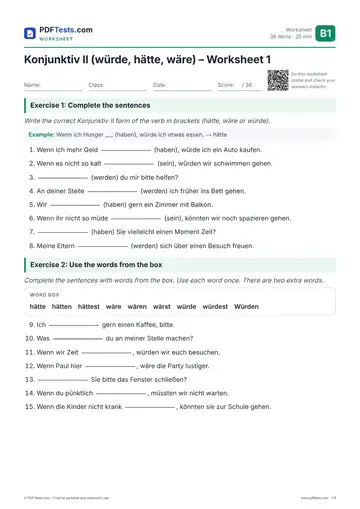
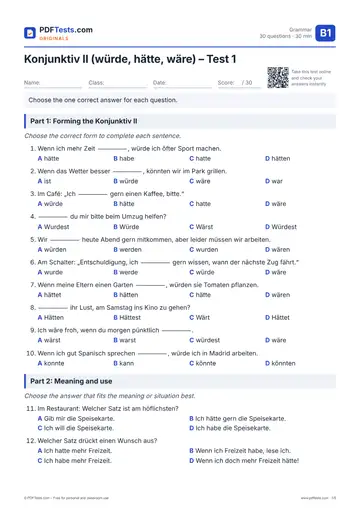
Now put the rules into practice: test yourself with our B1 Konjunktiv II test, which mixes würde, hätte, wäre and modal forms in requests, wishes and wenn-clauses. Pay special attention to word order in the wenn-clause and to the umlaut in hätte and wäre, as these cause the most errors. Once you feel confident, move on to Konjunktiv II in the past to talk about what would have happened, or compare it with Konjunktiv I for indirect speech.
Practise this topic: Konjunktiv II in German (würde, hätte, wäre)
Was this page helpful?
What was the problem?
Thank you for your feedback!