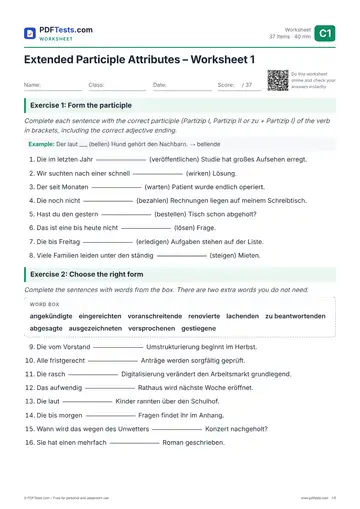
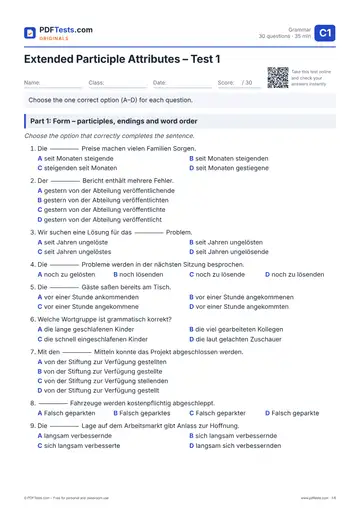
An extended participle attribute (erweitertes Partizipialattribut) is a participle used as an adjective and expanded with its own objects, adverbs or prepositional phrases. The whole block sits between the article and the noun: das gestern von der Regierung beschlossene Gesetz. It does the work of a relative clause in compressed form and is typical of formal written German: news reports, academic writing, official letters and legal texts.
What an extended participle attribute is
Compare these two sentences:
- Das Gesetz, das die Regierung gestern beschlossen hat, tritt im Mai in Kraft. The law that the government passed yesterday comes into force in May.
- Das gestern von der Regierung beschlossene Gesetz tritt im Mai in Kraft. The law passed by the government yesterday comes into force in May.
In the second sentence, the article das and the noun Gesetz form a frame. Everything inside the frame describes the noun. The participle always comes last, directly before the noun, and takes a normal adjective ending.
English usually places this information after the noun (the law passed yesterday). German places it before. That is why these structures feel difficult at first: you read the details before you know what they describe.
If you need to revise simple participles such as der lachende Mann or das reparierte Auto, start with our guide to participles used as adjectives.
The four types
| Type | Meaning | Example |
|---|---|---|
| Partizip I | active, happening at the same time | die schnell steigenden Preise – the rapidly rising prices |
| Partizip II (transitive verb) | passive, completed or resulting state | das frisch renovierte Haus – the freshly renovated house |
| Partizip II (intransitive verb with sein) | active, completed | die spät eingetroffenen Gäste – the guests who arrived late |
| zu + Partizip I | passive + necessity or possibility | die sofort zu prüfenden Anträge – the applications that must be checked immediately |
Partizip I: active and simultaneous
Form: infinitive + -d (spielen → spielend, lächeln → lächelnd, ändern → ändernd). The noun performs the action, and the action takes place at the same time as the action of the main verb.
- die seit Jahren steigenden Mieten – rents that have been rising for years
- Wir beobachteten die im Park joggenden Menschen. – We watched the people jogging in the park.
Reflexive verbs keep their reflexive pronoun, which goes at the start of the attribute:
- die sich rasch verändernde Arbeitswelt – the rapidly changing world of work
- eine sich schnell ausbreitende Krankheit – a rapidly spreading disease
Partizip II of transitive verbs: passive
The noun is the person or thing affected by the action, i.e. the accusative object of the active verb. The agent, if mentioned, is introduced with von.
- das von vielen Experten seit Langem geforderte Verbot – the ban that many experts have long called for
- der mir zum Geburtstag geschenkte Ring – the ring I was given for my birthday
Note that a dative object (mir) can stay inside the attribute. What matters is that the noun itself was the accusative object.
Partizip II of intransitive verbs with sein: active and completed
Verbs that form the perfect with sein (movement or change of state) produce active participles that describe a completed action.
- die gestern Abend eingetroffenen Gäste – the guests who arrived last night
- die in den letzten Jahren stark gewachsene Stadt – the city that has grown considerably in recent years
Intransitive verbs with haben cannot be used this way: you cannot say der lange geschlafene Student. Use a relative clause instead.
zu + Partizip I: something that must or can be done
This form expresses a passive meaning combined with necessity (müssen, sollen) or possibility (können), often with a negative or kaum.
- die bis Freitag zu erledigenden Aufgaben – the tasks that have to be done by Friday
- ein kaum zu lösendes Problem – a problem that can hardly be solved
- die abzugebenden Unterlagen – the documents to be submitted
With separable verbs, zu goes between the prefix and the verb and everything is written as one word: abzugebend, auszufüllend. This structure is closely related to sein + zu (Die Unterlagen sind abzugeben.), which you can review in our guide to alternatives to the passive.
Word order inside the attribute
The rule is simple: take the relative clause, remove the relative pronoun and the finite verb (including wird, wurde, ist, hat), keep all other elements in the same order, and put the participle at the end.
| Relative clause | Extended participle attribute | Translation |
|---|---|---|
| die Frau, die am Fenster sitzt | die am Fenster sitzende Frau | the woman sitting at the window |
| die Häuser, die nach dem Krieg gebaut wurden | die nach dem Krieg gebauten Häuser | the houses built after the war |
| der Zug, der pünktlich abgefahren ist | der pünktlich abgefahrene Zug | the train that left on time |
| die Formulare, die ausgefüllt werden müssen | die auszufüllenden Formulare | the forms that have to be filled in |
| die Rechnungen, die noch nicht bezahlt wurden | die noch nicht bezahlten Rechnungen | the bills that have not yet been paid |
As in a subordinate clause, nicht stands just before the participle, and the usual order of time, reason, manner and place applies.
A normal adjective that belongs closely to the noun usually comes after the attribute, directly before the noun:
- die vom Stadtrat geplante neue Brücke – the new bridge planned by the city council
Building one step by step
- Check the role of the noun: it must be the subject (Partizip I, Partizip II with sein) or the accusative object (passive Partizip II, zu + Partizip I).
- Choose the participle type according to meaning and time.
- Move all remaining elements in front of the noun, in their original order.
- Add the correct adjective ending to the participle.
Endings
The participle behaves exactly like any other adjective. If the endings are not yet automatic, revise our adjective endings guide.
| Case | Example |
|---|---|
| Nominative | der gestern eröffnete Laden – the shop opened yesterday |
| Accusative | den gestern eröffneten Laden |
| Dative | dem gestern eröffneten Laden |
| Genitive | des gestern eröffneten Ladens |
Without an article, strong endings apply:
- In Deutschland hergestellte Autos werden weltweit verkauft. – Cars made in Germany are sold worldwide.
How to read them
At C1 you will meet these structures constantly in reading texts. A reliable strategy:
- Spot the signal. An article followed by a preposition, an adverb or a second article is a strong hint that a frame has opened: die in den…, das von der…, den seit Jahren…
- Jump to the noun. Find the first noun that matches the article in gender, number and case. The word directly before it is the participle.
- Read the core first, then the details. Noun + participle gives you the basic meaning; the rest fills in when, where, by whom and how.
Example:
- Die in den letzten zehn Jahren deutlich gestiegenen Energiepreise belasten viele Haushalte. – Energy prices, which have risen significantly over the last ten years, are a burden on many households.
Core: die gestiegenen Energiepreise. Details: in den letzten zehn Jahren, deutlich.
Frames can also be nested:
- die von der neu gewählten Regierung angekündigten Reformen – the reforms announced by the newly elected government
Here der neu gewählten Regierung sits inside the larger frame die … angekündigten Reformen.
Participle attribute or relative clause?
Both structures describe a noun, but they are not always interchangeable.
| Extended participle attribute | Relative clause | |
|---|---|---|
| Register | formal, written | neutral, spoken and written |
| Length | compact | longer, but easier to follow |
| Tense | only simultaneous (Partizip I) or completed (Partizip II) | any tense |
| Modality | only must/can via zu + Partizip I | any modal verb, Konjunktiv |
| Role of the noun | subject or accusative object only | any case, with prepositions |
Use a relative clause when:
- the noun is a dative, genitive or prepositional object: der Kollege, dem ich vertraue (the colleague I trust);
- you need a modal verb, a future meaning or Konjunktiv: das Projekt, das wir hätten beenden sollen (the project we should have finished);
- the attribute would become very long. Once the frame contains more than about six or seven words, readers struggle.
In speech, relative clauses are almost always the better choice. In formal writing, participle attributes help create the dense nominal style that also relies on nominalisation.
Common mistakes
- ✗ das Gesetz gestern beschlossene → ✓ das gestern beschlossene Gesetz – the attribute goes between the article and the noun, not after the noun.
- ✗ die gestern beschlossene von der Regierung Reform → ✓ die gestern von der Regierung beschlossene Reform – the participle always comes last, directly before the noun.
- ✗ die von der Regierung beschlossen Maßnahmen → ✓ die von der Regierung beschlossenen Maßnahmen – the participle needs an adjective ending.
- ✗ der von mir gelesende Text → ✓ der von mir gelesene Text – the text is read (passive), so Partizip II is needed, not Partizip I.
- ✗ die zu erledigten Aufgaben → ✓ die zu erledigenden Aufgaben – the necessity structure uses zu + Partizip I.
- ✗ die zu ausfüllenden Formulare → ✓ die auszufüllenden Formulare – with separable verbs, zu goes inside the word.
- ✗ der mir geholfene Nachbar → ✓ der Nachbar, der mir geholfen hat – helfen takes a dative and has no attributive passive participle.
- ✗ der lange geschlafene Student → ✓ der Student, der lange geschlafen hat – intransitive verbs with haben cannot form attributive Partizip II.
- ✗ die schnell verändernde Welt → ✓ die sich schnell verändernde Welt – reflexive verbs keep sich inside the attribute.
Quick check
Turn the relative clause into an extended participle attribute, or correct the error.
- die Kinder, die auf dem Spielplatz spielen
- der Brief, der gestern abgeschickt wurde
- die Gäste, die spät angekommen sind
- die Probleme, die sofort gelöst werden müssen
- Correct: Wir sprachen mit dem in München wohnende Künstler.
Answers
- die auf dem Spielplatz spielenden Kinder – the children playing in the playground
- der gestern abgeschickte Brief – the letter sent yesterday
- die spät angekommenen Gäste – the guests who arrived late
- die sofort zu lösenden Probleme – the problems that must be solved immediately
- Wir sprachen mit dem in München wohnenden Künstler. – We spoke to the artist who lives in Munich. (dative after mit, weak ending -en)
Next step
The fastest way to master this structure is to convert in both directions: unpack attributes you find in newspaper articles into relative clauses, and compress your own relative clauses into attributes. When you feel confident, test yourself with our C1 Extended Participle Attributes test, which mixes all four participle types, word order and endings in realistic formal sentences.
Practise this topic: Extended Participle Attributes in German
Was this page helpful?
What was the problem?
Thank you for your feedback!