A German relative clause (Relativsatz) gives extra information about a noun, like English clauses with who, which or that. It starts with a relative pronoun such as der, die or das, it is separated by commas, and the conjugated verb goes to the end. To choose the right pronoun, you need two things: the gender and number of the noun, and the case the pronoun has inside its own clause.
What a relative clause does
A relative clause lets you combine two sentences into one. Compare:
- Das ist mein Nachbar. Er spielt jeden Abend Gitarre. That is my neighbour. He plays the guitar every evening.
- Das ist mein Nachbar, der jeden Abend Gitarre spielt. That is my neighbour who plays the guitar every evening.
The relative pronoun der replaces er and refers back to Nachbar. The noun it refers to is called the antecedent.
Relative clauses are used to:
- identify a person or thing: Die Frau, die dort steht, ist meine Chefin. The woman who is standing there is my boss.
- add information: Mein Bruder, der in Hamburg wohnt, besucht uns am Wochenende. My brother, who lives in Hamburg, is visiting us at the weekend.
- describe things precisely in writing and speaking: Ich suche eine Wohnung, die nicht zu teuer ist. I’m looking for a flat that isn’t too expensive.
The relative pronouns
Most relative pronouns look exactly like the definite article. The differences are highlighted in bold: the dative plural and all genitive forms.
| Case | Masculine | Feminine | Neuter | Plural |
|---|---|---|---|---|
| Nominative | der | die | das | die |
| Accusative | den | die | das | die |
| Dative | dem | der | dem | denen |
| Genitive | dessen | deren | dessen | deren |
If you already know the articles, you only need to learn five new forms. If the articles still feel shaky, review our guide to the dative case in German first, because the dative forms cause the most mistakes.
How to choose the right pronoun
Use this three-step method every time.
- Gender and number come from the noun. Der Film → masculine, die Serie → feminine, das Buch → neuter, die Freunde → plural.
- Case comes from the relative clause. Ask what job the pronoun does in its own clause: subject (nominative), direct object (accusative), indirect object or after a dative verb (dative), or possession (genitive).
- Find the form in the table.
Example: Der Film, ___ ich gestern gesehen habe, war langweilig.
- Film is masculine singular.
- In the relative clause, ich is the subject; the film is what I saw, so it is the direct object → accusative.
- Masculine accusative = den.
Der Film, den ich gestern gesehen habe, war langweilig. The film that I watched yesterday was boring.
The case of the noun in the main clause does not matter. Only the role inside the relative clause counts.
Relative pronouns in each case
Nominative: the pronoun is the subject
- Der Kollege, der neben mir sitzt, kommt aus Wien. The colleague who sits next to me comes from Vienna.
- Ich habe eine Freundin, die perfekt Spanisch spricht. I have a friend who speaks perfect Spanish.
- Das Café, das an der Ecke liegt, ist sonntags geschlossen. The café that is on the corner is closed on Sundays.
Accusative: the pronoun is the direct object
- Der Pullover, den ich online bestellt habe, ist zu klein. The jumper that I ordered online is too small.
- Die Serie, die wir gerade schauen, ist richtig spannend. The series we’re watching at the moment is really exciting.
- Die Schuhe, die du trägst, sind schön. The shoes you’re wearing are nice.
Only the masculine form changes (der → den), just like the article. Our guide to the accusative case explains which verbs take a direct object.
Dative: indirect object or dative verb
- Der Freund, dem ich Geld geliehen habe, hat es nie zurückgegeben. The friend I lent money to never paid it back.
- Die Kollegin, der ich die Datei geschickt habe, ist heute krank. The colleague I sent the file to is ill today.
- Die Nachbarn, denen wir beim Umzug geholfen haben, haben uns zum Essen eingeladen. The neighbours we helped with the move invited us to dinner.
Watch out for verbs that always take the dative, such as helfen, danken, gefallen, gehören, antworten and gratulieren: Das ist der Mann, dem das Auto gehört. That’s the man who owns the car.
Genitive: possession with dessen and deren
Dessen and deren mean whose. The form depends on the owner, not on the thing owned.
- Der Mann, dessen Hund immer bellt, wohnt im dritten Stock. The man whose dog always barks lives on the third floor.
- Die Frau, deren Sohn mit mir studiert, ist Ärztin. The woman whose son studies with me is a doctor.
- Meine Freunde, deren Kinder schon erwachsen sind, reisen viel. My friends, whose children are already grown up, travel a lot.
The noun after dessen/deren has no article: dessen Hund, not dessen der Hund.
Word order and commas
A relative clause is a subordinate clause, so it follows the same rule as clauses with weil or dass: the conjugated verb goes to the end. If you need a refresher, see our guide to subordinate clauses with weil, dass and wenn.
| Verb type | Example |
|---|---|
| Simple verb | der Zug, der um acht Uhr fährt |
| Separable verb | der Zug, der um acht Uhr abfährt |
| Modal verb | das Buch, das ich bis Montag lesen muss |
| Perfect tense | die Jacke, die ich gestern gekauft habe |
| Passive | das Haus, das gerade renoviert wird |
Separable verbs join together again at the end (abfährt), and in tenses with two verbs, the conjugated verb comes last (lesen muss, gekauft habe).
Commas
A relative clause always has commas around it. If it sits in the middle of the main clause, you need two commas:
- Die Wohnung, die wir besichtigt haben, war zu dunkel. The flat we viewed was too dark.
The relative clause usually comes directly after its noun. If only a short element (often a participle or infinitive) would follow, it can move to the end of the sentence:
- Ich habe den Film gesehen, den du mir empfohlen hast. I watched the film you recommended to me.
Relative clauses with prepositions
When a verb or expression needs a preposition, the preposition comes first, before the relative pronoun. The preposition decides the case.
- Das ist die Freundin, mit der ich in den Urlaub fahre. That’s the friend I’m going on holiday with. (mit + dative)
- Die Kollegen, mit denen ich arbeite, sind sehr hilfsbereit. The colleagues I work with are very helpful.
- Das Thema, für das ich mich interessiere, ist Klimaschutz. The topic I’m interested in is climate protection. (sich interessieren für + accusative)
- Der Stuhl, auf dem du sitzt, ist kaputt. The chair you’re sitting on is broken. (auf + dative, location)
In English, the preposition often goes to the end (the friend I’m going with). In German this is impossible: the preposition must stand at the start of the relative clause. With two-way prepositions like in, auf and an, the usual dative/accusative rule applies; see our guide to two-way prepositions.
Was and wo as relative words
Was
Use was instead of das after:
- indefinite words: alles, etwas, nichts, vieles, manches
- Alles, was du sagst, stimmt. Everything you say is true.
- Es gibt nichts, was ich lieber mache. There’s nothing I’d rather do.
- superlatives used as nouns: Das ist das Beste, was mir passiert ist. That’s the best thing that has happened to me.
- a whole clause: Er hat die Prüfung bestanden, was mich sehr freut. He passed the exam, which makes me very happy.
Wo
After places, you can use wo instead of a preposition + pronoun. It is common in speech:
- Das ist die Stadt, wo ich aufgewachsen bin. = Das ist die Stadt, in der ich aufgewachsen bin. That’s the town where I grew up.
You may also see welcher/welche/welches as a relative pronoun in formal texts. At B1, you only need to recognise it; use der/die/das when you speak and write.
German vs English: key differences
- No omission. English often drops the pronoun: the book I’m reading. German never does: das Buch, das ich lese.
- Gender, not person/thing. English chooses who for people and which for things. German chooses by grammatical gender: die Tasche, die ich gekauft habe (a thing) uses the same pronoun as die Frau, die ich kenne (a person).
- Verb at the end and compulsory commas.
Common mistakes
- ✗ Der Mann, den mir hilft, ist nett. → ✓ Der Mann, der mir hilft, ist nett. The pronoun is the subject, so it is nominative.
- ✗ Die Jacke, die ich habe gestern gekauft, … → ✓ Die Jacke, die ich gestern gekauft habe, … The conjugated verb goes to the end.
- ✗ Das Buch ich lese ist spannend. → ✓ Das Buch, das ich lese, ist spannend. German cannot leave out the relative pronoun or the commas.
- ✗ Die Kinder, mit die ich spiele, … → ✓ Die Kinder, mit denen ich spiele, … The dative plural is denen, not die or den.
- ✗ Die Leute, die ich helfe, … → ✓ Die Leute, denen ich helfe, … Helfen takes the dative.
- ✗ Die Freundin, ich wohne mit der, … → ✓ Die Freundin, mit der ich wohne, … The preposition comes before the pronoun.
- ✗ Das ist alles, das ich weiß. → ✓ Das ist alles, was ich weiß. After alles, use was.
- ✗ Die Frau, dessen Auto kaputt ist, … → ✓ Die Frau, deren Auto kaputt ist, … The genitive form follows the owner (die Frau → deren).
- ✗ Das Haus, dass wir kaufen wollen, … → ✓ Das Haus, das wir kaufen wollen, … Dass is a conjunction, not a relative pronoun.
Quick check
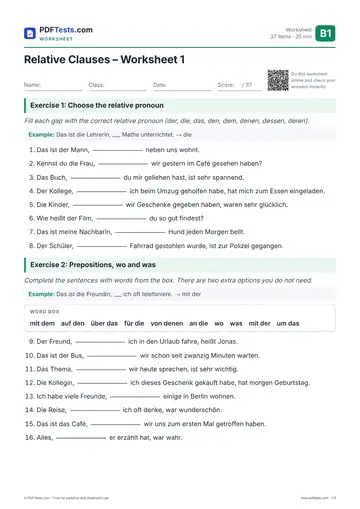
Fill in the gap with the correct relative pronoun (add a preposition where shown).
- Das ist der Film, ___ ich gestern gesehen habe.
- Die Frau, ___ neben mir wohnt, ist Lehrerin.
- Die Schüler, ___ ich Nachhilfe gebe, sind sehr motiviert.
- Das ist mein Kollege, mit ___ ich oft Mittag esse.
- Ich kenne einen Mann, ___ Tochter in Berlin studiert.
Answers
- den – masculine, direct object (accusative)
- die – feminine, subject (nominative)
- denen – plural, indirect object (dative)
- dem – masculine, after mit (dative)
- dessen – masculine owner, possession (genitive)
Next step
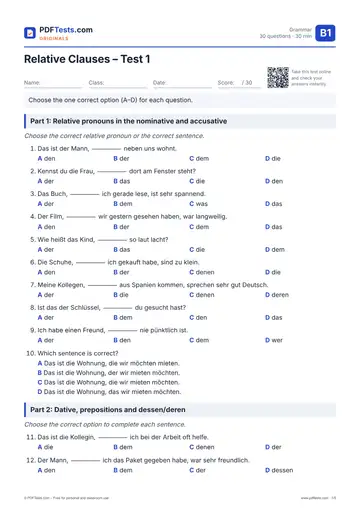
You now know how to choose a relative pronoun by gender, number and case, where to put the verb and how to handle prepositions, was and wo. The best way to make this automatic is practice with real sentences, so test yourself with our B1 Relative Clauses test and check which cases still cause problems. When you feel confident, explore the other German B1 tests to combine relative clauses with adjective endings, the passive and more.
Practise this topic: German Relative Clauses
Was this page helpful?
What was the problem?
Thank you for your feedback!