PDFTests Originals

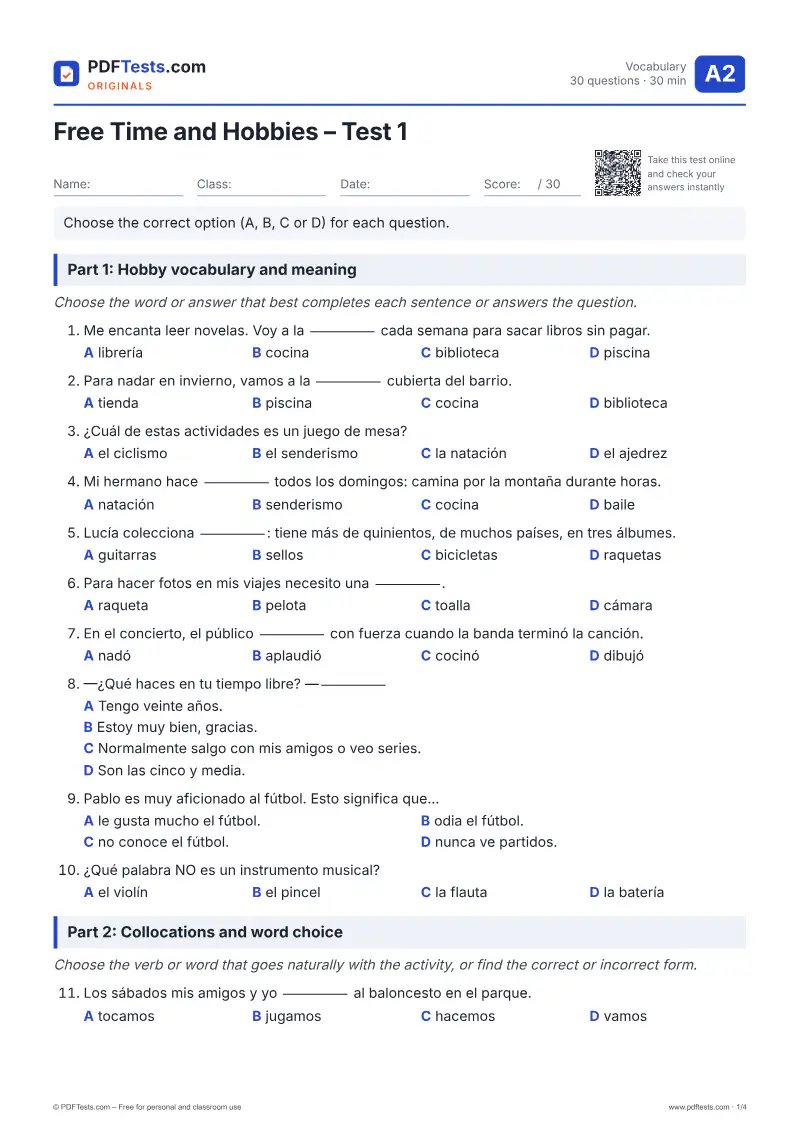
Free Time and Hobbies – Test 1

A2 Elementary VocabularySpanish

This A2 Spanish vocabulary test covers the words and expressions learners need to talk about free time and hobbies: sports, music, reading, cooking and going out. It checks meaning, key verb collocations such as jugar, tocar and hacer, and simple word families. It suits learners in their second year of Spanish, self-study students and teachers who want a quick topic review.
Questions
30
Time
30 min
PDF
4 pages
Answer key
Included
  • 100% free
  • No sign-up or email
  • Print-ready A4 PDF
Preview of page 1 of Free Time and Hobbies – Test 1 Open PDF

Take the test online

Choose the correct option (A, B, C or D) for each question. Choose your answers, then press “Check my answers”.

Part 1: Hobby vocabulary and meaning

Choose the word or answer that best completes each sentence or answers the question.

  1. Me encanta leer novelas. Voy a la _____ cada semana para sacar libros sin pagar.

  2. Para nadar en invierno, vamos a la _____ cubierta del barrio.

  3. ¿Cuál de estas actividades es un juego de mesa?

  4. Mi hermano hace _____ todos los domingos: camina por la montaña durante horas.

  5. Lucía colecciona _____: tiene más de quinientos, de muchos países, en tres álbumes.

  6. Para hacer fotos en mis viajes necesito una _____.

  7. En el concierto, el público _____ con fuerza cuando la banda terminó la canción.

  8. —¿Qué haces en tu tiempo libre? —_____

  9. Pablo es muy aficionado al fútbol. Esto significa que…

  10. ¿Qué palabra NO es un instrumento musical?

Part 2: Collocations and word choice

Choose the verb or word that goes naturally with the activity, or find the correct or incorrect form.

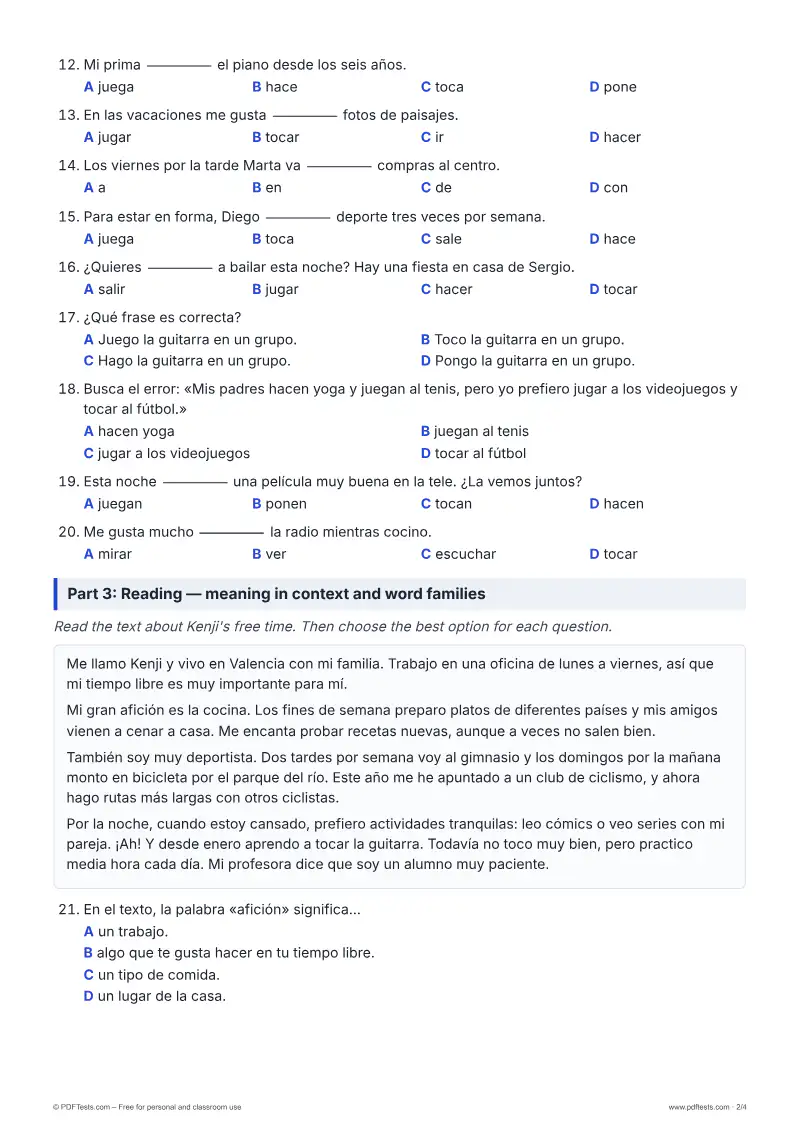
  1. Los sábados mis amigos y yo _____ al baloncesto en el parque.

  2. Mi prima _____ el piano desde los seis años.

  3. En las vacaciones me gusta _____ fotos de paisajes.

  4. Los viernes por la tarde Marta va _____ compras al centro.

  5. Para estar en forma, Diego _____ deporte tres veces por semana.

  6. ¿Quieres _____ a bailar esta noche? Hay una fiesta en casa de Sergio.

  7. ¿Qué frase es correcta?

  8. Busca el error: «Mis padres hacen yoga y juegan al tenis, pero yo prefiero jugar a los videojuegos y tocar al fútbol.»

  9. Esta noche _____ una película muy buena en la tele. ¿La vemos juntos?

  10. Me gusta mucho _____ la radio mientras cocino.

Part 3: Reading — meaning in context and word families

Read the text about Kenji's free time. Then choose the best option for each question.

Me llamo Kenji y vivo en Valencia con mi familia. Trabajo en una oficina de lunes a viernes, así que mi tiempo libre es muy importante para mí.

Mi gran afición es la cocina. Los fines de semana preparo platos de diferentes países y mis amigos vienen a cenar a casa. Me encanta probar recetas nuevas, aunque a veces no salen bien.

También soy muy deportista. Dos tardes por semana voy al gimnasio y los domingos por la mañana monto en bicicleta por el parque del río. Este año me he apuntado a un club de ciclismo, y ahora hago rutas más largas con otros ciclistas.

Por la noche, cuando estoy cansado, prefiero actividades tranquilas: leo cómics o veo series con mi pareja. ¡Ah! Y desde enero aprendo a tocar la guitarra. Todavía no toco muy bien, pero practico media hora cada día. Mi profesora dice que soy un alumno muy paciente.

  1. En el texto, la palabra «afición» significa…

  2. «Me he apuntado a un club de ciclismo» significa que Kenji…

  3. Una persona que monta en bicicleta como deporte es un _____.

  4. Kenji cocina muy bien. Una persona que cocina en un restaurante es un _____.

  5. En el texto, «recetas» son…

  6. Por la noche Kenji prefiere «actividades tranquilas». Son actividades…

  7. La profesora dice que Kenji es paciente. Lo contrario de «paciente» es _____.

  8. A Kenji le gusta leer cómics. Una persona que lee mucho es un buen _____.

  9. «Todavía no toco muy bien» significa que Kenji…

  10. Kenji disfruta mucho en la cocina: para él, cocinar es muy _____.

Was this page helpful?

Report a mistake

Spotted a wrong answer, a typo or an unclear explanation? Tell us and we will fix it.

Practise with a worksheet: Free Time and Hobbies – Worksheet 1

Preview

About this test

This A2 Spanish vocabulary test covers the words and expressions learners need to talk about free time and hobbies: sports, music, reading, cooking and going out. It checks meaning, key verb collocations such as jugar, tocar and hacer, and simple word families. It suits learners in their second year of Spanish, self-study students and teachers who want a quick topic review.

Topics covered

Hobbies and leisure activitiesSports and gamesMusic and instrumentsCollocations: jugar, tocar, hacerWord familiesReading in context

How to use this test

  1. Download the PDF and print it, or take the test online below.
  2. Answer every question without a dictionary or time pressure.
  3. Check your answers and note the topics you need to review.

Notes for teachers

Use this test after a unit on free time, or as a diagnostic before speaking tasks about hobbies. Part 2 targets common errors such as confusing jugar and tocar, jugar fútbol without 'al', and the false friend librería (bookshop) versus biblioteca (library). Part 3 checks word formation (-ista, -ero, -or, im-). As a follow-up, ask students to write a short paragraph like Kenji's describing their own free time, using at least five collocations from the test.