PDFTests Originals

Free Time and Hobbies – Worksheet 1

A2 Elementary WorksheetSpanish

This A2 worksheet practises Spanish vocabulary for free time and hobbies in context. Learners match hobby words to definitions and use collocations like tocar la guitarra and ir de pesca. They also use gustar, encantar and interesar, and form words such as nadadora and aburrido. It suits teenage and adult learners at elementary level.
items
38
Time
35 min
PDF
5 pages
Answer key
Included
  • 100% free
  • No sign-up or email
  • Print-ready A4 PDF
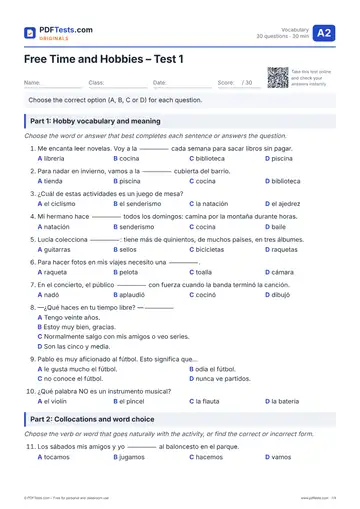
Preview of page 1 of Free Time and Hobbies – Worksheet 1 Open PDF

Do the worksheet online

Type your answers, then press “Check my answers”. Alternative correct answers are accepted.

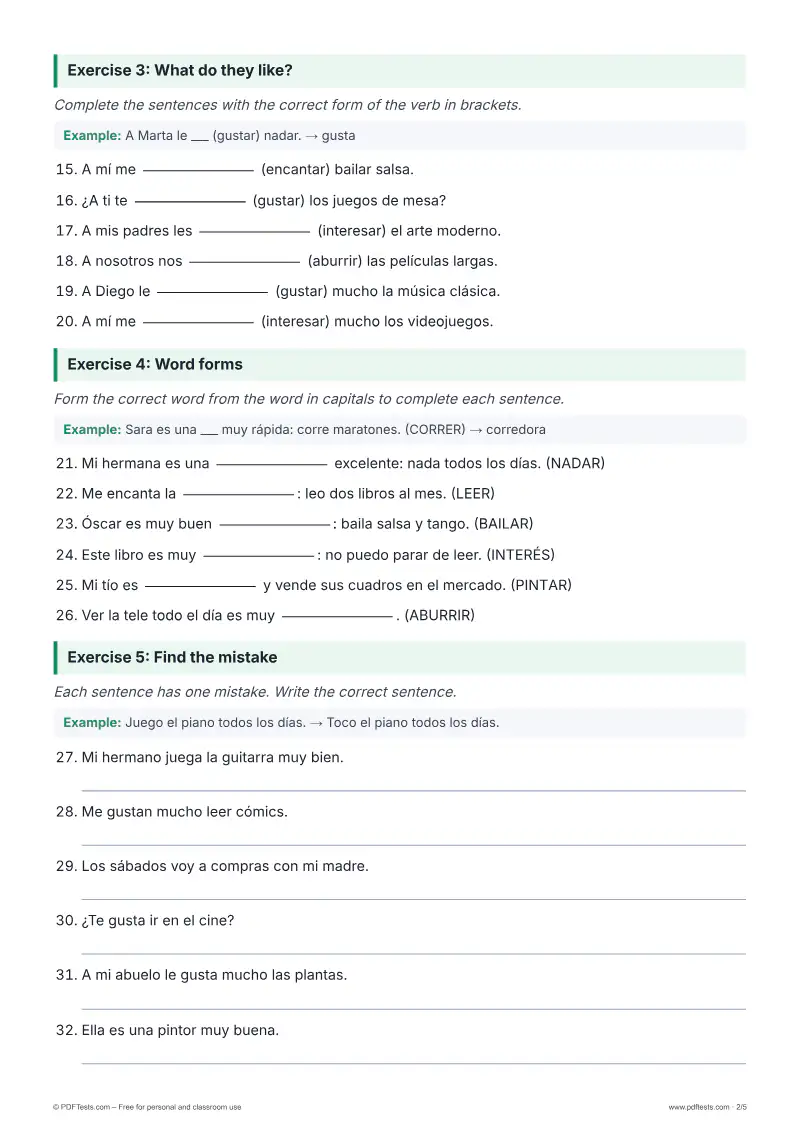
Exercise 1: Match the hobbies

Match each definition with a hobby from the box. There are two extra words.

Example: Montar en bicicleta por la ciudad o el campo. → el ciclismo

Word box el senderismola fotografíala jardineríala lecturael ajedrezla nataciónla pinturael bailela pesca

  1. Caminar por el campo o la montaña durante horas.

  2. Hacer fotos de personas y lugares.

  3. Cuidar las plantas y las flores.

  4. Leer libros, revistas o cómics.

  5. Un juego de mesa con un rey y una reina.

  6. Nadar en una piscina o en el mar.

  7. Hacer cuadros con colores.

Exercise 2: Hobby collocations

Complete each sentence with a verb from the box. Use each verb once. There are two extra verbs.

Example: Mi amiga ___ la batería en un grupo. → toca

Word box tocajuegahacecoleccionavaveleecorrepinta

  1. Lucía el violín en una orquesta.

  2. Mi padre al tenis los domingos.

  3. Andrés yoga por las mañanas.

  4. Mi abuela sellos de muchos países.

  5. Pablo de pesca con su tío.

  6. Elena series en el sofá por la noche.

  7. Teresa novelas de misterio antes de dormir.

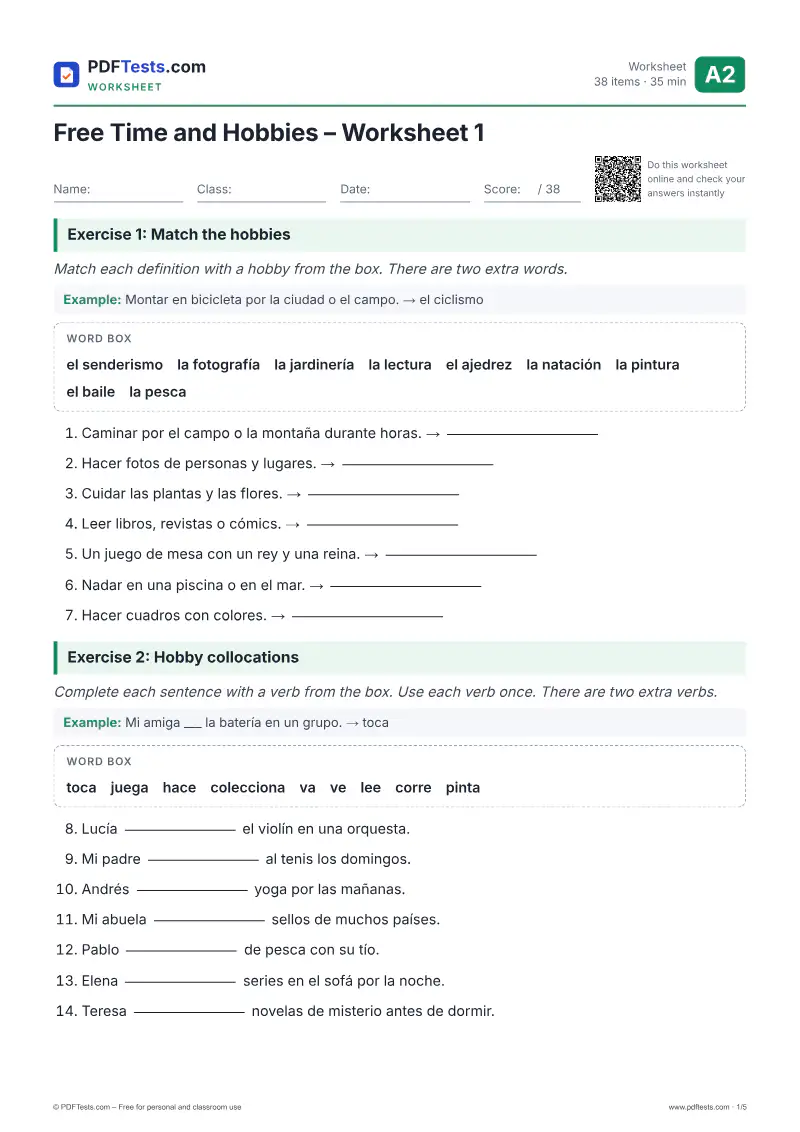
Exercise 3: What do they like?

Complete the sentences with the correct form of the verb in brackets.

Example: A Marta le ___ (gustar) nadar. → gusta

  1. A mí me (encantar) bailar salsa.

  2. ¿A ti te (gustar) los juegos de mesa?

  3. A mis padres les (interesar) el arte moderno.

  4. A nosotros nos (aburrir) las películas largas.

  5. A Diego le (gustar) mucho la música clásica.

  6. A mí me (interesar) mucho los videojuegos.

Exercise 4: Word forms

Form the correct word from the word in capitals to complete each sentence.

Example: Sara es una ___ muy rápida: corre maratones. (CORRER) → corredora

  1. Mi hermana es una excelente: nada todos los días. (NADAR)

  2. Me encanta la : leo dos libros al mes. (LEER)

  3. Óscar es muy buen : baila salsa y tango. (BAILAR)

  4. Este libro es muy : no puedo parar de leer. (INTERÉS)

  5. Mi tío es y vende sus cuadros en el mercado. (PINTAR)

  6. Ver la tele todo el día es muy . (ABURRIR)

Exercise 5: Find the mistake

Each sentence has one mistake. Write the correct sentence.

Example: Juego el piano todos los días. → Toco el piano todos los días.

  1. Mi hermano juega la guitarra muy bien.

  2. Me gustan mucho leer cómics.

  3. Los sábados voy a compras con mi madre.

  4. ¿Te gusta ir en el cine?

  5. A mi abuelo le gusta mucho las plantas.

  6. Ella es una pintor muy buena.

Exercise 6: Put the words in order

Put the words in the correct order to make sentences.

Example: cine / al / vamos / hoy → Hoy vamos al cine.

  1. juego / al / tenis / los / fines / de / semana

  2. le / a / Ana / encanta / cocinar

  3. qué / haces / en / tu / tiempo / libre

  4. mis / padres / nunca / van / al / teatro

  5. de / vamos / pesca / mañana

  6. tocar / quiero / aprender / a / el / piano

Was this page helpful?

Report a mistake

Spotted a wrong answer, a typo or an unclear explanation? Tell us and we will fix it.

Preview

About this test

Printable A2 Spanish worksheet on free time and hobbies: hobby words, verb collocations, gustar and encantar, and word forms. Answers included.

Topics covered

Hobbies and free timeVerb collocations (jugar, tocar, hacer, ir de)Gustar, encantar, interesar, aburrirWord formation: people and adjectivesWord order in sentences

Notes for teachers

Start with Exercise 1 as a warm-up and ask learners which hobbies they do. Common mistakes are using jugar with instruments instead of tocar, and using gusta with plural nouns. Learners also forget the feminine form of person nouns (pintora, nadadora). As a follow-up, pairs can interview each other with ¿Qué haces en tu tiempo libre? and report back using le gusta / le encanta.

All Spanish A2 tests →