PDFTests Originals

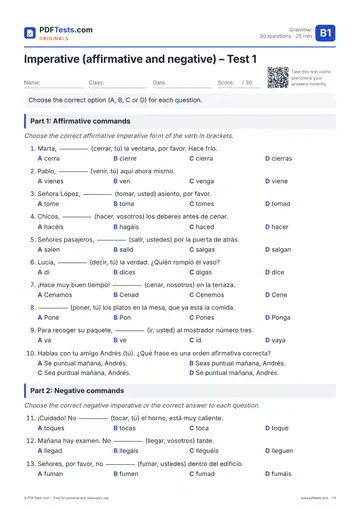
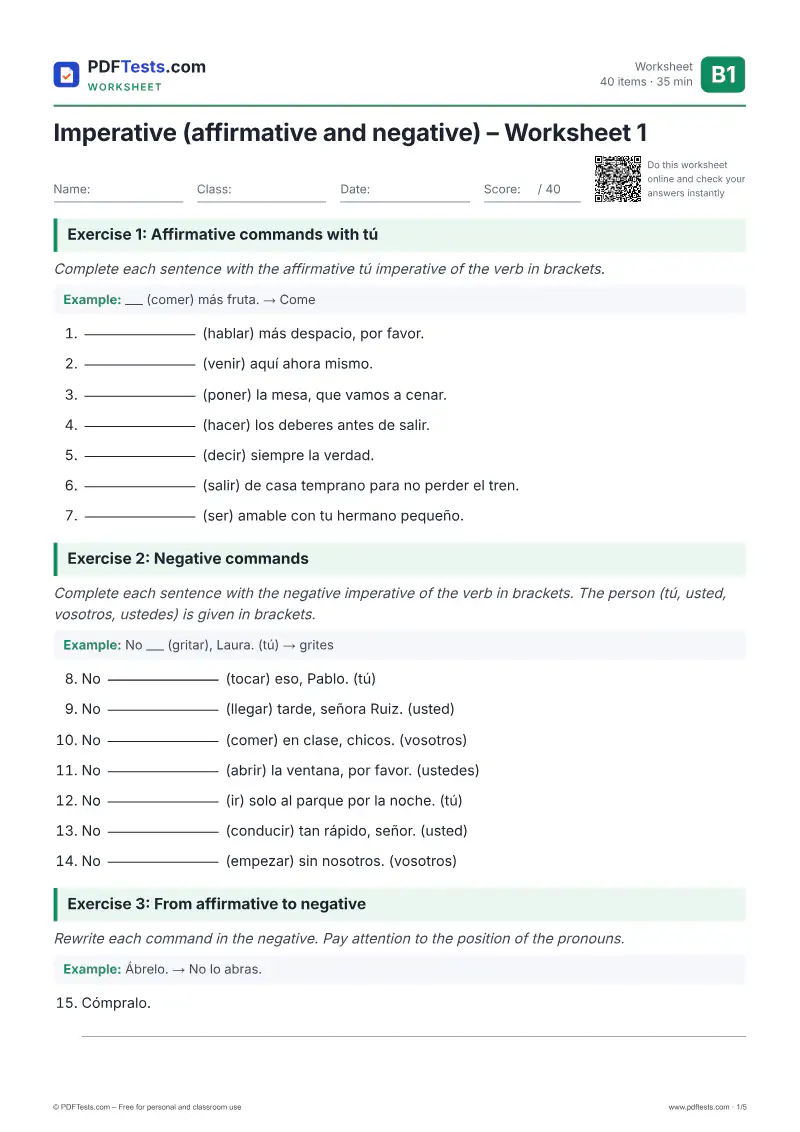
Imperative (affirmative and negative) – Worksheet 1

B1 Intermediate WorksheetSpanish

This B1 worksheet practises the Spanish imperative in affirmative and negative forms for tú, usted, vosotros and ustedes. Learners work on irregular forms (ven, haz, di, sé) and on where object and reflexive pronouns go. It suits intermediate learners in class or for self-study at home.
items
40
Time
35 min
PDF
5 pages
Answer key
Included
  • 100% free
  • No sign-up or email
  • Print-ready A4 PDF
Preview of page 1 of Imperative (affirmative and negative) – Worksheet 1 Open PDF
New to this topic? Read the guide first: Spanish Imperative (Affirmative and Negative): Forms, Rules and Examples

Do the worksheet online

Type your answers, then press “Check my answers”. Alternative correct answers are accepted.

Exercise 1: Affirmative commands with tú

Complete each sentence with the affirmative tú imperative of the verb in brackets.

Example: ___ (comer) más fruta. → Come

  1. (hablar) más despacio, por favor.

  2. (venir) aquí ahora mismo.

  3. (poner) la mesa, que vamos a cenar.

  4. (hacer) los deberes antes de salir.

  5. (decir) siempre la verdad.

  6. (salir) de casa temprano para no perder el tren.

  7. (ser) amable con tu hermano pequeño.

Exercise 2: Negative commands

Complete each sentence with the negative imperative of the verb in brackets. The person (tú, usted, vosotros, ustedes) is given in brackets.

Example: No ___ (gritar), Laura. (tú) → grites

  1. No (tocar) eso, Pablo. (tú)

  2. No (llegar) tarde, señora Ruiz. (usted)

  3. No (comer) en clase, chicos. (vosotros)

  4. No (abrir) la ventana, por favor. (ustedes)

  5. No (ir) solo al parque por la noche. (tú)

  6. No (conducir) tan rápido, señor. (usted)

  7. No (empezar) sin nosotros. (vosotros)

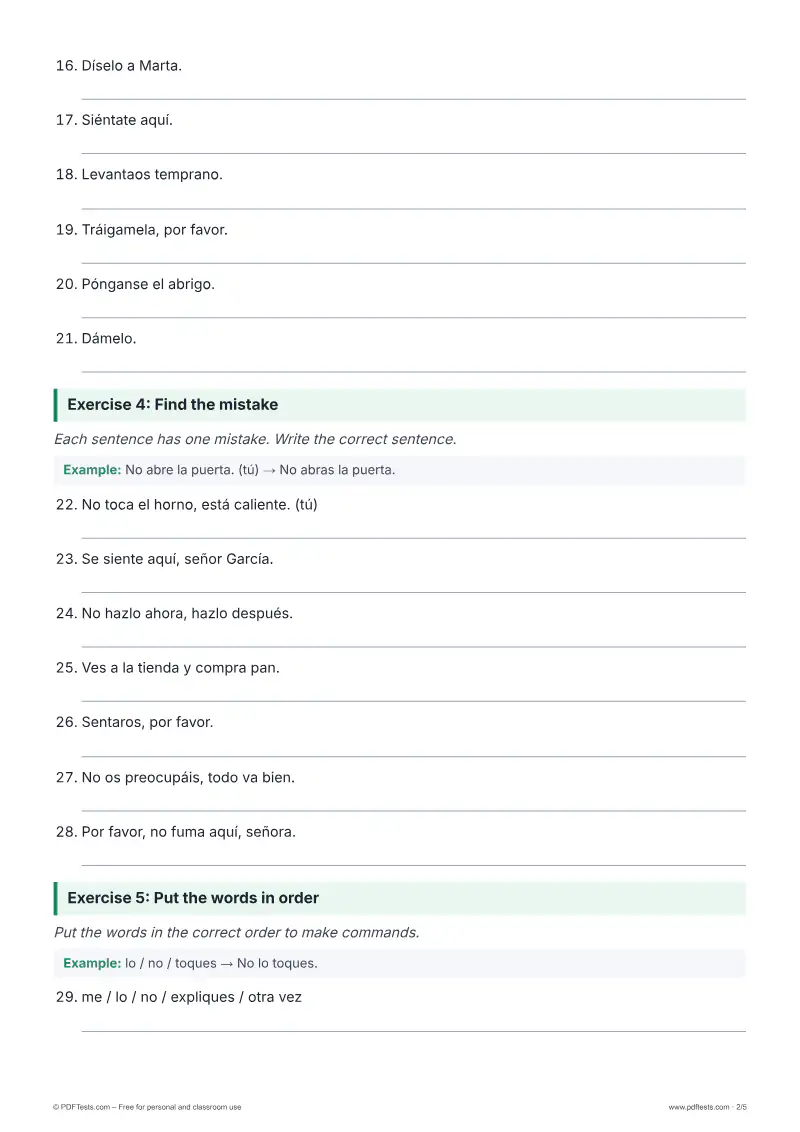
Exercise 3: From affirmative to negative

Rewrite each command in the negative. Pay attention to the position of the pronouns.

Example: Ábrelo. → No lo abras.

  1. Cómpralo.

  2. Díselo a Marta.

  3. Siéntate aquí.

  4. Levantaos temprano.

  5. Tráigamela, por favor.

  6. Pónganse el abrigo.

  7. Dámelo.

Exercise 4: Find the mistake

Each sentence has one mistake. Write the correct sentence.

Example: No abre la puerta. (tú) → No abras la puerta.

  1. No toca el horno, está caliente. (tú)

  2. Se siente aquí, señor García.

  3. No hazlo ahora, hazlo después.

  4. Ves a la tienda y compra pan.

  5. Sentaros, por favor.

  6. No os preocupáis, todo va bien.

  7. Por favor, no fuma aquí, señora.

Exercise 5: Put the words in order

Put the words in the correct order to make commands.

Example: lo / no / toques → No lo toques.

  1. me / lo / no / expliques / otra vez

  2. las / manos / lavaos / antes de comer

  3. no / se / preocupe / usted

  4. díselo / a tu madre / mañana

  5. tarde / no / lleguéis / a la reunión

  6. la puerta / cierren / al salir

Exercise 6: A recipe

Complete the recipe with the usted commands from the box. There are two extra words you do not need.

Word box calientecorteañadabatano dejesirvacortasañadís

  1. Primero, el aceite en una sartén.

  2. la cebolla en trozos pequeños.

  3. la cebolla al aceite caliente.

  4. que se queme la cebolla.

  5. los huevos con un poco de sal.

  6. Por último, la tortilla con un poco de pan.

Was this page helpful?

Report a mistake

Spotted a wrong answer, a typo or an unclear explanation? Tell us and we will fix it.

Preview

About this test

B1 Spanish worksheet on the imperative: affirmative and negative forms for tú, usted, vosotros and ustedes, irregular verbs and pronoun placement.

Topics covered

Affirmative imperativeNegative imperativeIrregular imperativesPronoun placementFormal vs informal commands

Notes for teachers

Start by reviewing how the negative imperative uses present subjunctive forms, while the affirmative tú and vosotros forms do not. Typical mistakes include saying *ves* instead of *ve*, using infinitives such as *venir* for vosotros, and putting pronouns in the wrong place (*no hazlo* instead of *no lo hagas*). Remind students to add written accents when pronouns are attached (cómpralo, siéntese). As a follow-up, students can write a set of house rules or a simple recipe using both affirmative and negative commands.

All Spanish B1 tests →