PDFTests Originals

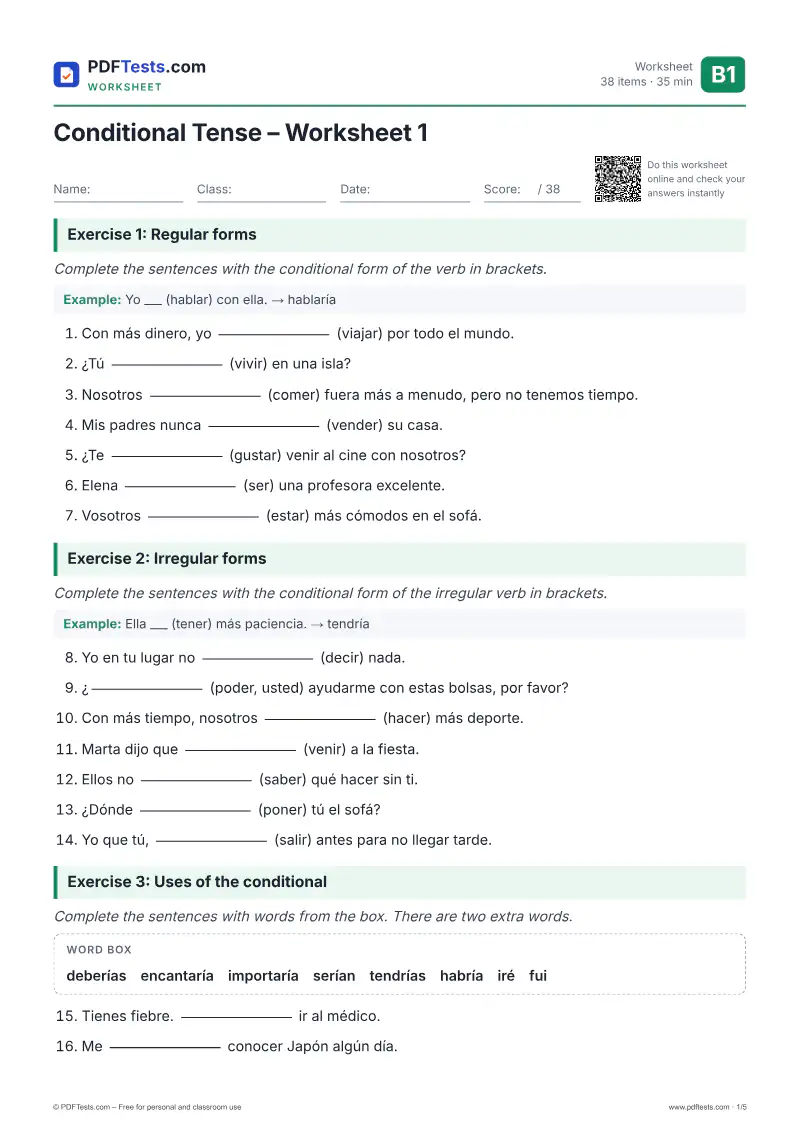
Conditional Tense – Worksheet 1

B1 Intermediate WorksheetSpanish

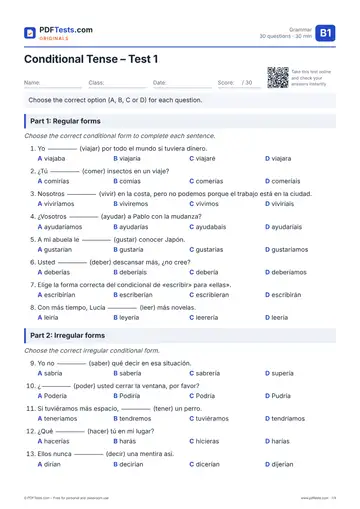
This B1 worksheet practises the Spanish conditional tense (condicional simple), from regular and irregular forms to its main uses: polite requests, advice, wishes, hypothetical situations, probability in the past and reported speech. It suits intermediate learners in class or at home and includes negatives and questions.
items
38
Time
35 min
PDF
5 pages
Answer key
Included
  • 100% free
  • No sign-up or email
  • Print-ready A4 PDF
Preview of page 1 of Conditional Tense – Worksheet 1 Open PDF
New to this topic? Read the guide first: Spanish Conditional Tense: Forms, Uses and Common Mistakes

Do the worksheet online

Type your answers, then press “Check my answers”. Alternative correct answers are accepted.

Exercise 1: Regular forms

Complete the sentences with the conditional form of the verb in brackets.

Example: Yo ___ (hablar) con ella. → hablaría

  1. Con más dinero, yo (viajar) por todo el mundo.

  2. ¿Tú (vivir) en una isla?

  3. Nosotros (comer) fuera más a menudo, pero no tenemos tiempo.

  4. Mis padres nunca (vender) su casa.

  5. ¿Te (gustar) venir al cine con nosotros?

  6. Elena (ser) una profesora excelente.

  7. Vosotros (estar) más cómodos en el sofá.

Exercise 2: Irregular forms

Complete the sentences with the conditional form of the irregular verb in brackets.

Example: Ella ___ (tener) más paciencia. → tendría

  1. Yo en tu lugar no (decir) nada.

  2. ¿ (poder, usted) ayudarme con estas bolsas, por favor?

  3. Con más tiempo, nosotros (hacer) más deporte.

  4. Marta dijo que (venir) a la fiesta.

  5. Ellos no (saber) qué hacer sin ti.

  6. ¿Dónde (poner) tú el sofá?

  7. Yo que tú, (salir) antes para no llegar tarde.

Exercise 3: Uses of the conditional

Complete the sentences with words from the box. There are two extra words.

Word box deberíasencantaríaimportaríaseríantendríashabríairéfui

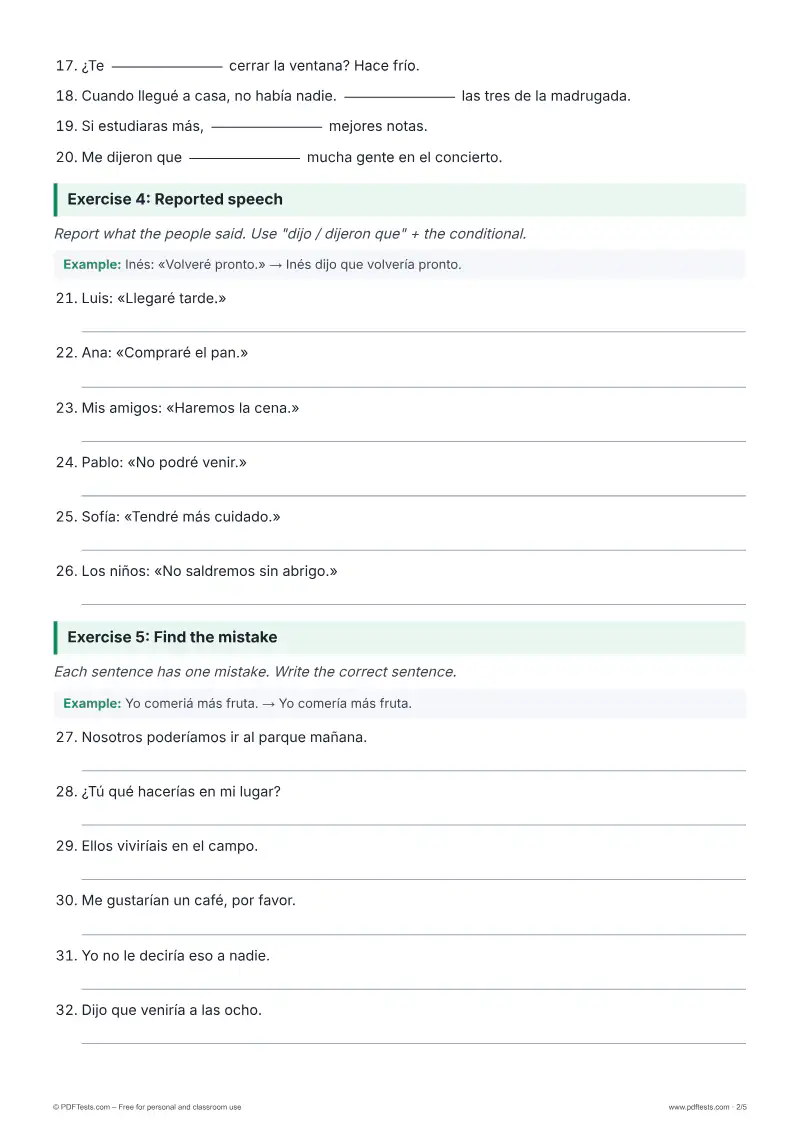
  1. Tienes fiebre. ir al médico.

  2. Me conocer Japón algún día.

  3. ¿Te cerrar la ventana? Hace frío.

  4. Cuando llegué a casa, no había nadie. las tres de la madrugada.

  5. Si estudiaras más, mejores notas.

  6. Me dijeron que mucha gente en el concierto.

Exercise 4: Reported speech

Report what the people said. Use "dijo / dijeron que" + the conditional.

Example: Inés: «Volveré pronto.» → Inés dijo que volvería pronto.

  1. Luis: «Llegaré tarde.»

  2. Ana: «Compraré el pan.»

  3. Mis amigos: «Haremos la cena.»

  4. Pablo: «No podré venir.»

  5. Sofía: «Tendré más cuidado.»

  6. Los niños: «No saldremos sin abrigo.»

Exercise 5: Find the mistake

Each sentence has one mistake. Write the correct sentence.

Example: Yo comeriá más fruta. → Yo comería más fruta.

  1. Nosotros poderíamos ir al parque mañana.

  2. ¿Tú qué hacerías en mi lugar?

  3. Ellos viviríais en el campo.

  4. Me gustarían un café, por favor.

  5. Yo no le deciría eso a nadie.

  6. Dijo que veniría a las ocho.

Exercise 6: Word order

Put the words in the correct order to make sentences and questions.

Example: ayudarte / podría / yo → Yo podría ayudarte.

  1. gustaría / mesa / me / una / reservar

  2. ¿ / podrías / la / me / sal / pasar / ?

  3. no / eso / yo / haría / nunca

  4. deberías / más / dormir / horas

  5. ¿ / qué / harías / con / dinero / el / ?

  6. dijo / que / llamaría / me / Carlos

Was this page helpful?

Report a mistake

Spotted a wrong answer, a typo or an unclear explanation? Tell us and we will fix it.

Preview

About this test

Printable B1 Spanish worksheet on the conditional tense: regular and irregular forms, polite requests, advice, reported speech and questions.

Topics covered

Conditional tense (condicional simple)Irregular conditional stemsPolite requests and adviceReported speechProbability in the past

Notes for teachers

Start by eliciting the endings (-ía, -ías, -ía, -íamos, -íais, -ían) and stress that they attach to the whole infinitive, then drill the irregular stems, which are the same as in the future tense. Typical mistakes are regularising stems (*poderíamos, *hacería, *veniría), dropping the written accent, and saying *me gustarían with a singular noun. As a follow-up, ask learners to write five sentences about what they would do with a free year, then report a partner's answers using "dijo que...".

All Spanish B1 tests →