PDFTests Originals

Present Subjunctive – Worksheet 1

B1 Intermediate WorksheetSpanish

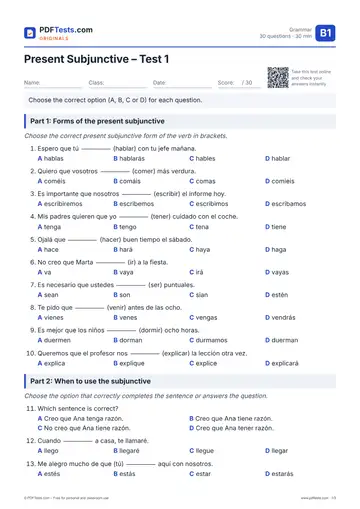
This B1 worksheet practises the Spanish present subjunctive: how to form regular, stem-changing and irregular verbs, and when to use them after expressions of wish, doubt, emotion, purpose and future time. It suits intermediate learners who know the present indicative and are ready to tell the two moods apart.
items
36
Time
40 min
PDF
5 pages
Answer key
Included
  • 100% free
  • No sign-up or email
  • Print-ready A4 PDF
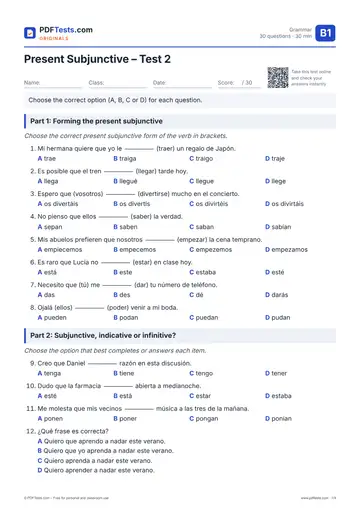
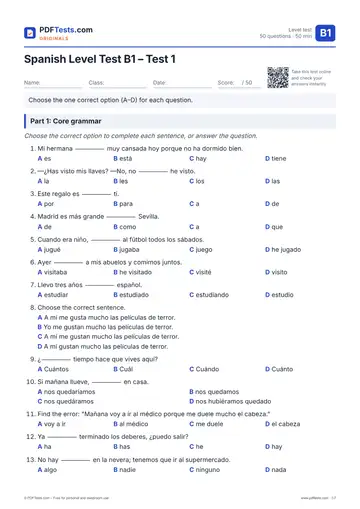
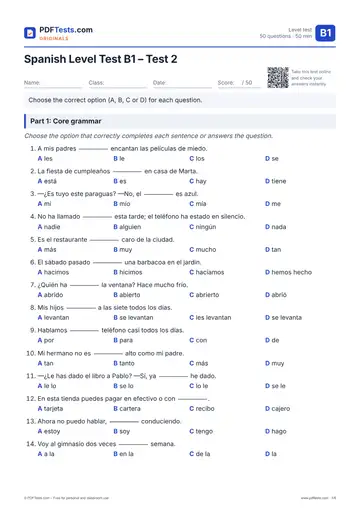
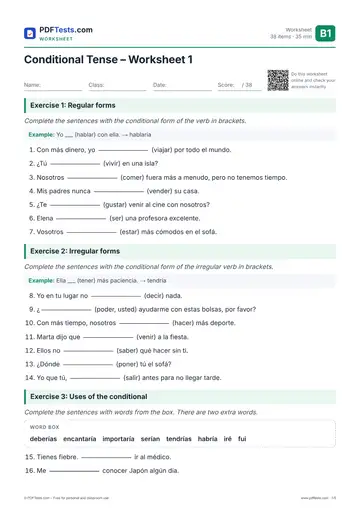
Preview of page 1 of Present Subjunctive – Worksheet 1 Open PDF
New to this topic? Read the guide first: Spanish Present Subjunctive: Forms, Uses and Common Mistakes

Do the worksheet online

Type your answers, then press “Check my answers”. Alternative correct answers are accepted.

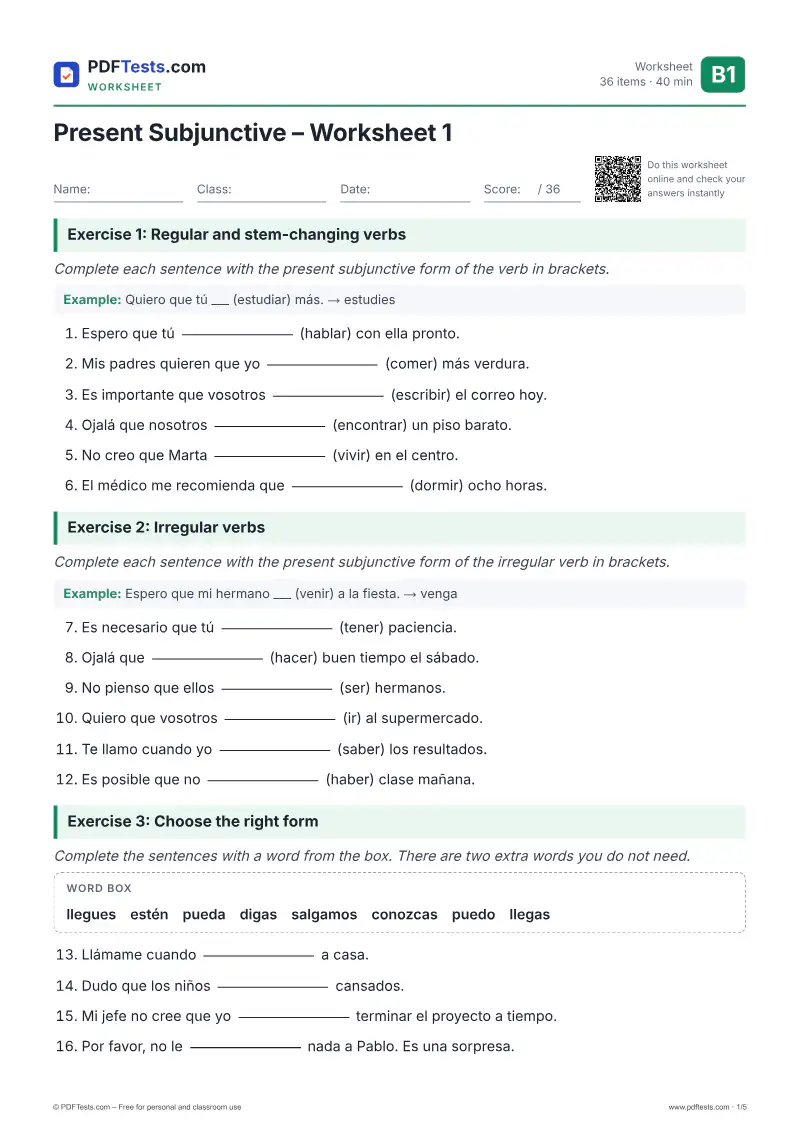
Exercise 1: Regular and stem-changing verbs

Complete each sentence with the present subjunctive form of the verb in brackets.

Example: Quiero que tú ___ (estudiar) más. → estudies

  1. Espero que tú (hablar) con ella pronto.

  2. Mis padres quieren que yo (comer) más verdura.

  3. Es importante que vosotros (escribir) el correo hoy.

  4. Ojalá que nosotros (encontrar) un piso barato.

  5. No creo que Marta (vivir) en el centro.

  6. El médico me recomienda que (dormir) ocho horas.

Exercise 2: Irregular verbs

Complete each sentence with the present subjunctive form of the irregular verb in brackets.

Example: Espero que mi hermano ___ (venir) a la fiesta. → venga

  1. Es necesario que tú (tener) paciencia.

  2. Ojalá que (hacer) buen tiempo el sábado.

  3. No pienso que ellos (ser) hermanos.

  4. Quiero que vosotros (ir) al supermercado.

  5. Te llamo cuando yo (saber) los resultados.

  6. Es posible que no (haber) clase mañana.

Exercise 3: Choose the right form

Complete the sentences with a word from the box. There are two extra words you do not need.

Word box lleguesesténpuedadigassalgamosconozcaspuedollegas

  1. Llámame cuando a casa.

  2. Dudo que los niños cansados.

  3. Mi jefe no cree que yo terminar el proyecto a tiempo.

  4. Por favor, no le nada a Pablo. Es una sorpresa.

  5. ¿Quieres que esta noche a cenar?

  6. Quiero que a mi amiga Lucía; es muy simpática.

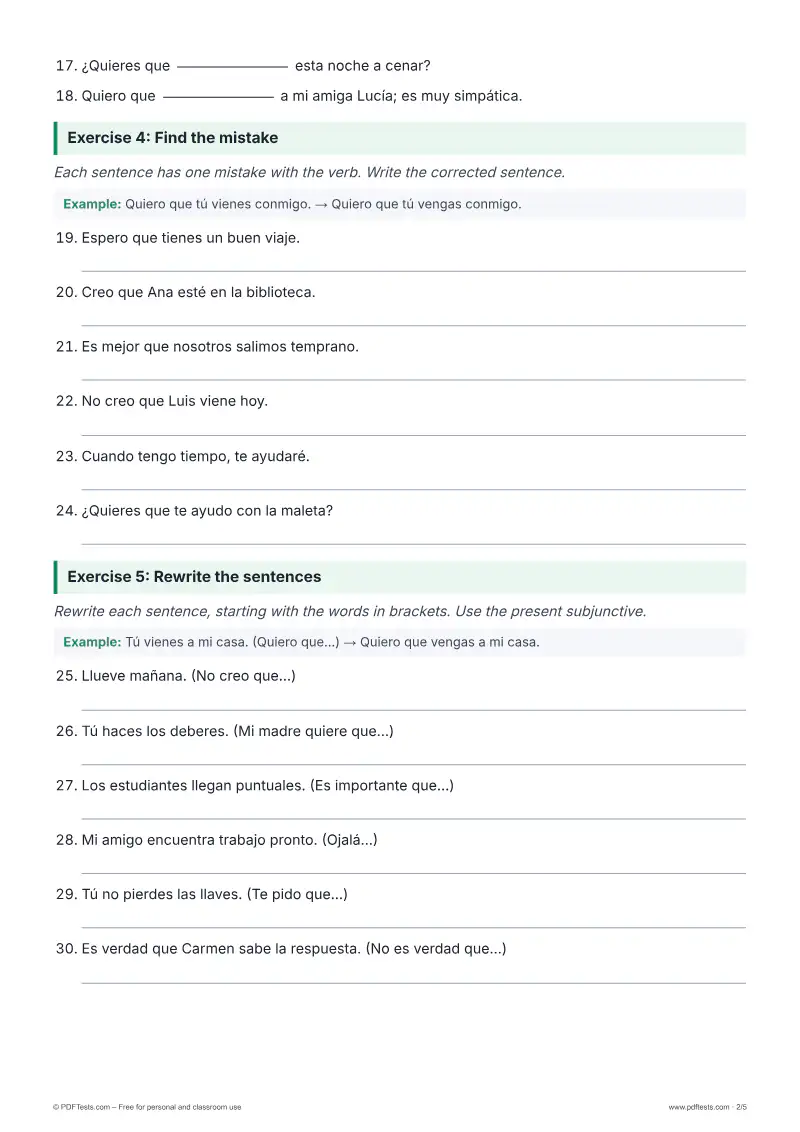
Exercise 4: Find the mistake

Each sentence has one mistake with the verb. Write the corrected sentence.

Example: Quiero que tú vienes conmigo. → Quiero que tú vengas conmigo.

  1. Espero que tienes un buen viaje.

  2. Creo que Ana esté en la biblioteca.

  3. Es mejor que nosotros salimos temprano.

  4. No creo que Luis viene hoy.

  5. Cuando tengo tiempo, te ayudaré.

  6. ¿Quieres que te ayudo con la maleta?

Exercise 5: Rewrite the sentences

Rewrite each sentence, starting with the words in brackets. Use the present subjunctive.

Example: Tú vienes a mi casa. (Quiero que…) → Quiero que vengas a mi casa.

  1. Llueve mañana. (No creo que…)

  2. Tú haces los deberes. (Mi madre quiere que…)

  3. Los estudiantes llegan puntuales. (Es importante que…)

  4. Mi amigo encuentra trabajo pronto. (Ojalá…)

  5. Tú no pierdes las llaves. (Te pido que…)

  6. Es verdad que Carmen sabe la respuesta. (No es verdad que…)

Exercise 6: Put the words in order

Put the words in the correct order to make sentences.

Example: que / vengas / quiero / pronto → Quiero que vengas pronto.

  1. el regalo / que / guste / espero / te

  2. sea / no / que / difícil / creo

  3. ¿ / te / quieres / mañana / llame / que / ?

  4. no / Es / ellos / vengan / que / posible

  5. me / para que / doy / te / escribas / mi número

  6. en el examen / tengamos / ojalá / suerte

Was this page helpful?

Report a mistake

Spotted a wrong answer, a typo or an unclear explanation? Tell us and we will fix it.

Preview

About this test

Free printable B1 Spanish worksheet on the present subjunctive: regular and irregular forms, triggers, negatives and questions, with answers.

Topics covered

Present subjunctive formsIrregular subjunctive verbsWishes and recommendationsDoubt and denialCuando and para queSubjunctive vs indicative

Notes for teachers

Start with Exercises 1–2 to check forms. Then use Exercise 4 to discuss the key contrast: 'creo que' takes the indicative, but 'no creo que' takes the subjunctive. Learners often keep the indicative after 'cuando' with future meaning. They also forget spelling changes such as llegar → llegue and the irregular stems in haya, vaya and sepa. As a follow-up, pairs can write five wishes for a classmate using 'Espero que…' and 'Ojalá…'.

All Spanish B1 tests →