The Spanish present subjunctive (presente de subjuntivo) is the verb form you use for things that are wished for, needed, felt, doubted or not yet real, rather than facts. It appears mostly in a second clause after que, especially when the two clauses have different subjects: Quiero que vengas (I want you to come). At B1 you need it for wishes, advice, emotions, doubt and future plans with cuando.
What the subjunctive does
The indicative describes reality as the speaker sees it. The subjunctive presents an action as something that is wanted, possible, uncertain or still in the future.
- Sé que viene mañana. I know he is coming tomorrow. (fact → indicative)
- Espero que venga mañana. I hope he comes tomorrow. (wish → subjunctive)
Most subjunctive sentences follow this pattern:
main verb (wish, emotion, doubt…) + que + new subject + subjunctive
How to form the present subjunctive
Regular verbs
Take the yo form of the present indicative, remove the final -o, and add the opposite vowel: -ar verbs take e endings, -er and -ir verbs take a endings.
| Person | hablar | comer | vivir |
|---|---|---|---|
| yo | hable | coma | viva |
| tú | hables | comas | vivas |
| él / ella / usted | hable | coma | viva |
| nosotros/as | hablemos | comamos | vivamos |
| vosotros/as | habléis | comáis | viváis |
| ellos / ellas / ustedes | hablen | coman | vivan |
Note that the yo and él/ella/usted forms are identical. Add a subject pronoun if the meaning is unclear: Quiere que yo hable vs Quiere que ella hable.
Negatives and questions do not change the verb form. Just add no before the verb or use question intonation: Espero que no llueva. I hope it doesn’t rain. / ¿Quieres que te ayude? Do you want me to help you?
Verbs with an irregular yo form
Because the stem comes from the yo form, verbs that are irregular in yo keep that irregularity in every person. If you need to review these, see our guide to the Spanish present tense with irregular verbs.
| Infinitive | yo (present) | Subjunctive |
|---|---|---|
| tener | tengo | tenga, tengas, tengamos… |
| hacer | hago | haga, hagas, hagamos… |
| decir | digo | diga, digas, digamos… |
| poner | pongo | ponga, pongas, pongamos… |
| salir | salgo | salga, salgas, salgamos… |
| venir | vengo | venga, vengas, vengamos… |
| conocer | conozco | conozca, conozcas, conozcamos… |
| ver | veo | vea, veas, veamos… |
Stem-changing verbs
Verbs like pensar (e → ie) and poder (o → ue) change in the same persons as in the present indicative: all except nosotros and vosotros.
| pensar | poder |
|---|---|
| piense, pienses, piense | pueda, puedas, pueda |
| pensemos, penséis | podamos, podáis |
| piensen | puedan |
-ir stem-changing verbs have an extra change in nosotros and vosotros: e → i and o → u.
- pedir: pida, pidas, pida, pidamos, pidáis, pidan
- dormir: duerma, duermas, duerma, durmamos, durmáis, duerman
- sentir: sienta, sientas, sienta, sintamos, sintáis, sientan
Spelling changes
Some verbs change their spelling to keep the same sound before e or a.
| Ending | Change | Example |
|---|---|---|
| -car | c → qu | buscar → busque |
| -gar | g → gu | llegar → llegue |
| -zar | z → c | empezar → empiece |
| -ger / -gir | g → j | coger → coja, elegir → elija |
The six key irregular verbs
These verbs do not follow the yo rule. Learn them as a group.
| Person | ser | estar | ir | haber | saber | dar |
|---|---|---|---|---|---|---|
| yo | sea | esté | vaya | haya | sepa | dé |
| tú | seas | estés | vayas | hayas | sepas | des |
| él / ella / usted | sea | esté | vaya | haya | sepa | dé |
| nosotros/as | seamos | estemos | vayamos | hayamos | sepamos | demos |
| vosotros/as | seáis | estéis | vayáis | hayáis | sepáis | deis |
| ellos / ellas / ustedes | sean | estén | vayan | hayan | sepan | den |
Haya is the subjunctive of hay: Espero que haya sitio. I hope there’s room. The accent on dé separates it from the preposition de.
When to use the present subjunctive
Wishes and wants
After verbs like querer, esperar, preferir, desear + que, and after ojalá.
- Quiero que me llames esta noche. I want you to call me tonight.
- Espero que tengáis buen tiempo. I hope you have good weather.
- Ojalá aprobemos el examen. I hope we pass the exam.
Advice, requests and necessity
After recomendar, aconsejar, pedir, decir (meaning ‘tell someone to’), necesitar, and impersonal phrases such as es importante que, es necesario que, es mejor que.
- Te recomiendo que pruebes la paella. I recommend you try the paella.
- Mi jefa me pide que llegue antes de las nueve. My boss asks me to arrive before nine.
- Es importante que duermas bien. It’s important that you sleep well.
Emotions and reactions
After expressions of feeling: me alegra que, me encanta que, me molesta que, siento que, tengo miedo de que, es una pena que.
- Me alegra que estés aquí. I’m glad you’re here.
- Siento que no puedas venir. I’m sorry you can’t come.
- Me molesta que la gente hable en el cine. It annoys me when people talk in the cinema.
Doubt, denial and possibility
After dudar que, no creer que, no pensar que, es posible que, puede que, quizás / tal vez (often).
- Dudo que sea tan fácil. I doubt it’s that easy.
- No creo que lleguen a tiempo. I don’t think they’ll arrive on time.
- Es posible que vaya a la fiesta. It’s possible I’ll go to the party.
Future actions after time expressions
After cuando, en cuanto, hasta que, antes de que when the action has not happened yet. Never use the future tense here.
- Cuando termine el curso, buscaré trabajo. When I finish the course, I’ll look for a job.
- Te llamo en cuanto sepa algo. I’ll call you as soon as I know something.
Purpose
After para que (so that), always.
- Te lo explico para que lo entiendas. I’m explaining it to you so that you understand it.
One subject or two: infinitive or que + subjunctive
With verbs of wanting, preferring or needing, use the infinitive when both verbs have the same subject, and que + subjunctive when the subjects are different.
| Same subject → infinitive | Different subject → que + subjunctive |
|---|---|
| Quiero viajar. I want to travel. | Quiero que viajes. I want you to travel. |
| Prefiero quedarme. I prefer to stay. | Prefiero que te quedes. I prefer you to stay. |
| Es importante descansar. It’s important to rest. | Es importante que descanses. It’s important that you rest. |
Subjunctive vs indicative
Learners often mix up these pairs. The key question is: is it presented as a fact, or as something wished, doubted or not yet real?
| Indicative | Subjunctive |
|---|---|
| Creo que es verdad. I think it’s true. | No creo que sea verdad. I don’t think it’s true. |
| Es verdad que está enfermo. It’s true he’s ill. | Es posible que esté enfermo. It’s possible he’s ill. |
| Cuando llego, ceno. When I get home, I have dinner. (habit) | Cuando llegue, cenaré. When I get home, I’ll have dinner. (future) |
Creer and pensar in the affirmative take the indicative; in the negative they normally take the subjunctive. For a full comparison, read our guide on subjunctive vs indicative.
The present subjunctive also gives you most imperative forms: usted commands (Venga aquí) and all negative commands (No hables) use the same forms.
Signal words
| Type | Triggers |
|---|---|
| Wishes | querer que, esperar que, preferir que, ojalá |
| Advice / requests | recomendar que, pedir que, aconsejar que, es importante que, es mejor que |
| Emotions | me alegra que, siento que, me molesta que, es una pena que |
| Doubt | dudo que, no creo que, es posible que, puede que |
| Future time | cuando, en cuanto, hasta que, antes de que |
| Purpose | para que |
Common mistakes
- ✗ Quiero que vienes conmigo. → ✓ Quiero que vengas conmigo. After querer que with a new subject, use the subjunctive.
- ✗ Quiero que yo vaya al cine. → ✓ Quiero ir al cine. Same subject in both clauses means infinitive, not que.
- ✗ Cuando llegarás, llámame. → ✓ Cuando llegues, llámame. Cuando + future idea takes the subjunctive, never the future tense.
- ✗ Creo que sea verdad. → ✓ Creo que es verdad. Affirmative creer que expresses belief, so it takes the indicative.
- ✗ Ojalá que hace sol mañana. → ✓ Ojalá que haga sol mañana. Ojalá is always followed by the subjunctive.
- ✗ Espero que llege pronto. → ✓ Espero que llegue pronto. Verbs in -gar add a u to keep the hard g sound.
- ✗ Es necesario que dormamos más. → ✓ Es necesario que durmamos más. -ir stem-changers change o → u in nosotros.
Quick check
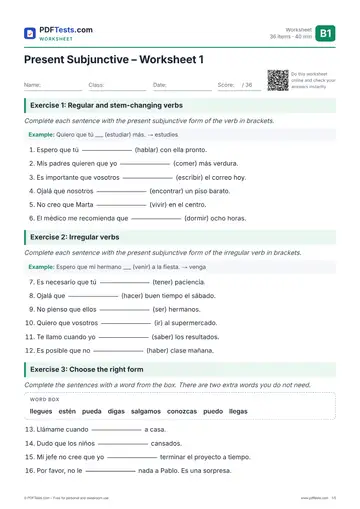
Complete each sentence with the correct form.
- Espero que (tú / tener) ___ un buen viaje.
- No creo que Marta (estar) ___ en casa ahora.
- Cuando (yo / llegar) ___ a Madrid, te mando un mensaje.
- Es importante que (nosotros / dormir) ___ ocho horas.
- Prefiero ___ (quedarme / que me quede) en casa esta noche.
Answers
- tengas – wish with a different subject.
- esté – no creo que expresses doubt.
- llegue – future action after cuando; -gar → -gue.
- durmamos – -ir stem-changer, o → u in nosotros.
- quedarme – same subject, so use the infinitive.
Next step
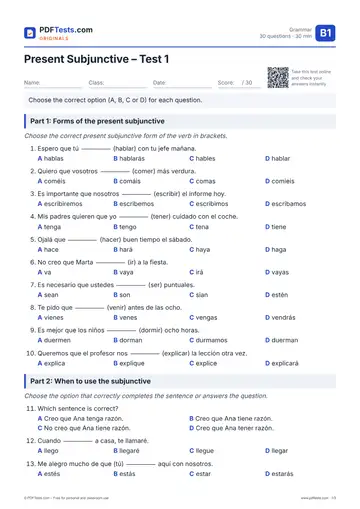
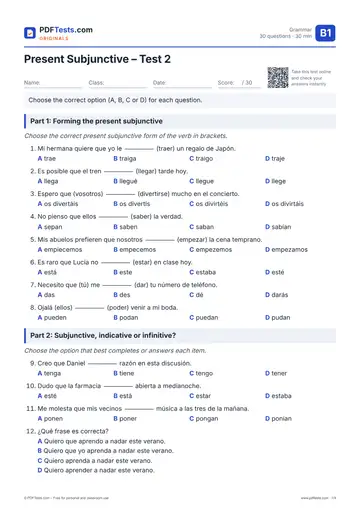
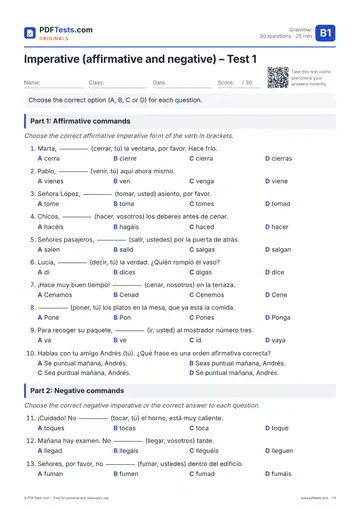
Start by memorising the six irregular verbs and the que + new subject pattern, then practise until the triggers feel automatic. Test yourself with our B1 Present Subjunctive test and then try Present Subjunctive Test 2 for more varied contexts. Once you are confident, move on to the past forms in our guide to the imperfect subjunctive.
Was this page helpful?
What was the problem?
Thank you for your feedback!