Spanish relative pronouns are words like que, quien, el que, el cual, lo que and cuyo. They introduce a clause that describes or identifies a noun: el libro que leí (the book that I read). You use them wherever English uses who, which, that, whose or what. You also need them where English leaves the pronoun out, because in Spanish the relative can never be dropped.
The relative pronouns at a glance
| Pronoun | Refers to | English | Example |
|---|---|---|---|
| que | people, things | who, which, that | el coche que compré |
| quien / quienes | people only | who, whom | la mujer con quien hablé |
| el que, la que, los que, las que | people, things | who, which, the one(s) that | la casa en la que vivo |
| el cual, la cual, los cuales, las cuales | people, things (formal) | who, which | el motivo por el cual vine |
| lo que / lo cual | an idea or a whole clause | what, which | Lo que dices es verdad. |
| cuyo, cuya, cuyos, cuyas | possession | whose | el autor cuyo libro leí |
| donde | places | where | el bar donde nos conocimos |
One rule matters more than any other. English can say the film I saw, but Spanish must say la película que vi. The relative pronoun is always there.
Que: the all-purpose relative
Que is by far the most frequent relative pronoun. It never changes form. It can refer to people or things, and it can be the subject or the object of the clause.
- El chico que vive arriba es médico. — The guy who lives upstairs is a doctor.
- La serie que estoy viendo es muy buena. — The series I’m watching is really good.
- Los móviles que venden aquí son caros. — The phones they sell here are expensive.
When a person is the direct object, you can use plain que or a + article + que. Both are correct:
- La profesora que conocí ayer es de Bilbao. / La profesora a la que conocí ayer es de Bilbao. — The teacher I met yesterday is from Bilbao.
Defining and non-defining clauses
A defining clause (oración especificativa) tells you which person or thing you mean. It has no commas. A non-defining clause (oración explicativa) adds extra information about something already identified. It goes between commas.
- Los alumnos que estudiaron aprobaron. — The students who studied passed. (only some of them studied)
- Los alumnos, que estudiaron, aprobaron. — The students, who had studied, passed. (all of them studied)
In a defining clause with no preposition, use que. In a non-defining clause you can use que, quien (for people) or el cual:
- Mi hermana, que vive en Lima, viene en julio. / Mi hermana, quien vive en Lima, viene en julio. — My sister, who lives in Lima, is coming in July.
Quien and quienes
Quien refers only to people. It agrees in number: quien for one person, quienes for several. It has three main uses.
1. After a preposition
- La amiga con quien viajé a México se llama Ana. — The friend I travelled to Mexico with is called Ana.
- Los clientes a quienes escribimos no han contestado. — The customers we wrote to haven’t replied.
2. In non-defining clauses
- Mi jefe, quien es muy exigente, me ha dado el viernes libre. — My boss, who is very demanding, has given me Friday off.
3. Without a noun, meaning ‘whoever’ or ‘the person who’
- Quien llega primero elige mesa. — Whoever arrives first chooses the table.
Do not use quien in a defining clause without a preposition. El hombre quien me llamó is wrong; say el hombre que me llamó.
El que, la que, los que, las que
These forms combine the definite article with que. The article agrees in gender and number with the noun it refers to. If you need a refresher on gender, see our guide to Spanish articles and gender.
| Singular | Plural | |
|---|---|---|
| Masculine | el que | los que |
| Feminine | la que | las que |
| Neuter (ideas) | lo que | — |
After prepositions
This is the most common pattern after prepositions. The preposition always goes before the relative pronoun. It never comes at the end of the clause as it often does in English.
- La empresa para la que trabajo es alemana. — The company I work for is German.
- Es el chico del que te hablé. — He’s the guy I told you about. (de + el = del)
- Ese es el motivo por el que no vine. — That’s the reason why I didn’t come.
- Las personas con las que vivo son muy majas. — The people I live with are really nice.
- El chico al que llamé no contestó. — The guy I called didn’t answer. (a + el = al)
With en for places and times, plain que is also very common:
- La casa en (la) que vivo es antigua. — The house I live in is old.
- El año en que nací hubo una gran tormenta. — The year I was born there was a huge storm.
With people, keep the article after a preposition. La chica con que salgo sounds wrong; say la chica con la que salgo or la chica con quien salgo.
Without a noun: ‘the one who’, ‘those who’
El que and its forms can stand alone, meaning the one(s) that or those who:
- Los que viven en el centro pagan más alquiler. — Those who live in the centre pay more rent.
- ¿Qué chaqueta prefieres? —La que llevabas ayer. — Which jacket do you prefer? — The one you were wearing yesterday.
- Mi coche es el que está aparcado fuera. — My car is the one parked outside.
El cual, la cual, los cuales, las cuales
El cual means the same as el que but sounds more formal. You will meet it mainly in writing, news and formal speech. It has two uses:
- After prepositions, especially longer ones such as durante, según, sin, a través de or gracias a.
- In non-defining clauses, between commas.
Examples:
- La reunión durante la cual se tomó la decisión duró tres horas. — The meeting during which the decision was taken lasted three hours.
- Visitamos el castillo, el cual fue construido en el siglo XII. — We visited the castle, which was built in the 12th century.
El cual cannot be used without a preposition in a defining clause. It also cannot stand alone to mean ‘the one who’. El cual llega tarde paga is wrong; say el que llega tarde paga.
Lo que and lo cual
Lo que refers to an idea or situation, not to a specific noun. It has two main uses.
1. ‘What’ = ‘the thing that’
- Lo que necesito es dormir. — What I need is sleep.
- No entiendo lo que quieres decir. — I don’t understand what you mean.
- Todo lo que dijo era mentira. — Everything he said was a lie.
2. ‘Which’ referring to a whole previous clause
- Perdí el tren, lo que significa que llegaré tarde. — I missed the train, which means I’ll be late.
Lo cual works only in the second use, after a comma:
- Perdí el tren, lo cual significa que llegaré tarde. — I missed the train, which means I’ll be late.
When English which refers to a whole sentence, Spanish needs lo que or lo cual, never que alone.
Cuyo, cuya, cuyos, cuyas
Cuyo means whose. It behaves like an adjective. It agrees with the thing that is possessed, the noun right after it, not with the owner.
| Singular | Plural | |
|---|---|---|
| Masculine | cuyo | cuyos |
| Feminine | cuya | cuyas |
- Es una escritora cuyos libros se leen en todo el mundo. — She’s a writer whose books are read all over the world.
- El vecino cuya perra ladra toda la noche se ha mudado. — The neighbour whose dog barks all night has moved out.
Cuyo is common in writing but less frequent in conversation. In speech, people often rephrase: el vecino que tiene una perra que ladra. Avoid que su (el vecino que su perra ladra). You will hear it in casual speech, but it is considered incorrect.
Donde, cuando and como
These relative adverbs work much like their English equivalents.
Donde means where. It replaces en el que or en la que:
- El restaurante donde cenamos estaba lleno. — The restaurant where we had dinner was full.
With verbs of movement, use adonde or a donde:
- El pueblo adonde vamos en verano es precioso. — The village we go to in summer is beautiful.
Cuando appears mostly in non-defining clauses:
- En agosto, cuando hace más calor, cierran la oficina. — In August, when it’s hottest, they close the office.
After a time noun in a defining clause, (en) que is more natural:
- El día (en) que nos conocimos llovía. — The day we met, it was raining.
Como means the way, as in la forma como or la forma en que:
- Me gusta la forma en que explicas las cosas. — I like the way you explain things.
A note on accents
Relative words never carry a written accent: que, quien, donde, cuando, como. Accented forms (qué, quién, dónde) are question words, including indirect questions:
- No sé qué hacer. — I don’t know what to do. (indirect question)
- El trabajo que hago es interesante. — The work I do is interesting. (relative)
Indicative or subjunctive in relative clauses
At B1 you also need to choose the right mood after a relative pronoun.
- Use the indicative when the person or thing exists and is known.
- Use the subjunctive when it is unknown, hypothetical or does not exist.
Compare:
- Tengo un compañero que habla chino. — I have a colleague who speaks Chinese.
- Busco un compañero que hable chino. — I’m looking for a colleague who speaks Chinese. (I don’t know if one exists)
- No hay nadie que sepa la respuesta. — There’s nobody who knows the answer.
For the forms, see our present subjunctive guide. For more complex cases, read the guide to advanced subjunctive in relative clauses.
Common mistakes
- ✗ El libro leí es genial. → ✓ El libro que leí es genial. — Spanish never omits the relative pronoun.
- ✗ La chica que salgo con es italiana. → ✓ La chica con la que salgo es italiana. — The preposition goes before the relative, not at the end.
- ✗ El profesor quien me ayudó es nuevo. → ✓ El profesor que me ayudó es nuevo. — Quien is not used in a defining clause without a preposition.
- ✗ La empresa en el que trabajo es pequeña. → ✓ La empresa en la que trabajo es pequeña. — The article agrees with the noun it refers to.
- ✗ Que más me gusta es la playa. → ✓ Lo que más me gusta es la playa. — ‘What’ with no noun is lo que.
- ✗ Suspendí, que me sentó fatal. → ✓ Suspendí, lo que me sentó fatal. — Referring to a whole clause needs lo que or lo cual.
- ✗ Es el autor cuyo novela ganó el premio. → ✓ Es el autor cuya novela ganó el premio. — Cuyo agrees with the thing possessed.
- ✗ El vecino que su perro ladra. → ✓ El vecino cuyo perro ladra. — Use cuyo instead of que su.
- ✗ El motivo por cual vine. → ✓ El motivo por el cual vine. — Cual as a relative always needs its article.
Quick check
Choose the correct option.
- La ciudad ___ nací es pequeña. (donde / que)
- Esta es la amiga con ___ fui a México. (que / la que)
- ___ me preocupa es el precio. (Que / Lo que)
- Es un pintor ___ obras están en el Prado. (cuyo / cuyas)
- El chico ___ me llamó es mi primo. (que / quien)
Answers
- donde (or en la que) — a place after a verb that needs en.
- la que (or quien) — a person after a preposition needs the article.
- Lo que — ‘what’ with no noun.
- cuyas — it agrees with obras, feminine plural.
- que — a defining clause with no preposition.
Next step
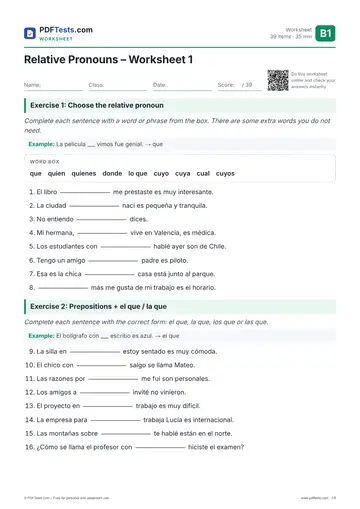
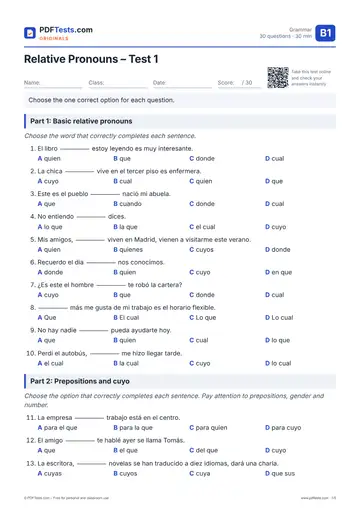
You now know which relative pronoun to choose and why. Put it into practice with our Spanish B1 Relative Pronouns test. Pay special attention to prepositions, article agreement and the difference between que and lo que. When you can score well, review the mood choice with the present subjunctive guide. Then explore the other Spanish B1 tests to see how relative clauses combine with the rest of B1 grammar.
Practise this topic: Spanish Relative Pronouns
Was this page helpful?
What was the problem?
Thank you for your feedback!