PDFTests Originals

Subjunctive vs Indicative – Worksheet 1

B2 Upper-intermediate WorksheetSpanish

This B2 worksheet practises one of the trickiest areas of Spanish grammar: when to use the subjunctive and when to use the indicative. Learners work with opinions and negatives, emotions and wishes, time clauses, conjunctions and relative clauses, moving from controlled gap-fills to error correction and sentence building. It is suitable for upper-intermediate students in class or for self-study.
items
40
Time
35 min
PDF
5 pages
Answer key
Included
  • 100% free
  • No sign-up or email
  • Print-ready A4 PDF
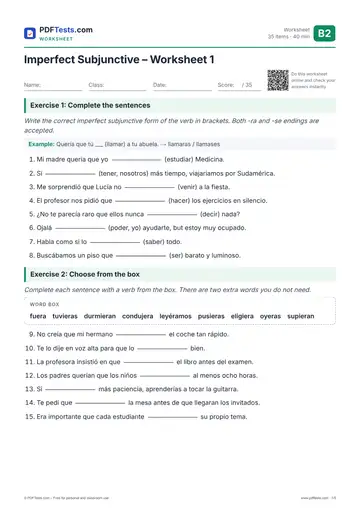
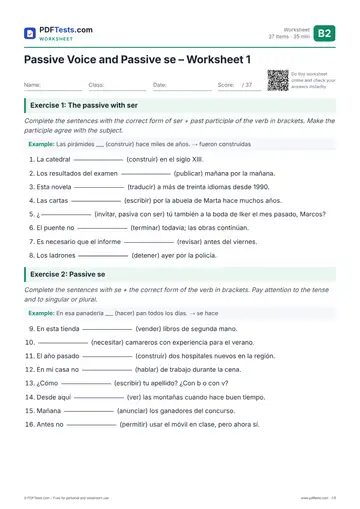
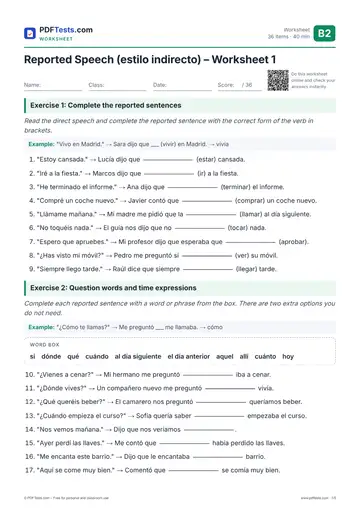
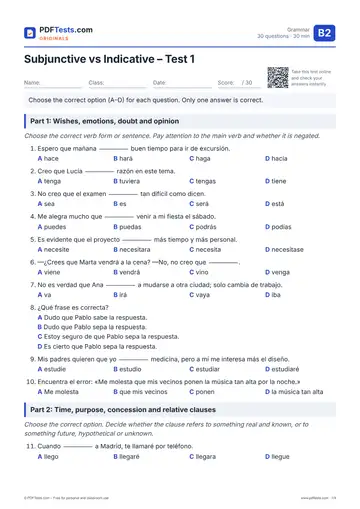
Preview of page 1 of Subjunctive vs Indicative – Worksheet 1 Open PDF
New to this topic? Read the guide first: Subjunctive vs Indicative in Spanish: Rules, Examples and Common Mistakes

Do the worksheet online

Type your answers, then press “Check my answers”. Alternative correct answers are accepted.

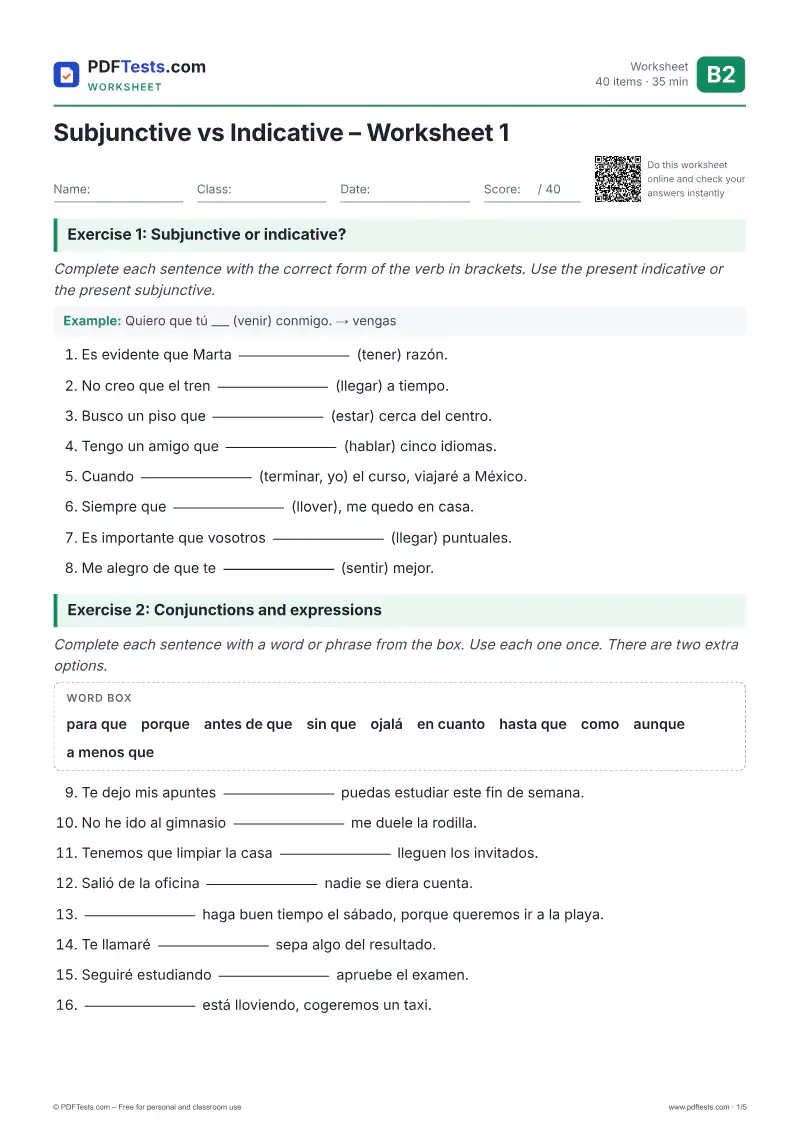
Exercise 1: Subjunctive or indicative?

Complete each sentence with the correct form of the verb in brackets. Use the present indicative or the present subjunctive.

Example: Quiero que tú ___ (venir) conmigo. → vengas

  1. Es evidente que Marta (tener) razón.

  2. No creo que el tren (llegar) a tiempo.

  3. Busco un piso que (estar) cerca del centro.

  4. Tengo un amigo que (hablar) cinco idiomas.

  5. Cuando (terminar, yo) el curso, viajaré a México.

  6. Siempre que (llover), me quedo en casa.

  7. Es importante que vosotros (llegar) puntuales.

  8. Me alegro de que te (sentir) mejor.

Exercise 2: Conjunctions and expressions

Complete each sentence with a word or phrase from the box. Use each one once. There are two extra options.

Word box para queporqueantes de quesin queojaláen cuantohasta quecomoaunquea menos que

  1. Te dejo mis apuntes puedas estudiar este fin de semana.

  2. No he ido al gimnasio me duele la rodilla.

  3. Tenemos que limpiar la casa lleguen los invitados.

  4. Salió de la oficina nadie se diera cuenta.

  5. haga buen tiempo el sábado, porque queremos ir a la playa.

  6. Te llamaré sepa algo del resultado.

  7. Seguiré estudiando apruebe el examen.

  8. está lloviendo, cogeremos un taxi.

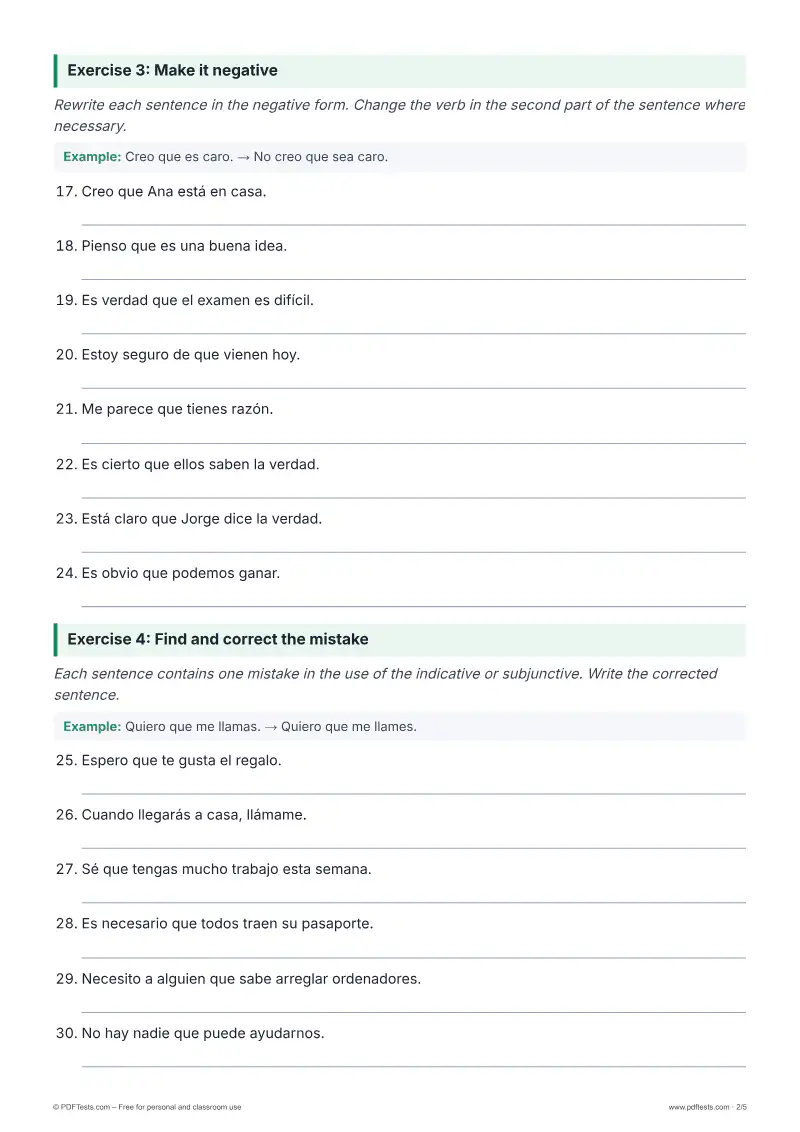
Exercise 3: Make it negative

Rewrite each sentence in the negative form. Change the verb in the second part of the sentence where necessary.

Example: Creo que es caro. → No creo que sea caro.

  1. Creo que Ana está en casa.

  2. Pienso que es una buena idea.

  3. Es verdad que el examen es difícil.

  4. Estoy seguro de que vienen hoy.

  5. Me parece que tienes razón.

  6. Es cierto que ellos saben la verdad.

  7. Está claro que Jorge dice la verdad.

  8. Es obvio que podemos ganar.

Exercise 4: Find and correct the mistake

Each sentence contains one mistake in the use of the indicative or subjunctive. Write the corrected sentence.

Example: Quiero que me llamas. → Quiero que me llames.

  1. Espero que te gusta el regalo.

  2. Cuando llegarás a casa, llámame.

  3. Sé que tengas mucho trabajo esta semana.

  4. Es necesario que todos traen su pasaporte.

  5. Necesito a alguien que sabe arreglar ordenadores.

  6. No hay nadie que puede ayudarnos.

  7. Me molesta que mis vecinos hacen tanto ruido.

  8. Creo que Elena trabaje en un banco.

Exercise 5: Build the sentences

Put the words in the correct order to make sentences and questions.

Example: que / Quiero / estudies / más → Quiero que estudies más.

  1. que / Ojalá / pronto / mejores

  2. que / quiere / Mi madre / la / ayude / a cocinar

  3. Dudo / sea / que / verdad / eso

  4. ¿ / Conoces / que / a alguien / guitarra / toque / la / ?

  5. en cuanto / llegue / Te aviso

  6. ¿ / Es posible / que / cambiemos / la fecha / ?

  7. aunque / estoy / cansado / Voy a salir

  8. Le / pedí / que / cerrara / la ventana

Was this page helpful?

Report a mistake

Spotted a wrong answer, a typo or an unclear explanation? Tell us and we will fix it.

Preview

About this test

B2 Spanish worksheet: choose between the subjunctive and indicative after verbs of opinion, emotion and doubt, after conjunctions and in relative clauses.

Topics covered

Present subjunctive vs present indicativeOpinion and certainty (creer, es evidente, no creo)Emotion, wishes and influenceTime clauses and conjunctionsRelative clauses with known and unknown antecedents

Notes for teachers

Start by eliciting the key contrast: the indicative presents facts and beliefs, while the subjunctive expresses wishes, emotions, doubt, the unknown and the not-yet-happened. Typical mistakes include using the subjunctive after affirmative creer or pensar, using the future after cuando with a future meaning (*cuando llegarás*), and using the indicative after an unknown antecedent (*busco a alguien que sabe*). As a follow-up, ask students to write five opinions about their town with creo que and then make them negative with no creo que.

All Spanish B2 tests →