The past simple (I visited) talks about a finished action at a finished time in the past. The present perfect (I have visited) talks about the past from the point of view of now. The time is not stated or is not finished, or the action still matters today. If you can say exactly when something happened, and that time is over, you usually need the past simple.
The key difference in one minute
Compare these two sentences:
- I lost my keys yesterday. (past simple: a finished time, yesterday)
- I*’ve lost** my keys.* (present perfect: no time given, and the result is now. I can’t open the door.)
Both actions happened in the past. The difference is how the speaker sees them:
| Past simple | Present perfect |
|---|---|
| Finished time (yesterday, in 2019, last week) | Unfinished or unstated time (today, this year, ever) |
| The focus is when it happened | The focus is that it happened, or its result now |
| A completed story or sequence | Experience, news, or a situation that continues |
Form
Past simple
| Example | |
|---|---|
| Affirmative | She worked in Berlin. They went home. |
| Negative | She didn’t work in Berlin. They didn’t go home. |
| Question | Did she work in Berlin? Did they go home? |
Regular verbs add -ed. Irregular verbs have their own form (go → went, see → saw). For a full review, see our guide to the Past Simple with regular and irregular verbs.
Present perfect
| Example | |
|---|---|
| Affirmative | She has worked in Berlin. They*’ve gone** home.* |
| Negative | She hasn’t worked in Berlin. They haven’t gone home. |
| Question | Has she worked in Berlin? Have they gone home? |
The structure is have/has + past participle. Use has with he, she, it.
Watch the irregular verbs
Many mistakes happen because learners mix up the past simple form and the past participle. Learn them in pairs:
| Base form | Past simple | Past participle |
|---|---|---|
| go | went | gone / been |
| see | saw | seen |
| eat | ate | eaten |
| write | wrote | written |
| take | took | taken |
| do | did | done |
| buy | bought | bought |
When to use the past simple
1. A finished time is stated or clear
- We moved to Leeds in 2020.
- I saw Tom two days ago.
- Did you watch the match last night?
2. Telling a story or a sequence of events
Once we are talking about a specific past situation, we stay in the past simple.
- I got up, had a coffee and left for work.
3. The period or the person is no longer there
- My grandfather travelled all over Asia. (He is no longer alive.)
- When I was at school, I played the piano. (School is finished.)
4. Questions with When…? and What time…?
These questions ask for a specific time, so they take the past simple.
- When did you arrive? (not When have you arrived?)
When to use the present perfect
1. Life experience (no specific time)
We care about whether something happened in your life up to now, not when.
- I*’ve been** to Japan twice.*
- Have you ever tried surfing?
- She*’s never met** a famous person.*
2. An unfinished time period
If the period includes now, use the present perfect.
- I*’ve had** three coffees today.* (The day isn’t over.)
- We haven’t seen much rain this month.
3. A past action with a result now
- Someone has taken my bike. (It isn’t here now.)
- He*’s broken** his leg, so he can’t play.*
4. Recent news with just, already, yet
- I*’ve just finished** my report.*
- They*’ve already left**.*
- Have you booked the tickets yet?
You can revise these adverbs in our guide to the Present Perfect with ever, never, just, already and yet.
5. A situation that started in the past and continues now
Use for (a length of time) or since (a starting point).
- I*’ve lived** here for five years.* (I still live here.)
- She*’s known** him since 2018.*
For actions in progress (I’ve been waiting for an hour), see the Present Perfect Continuous.
Signal words
| Past simple | Present perfect |
|---|---|
| yesterday | ever, never |
| last night / week / year | just, already, yet |
| … ago | so far, up to now |
| in 2015, in May | today, this week, this year (still going) |
| when I was a child | for (unfinished situation), since |
| When…? What time…? | recently, lately |
Signal words help, but they are not a guarantee. Always ask yourself: is the time finished?
Tricky cases
This morning, today, this week
These depend on when you are speaking.
- At 10 a.m.: I*’ve drunk** two coffees this morning.* (The morning isn’t over.)
- At 4 p.m.: I drank two coffees this morning. (The morning is finished.)
For with both tenses
For is not only a present perfect word. The tense shows whether the situation continues.
- I*’ve worked** at this company for six years.* (I still work there.)
- I worked at that company for six years. (I don’t work there now.)
News: present perfect first, then past simple
We often introduce news with the present perfect, then give the details in the past simple, because the details have a specific time and place.
- Have you heard? Maria*’s got** a new job. She started on Monday and she loves it.*
- The police have arrested a man. They stopped him at the airport last night.
The same happens in conversation about experience:
- A: Have you ever been to Rome?
- B: Yes, I went there last summer. We stayed for a week.
Been or gone
- She*’s been** to Paris.* She went and came back.
- She*’s gone** to Paris.* She is there now, or on her way.
Since + past simple
After since, a clause with a verb usually uses the past simple, because it refers to a finished moment.
- I*’ve known** her since we were at university.*
American English
In informal American English, people often use the past simple with just, already and yet: Did you eat yet? I already did it. In British English and in most exams, the present perfect is the safer choice.
Common mistakes
✗ I have seen him yesterday. → ✓ I saw him yesterday. A finished time (yesterday) needs the past simple.
✗ When have you started your new job? → ✓ When did you start your new job? When asks for a specific time, so use the past simple.
✗ I live here since 2019. → ✓ I*’ve lived** here since 2019.* A situation that started in the past and continues needs the present perfect, not the present simple.
✗ Did you ever go to Canada? → ✓ Have you ever been to Canada? For general life experience, use the present perfect.
✗ I’ve went to the gym. → ✓ I*’ve gone** / I**’ve been** to the gym.* After have/has, use the past participle, not the past simple form.
✗ Shakespeare has written many plays. → ✓ Shakespeare wrote many plays. His life is finished, so the time period is finished.
✗ I’ve finished school two years ago. → ✓ I finished school two years ago. Ago always points to a finished time.
✗ She has already arrived last week. → ✓ She arrived last week. / She*’s already arrived**.* Don’t combine a finished time expression with the present perfect.
Quick check
Choose the correct form.
- I ___ (never / eat) sushi. I’d like to try it.
- We ___ (go) to the beach last Saturday.
- ___ you ___ (finish) your homework yet?
- My brother ___ (work) in a bank from 2015 to 2021.
- They ___ (be) married for ten years, and they’re still very happy.
Answers
- have never eaten – life experience up to now.
- went – last Saturday is a finished time.
- Have you finished – yet with a question about recent results.
- worked – the period (2015–2021) is finished.
- have been – the situation started in the past and continues now.
Next step
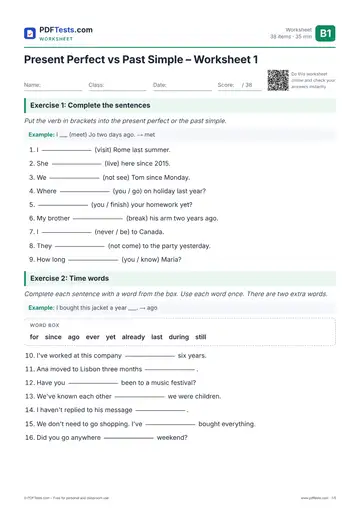
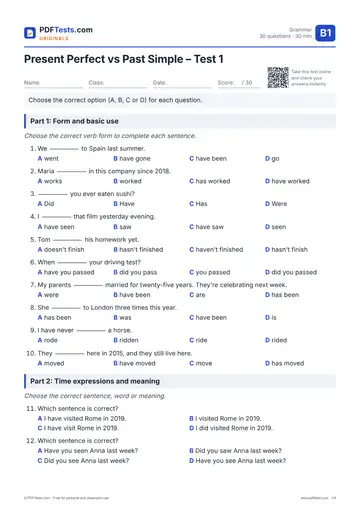
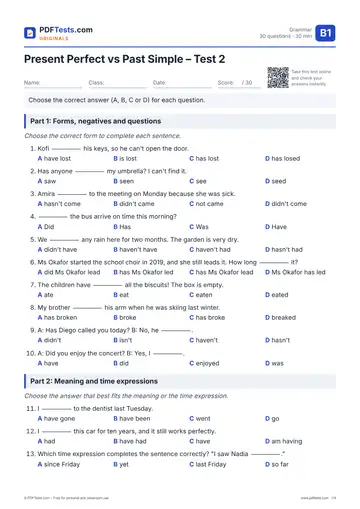
You now have the main rule: finished time means past simple; a connection to now means present perfect. The best way to make this automatic is practice with real sentences. Test yourself with our B1 Present Perfect vs Past Simple test, check your answers against the rules above, and then try Present Perfect vs Past Simple – Test 2 to see if your score improves.
Was this page helpful?
What was the problem?
Thank you for your feedback!