PDFTests Originals

Voz pasiva (Passive Voice) – Test 2

B2 Intermedio alto GramáticaInglés

Este test de gramática inglesa de nivel B2 comprueba si sabes formar y usar la voz pasiva en los distintos tiempos verbales, con verbos modales y en oraciones negativas e interrogativas. También incluye estructuras más avanzadas, como la causativa con have/get, el gerundio pasivo, la pasiva con verbos de opinión y declaración (reporting passive) y los verbos preposicionales, y termina con un breve texto de comprensión lectora. Es ideal para alumnos de nivel intermedio alto, candidatos a exámenes oficiales y profesores que buscan una ficha de repaso o evaluación lista para usar.
Preguntas
30
Tiempo
35 min
PDF
5 páginas
Soluciones
Incluidas
  • 100 % gratis
  • Sin registro
  • PDF A4 listo para imprimir
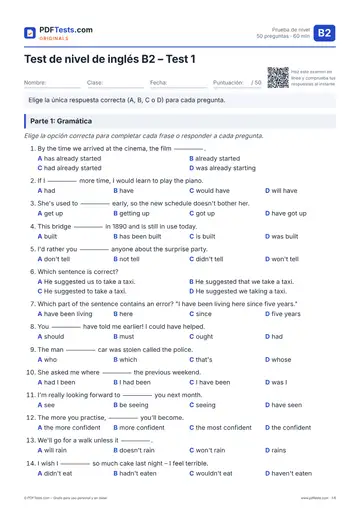
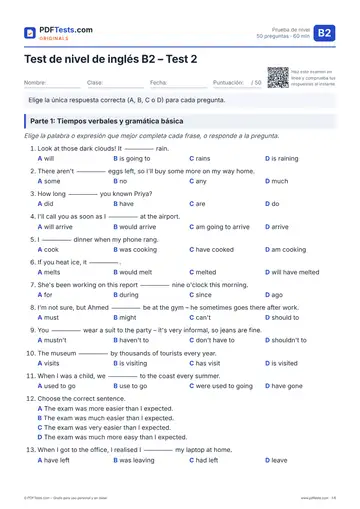
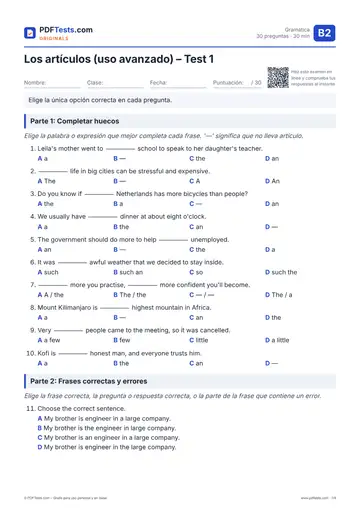
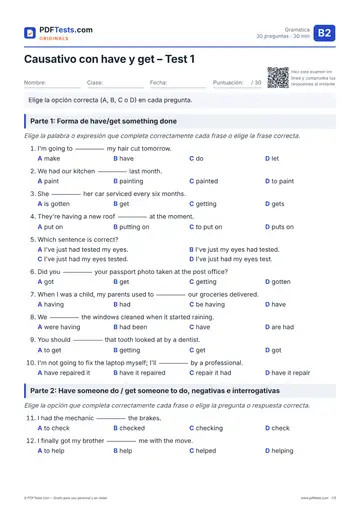
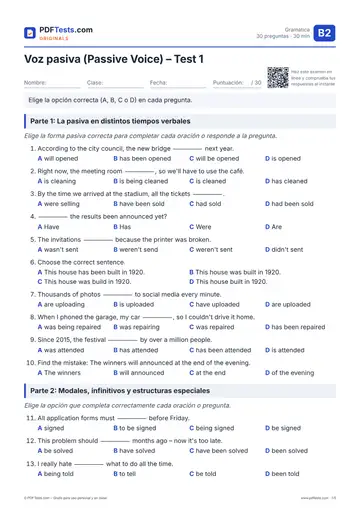
Vista previa de la página 1: Voz pasiva (Passive Voice) – Test 2 Abrir PDF

Haz el examen en línea

Elige la opción correcta (A, B, C o D) en cada pregunta. Elige tus respuestas y pulsa «Comprobar respuestas».

Parte 1: La pasiva en los distintos tiempos

Elige la forma pasiva correcta para completar cada oración.

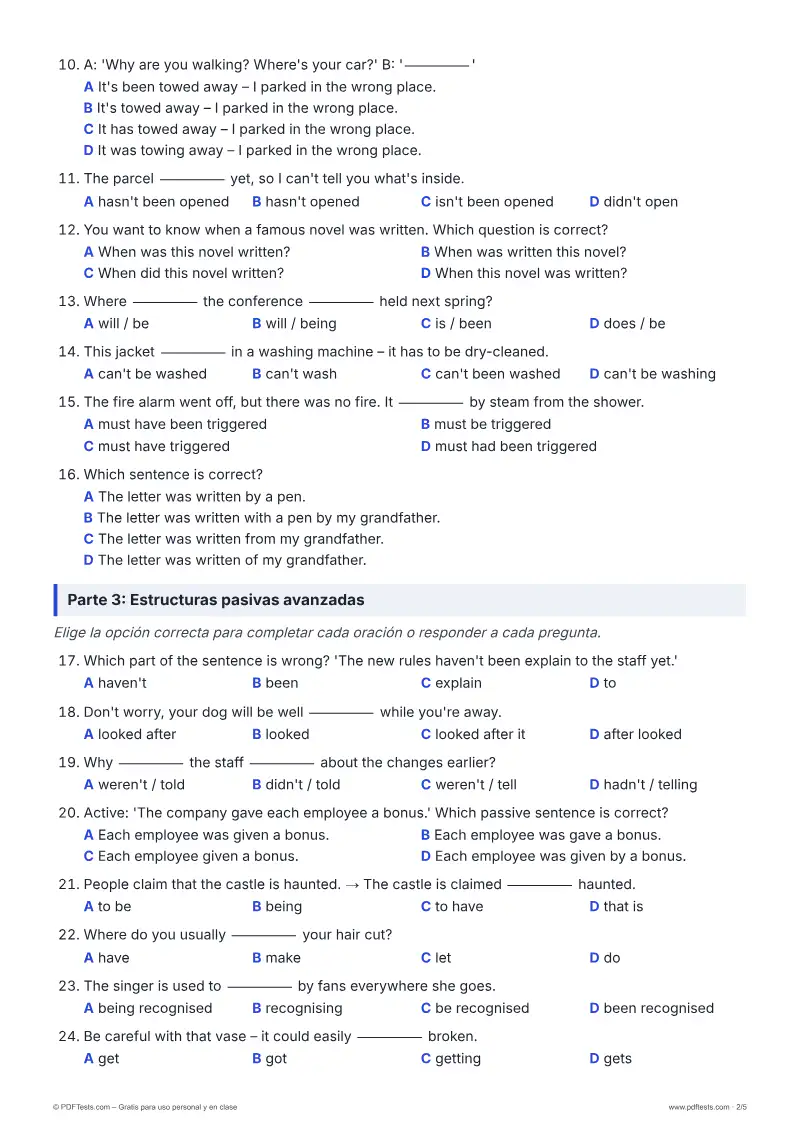
  1. Every December, the town's main square _____ with thousands of coloured lights.

  2. Please wait outside – the patient _____ by the doctor.

  3. The first email _____ in 1971, long before most people had a computer at home.

  4. Don't worry about the dishes – they _____.

  5. The road was closed for a week because a new water pipe _____ underneath it.

  6. Before the guests arrived, the tables _____ and the candles had been lit.

  7. The old cinema _____ into a supermarket – the plans were approved yesterday.

  8. Which part of the sentence is wrong? 'English is spoke in many countries as a second language.'

Parte 2: Negativas, interrogativas, modales y el agente

Elige la opción correcta en cada pregunta.

  1. Which sentence is grammatically correct?

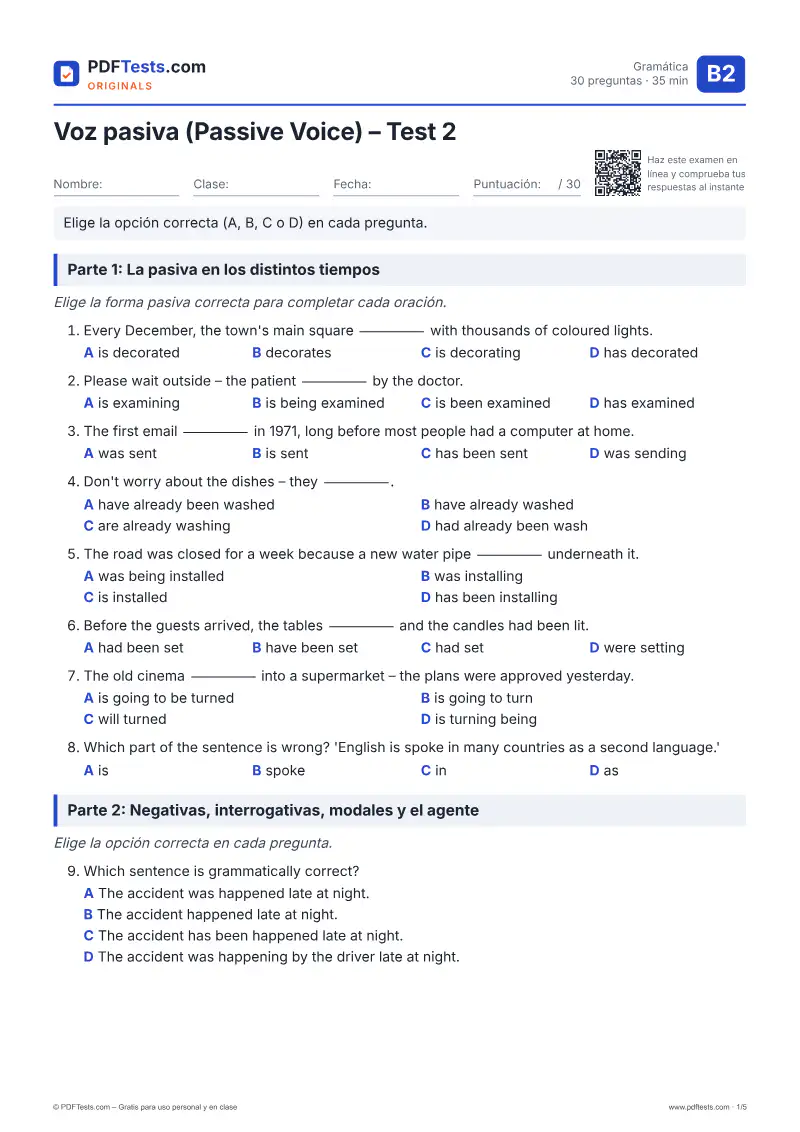
  2. A: 'Why are you walking? Where's your car?' B: '_____'

  3. The parcel _____ yet, so I can't tell you what's inside.

  4. You want to know when a famous novel was written. Which question is correct?

  5. Where _____ the conference _____ held next spring?

  6. This jacket _____ in a washing machine – it has to be dry-cleaned.

  7. The fire alarm went off, but there was no fire. It _____ by steam from the shower.

  8. Which sentence is correct?

Parte 3: Estructuras pasivas avanzadas

Elige la opción correcta para completar cada oración o responder a cada pregunta.

  1. Which part of the sentence is wrong? 'The new rules haven't been explain to the staff yet.'

  2. Don't worry, your dog will be well _____ while you're away.

  3. Why _____ the staff _____ about the changes earlier?

  4. Active: 'The company gave each employee a bonus.' Which passive sentence is correct?

  5. People claim that the castle is haunted. → The castle is claimed _____ haunted.

  6. Where do you usually _____ your hair cut?

  7. The singer is used to _____ by fans everywhere she goes.

  8. Be careful with that vase – it could easily _____ broken.

Parte 4: Lectura – la pasiva en contexto

Lee el texto y elige la mejor respuesta para cada pregunta.

For more than a century, the old map of the Velden valley was thought to have been destroyed in a fire. Last spring, however, it was found by chance in a box of papers that had been kept in the basement of the town museum since the 1950s.

The discovery was made by Priya Nandakumar, a student who was being paid to sort through the museum's archives during her summer holidays. 'I knew immediately that it was something special,' she says. 'It had been folded very carefully and wrapped in cloth.'

Experts have since confirmed that the map was drawn in 1874. It is believed to be the only surviving record of several villages that were later flooded when a dam was built. Because the paper had been damaged by damp, the museum had the map restored by a specialist team in another city.

The map is now being displayed in a special exhibition, and copies can be ordered online. The museum hopes that the original will be seen by thousands of visitors before it has to be returned to storage to protect it from light.

  1. According to the text, before last spring people believed that the map _____ in a fire.

  2. Which sentence means the same as 'the museum had the map restored by a specialist team'?

  3. 'It is believed to be the only surviving record...' Which sentence has the same meaning?

  4. What does 'a student who was being paid to sort through the museum's archives' tell us?

  5. Which phrase from the text contains a passive with a modal verb?

  6. Which question about the text is grammatically correct?

Vista previa

Sobre este examen

Este test de gramática inglesa de nivel B2 comprueba si sabes formar y usar la voz pasiva en los distintos tiempos verbales, con verbos modales y en oraciones negativas e interrogativas. También incluye estructuras más avanzadas, como la causativa con have/get, el gerundio pasivo, la pasiva con verbos de opinión y declaración (reporting passive) y los verbos preposicionales, y termina con un breve texto de comprensión lectora. Es ideal para alumnos de nivel intermedio alto, candidatos a exámenes oficiales y profesores que buscan una ficha de repaso o evaluación lista para usar.

Temas

La pasiva en los distintos tiemposNegativas e interrogativasPasiva con verbos modalesEl agente: by o withCausativa con have/getPasiva con verbos de opinión (reporting passive)Gerundio pasivoErrores frecuentes

Cómo usar este examen

  1. Descarga el PDF e imprímelo, o haz el examen en línea más abajo.
  2. Responde todas las preguntas sin diccionario y sin prisas.
  3. Comprueba tus respuestas y apunta los temas que debes repasar.

Notas para el profesor

Utilice este test después de trabajar las formas pasivas en los distintos tiempos verbales o como prueba diagnóstica antes de pasar a las estructuras con verbos de opinión y declaración. Los distractores recogen errores típicos del nivel B2: participios pasados incorrectos, omisión de 'be' o 'been', formas pasivas de verbos intransitivos, orden incorrecto de las palabras en las preguntas y confusión entre 'by' y 'with'. Como actividad de seguimiento, pida a los alumnos que reescriban el texto de lectura en voz activa y comenten qué versión suena más natural y por qué.