PDFTests Originals

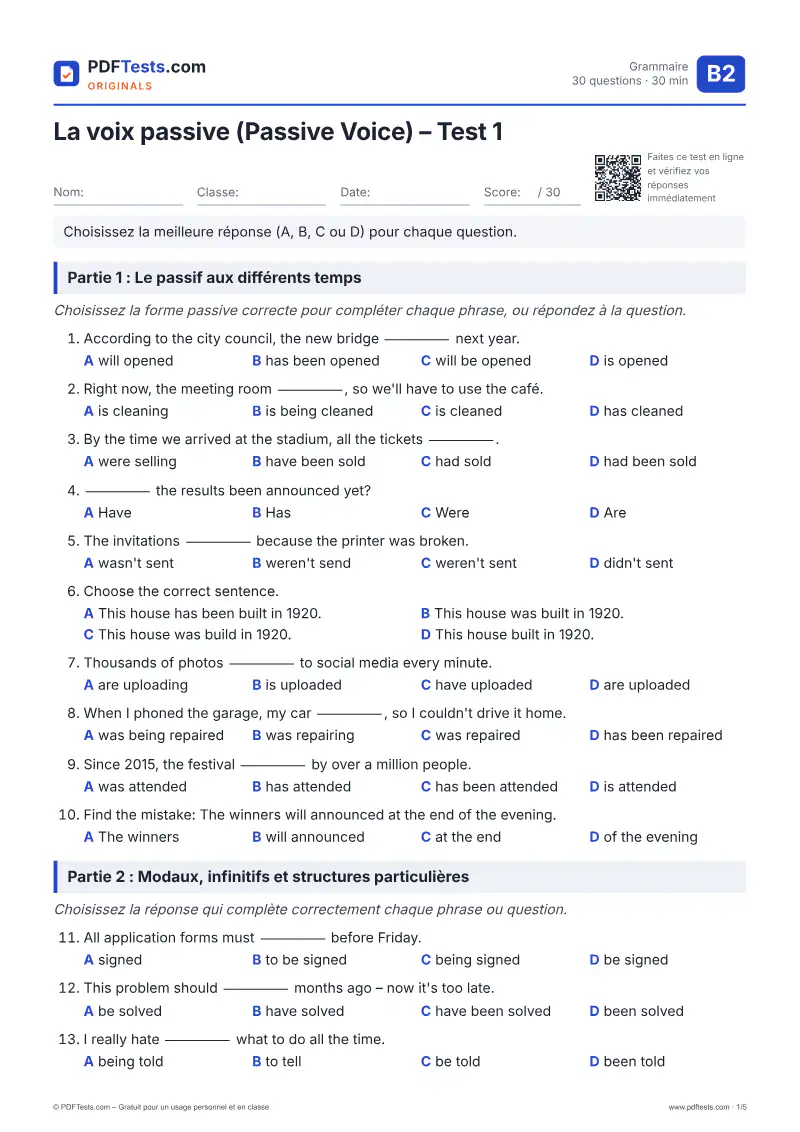
La voix passive (Passive Voice) – Test 1

B2 Intermédiaire avancé GrammaireAnglais

Ce test de grammaire anglaise de niveau B2 évalue la capacité des apprenants à former et à employer la voix passive (Passive Voice). Il couvre tous les temps principaux, les phrases négatives et interrogatives, le passif avec les modaux et à l'infinitif, les tournures impersonnelles comme « It is said that… », le passif avec « get » et la structure « have something done », et se termine par un texte de compréhension. Il convient aux apprenants de niveau intermédiaire avancé, aux candidats aux examens et aux enseignants qui recherchent une fiche de révision ou d'évaluation prête à l'emploi.
Questions
30
Durée
30 min
PDF
5 pages
Corrigé
Inclus
  • 100 % gratuit
  • Sans inscription
  • PDF A4 prêt à imprimer
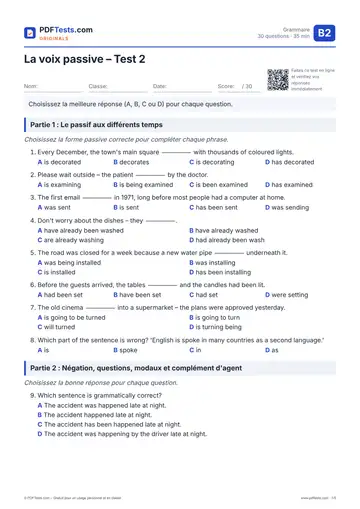
Aperçu de la page 1 : La voix passive (Passive Voice) – Test 1 Ouvrir le PDF

Faire le test en ligne

Choisissez la meilleure réponse (A, B, C ou D) pour chaque question. Choisissez vos réponses, puis cliquez sur « Vérifier mes réponses ».

Partie 1 : Le passif aux différents temps

Choisissez la forme passive correcte pour compléter chaque phrase, ou répondez à la question.

  1. According to the city council, the new bridge _____ next year.

  2. Right now, the meeting room _____, so we'll have to use the café.

  3. By the time we arrived at the stadium, all the tickets _____.

  4. _____ the results been announced yet?

  5. The invitations _____ because the printer was broken.

  6. Choose the correct sentence.

  7. Thousands of photos _____ to social media every minute.

  8. When I phoned the garage, my car _____, so I couldn't drive it home.

  9. Since 2015, the festival _____ by over a million people.

  10. Find the mistake: The winners will announced at the end of the evening.

Partie 2 : Modaux, infinitifs et structures particulières

Choisissez la réponse qui complète correctement chaque phrase ou question.

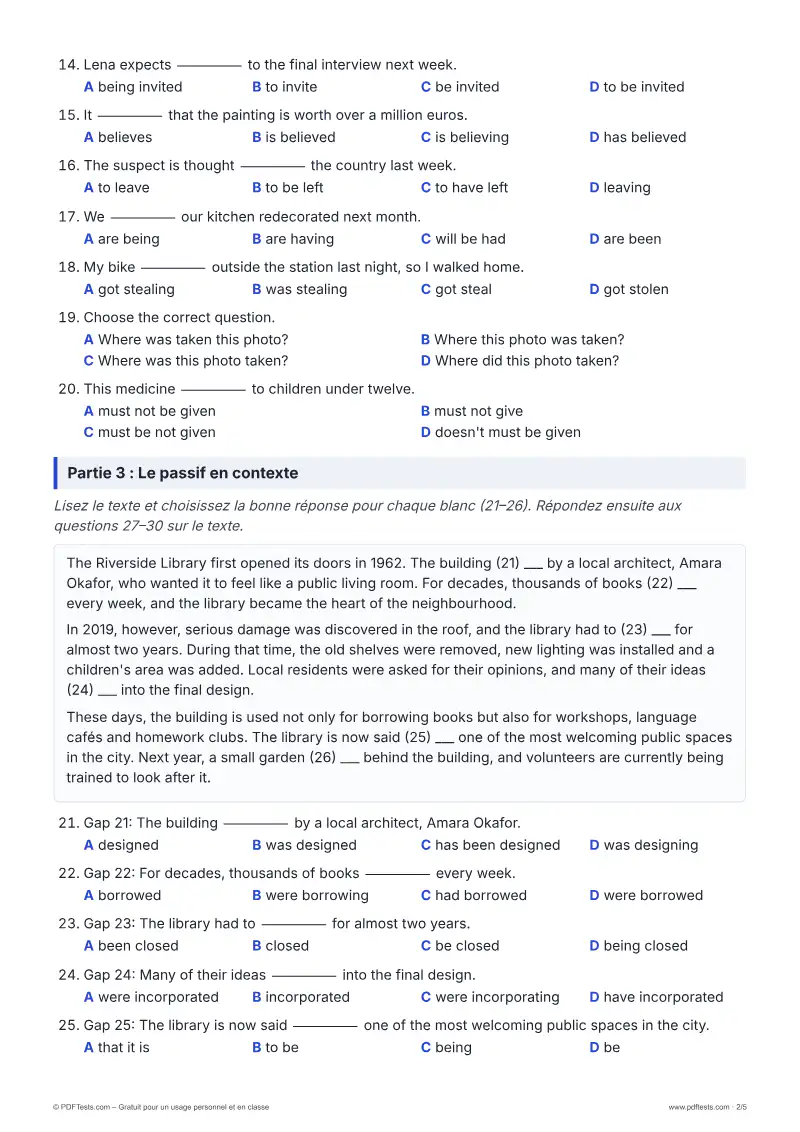
  1. All application forms must _____ before Friday.

  2. This problem should _____ months ago – now it's too late.

  3. I really hate _____ what to do all the time.

  4. Lena expects _____ to the final interview next week.

  5. It _____ that the painting is worth over a million euros.

  6. The suspect is thought _____ the country last week.

  7. We _____ our kitchen redecorated next month.

  8. My bike _____ outside the station last night, so I walked home.

  9. Choose the correct question.

  10. This medicine _____ to children under twelve.

Partie 3 : Le passif en contexte

Lisez le texte et choisissez la bonne réponse pour chaque blanc (21–26). Répondez ensuite aux questions 27–30 sur le texte.

The Riverside Library first opened its doors in 1962. The building (21) ___ by a local architect, Amara Okafor, who wanted it to feel like a public living room. For decades, thousands of books (22) ___ every week, and the library became the heart of the neighbourhood.

In 2019, however, serious damage was discovered in the roof, and the library had to (23) ___ for almost two years. During that time, the old shelves were removed, new lighting was installed and a children's area was added. Local residents were asked for their opinions, and many of their ideas (24) ___ into the final design.

These days, the building is used not only for borrowing books but also for workshops, language cafés and homework clubs. The library is now said (25) ___ one of the most welcoming public spaces in the city. Next year, a small garden (26) ___ behind the building, and volunteers are currently being trained to look after it.

  1. Gap 21: The building _____ by a local architect, Amara Okafor.

  2. Gap 22: For decades, thousands of books _____ every week.

  3. Gap 23: The library had to _____ for almost two years.

  4. Gap 24: Many of their ideas _____ into the final design.

  5. Gap 25: The library is now said _____ one of the most welcoming public spaces in the city.

  6. Gap 26: Next year, a small garden _____ behind the building.

  7. Why does the writer use the passive in 'serious damage was discovered in the roof'?

  8. Which sentence from the text is NOT in the passive voice?

  9. What does 'volunteers are currently being trained to look after it' mean?

  10. Which is the correct passive version of 'Residents asked the council to keep the library open'?

Aperçu

À propos de ce test

Ce test de grammaire anglaise de niveau B2 évalue la capacité des apprenants à former et à employer la voix passive (Passive Voice). Il couvre tous les temps principaux, les phrases négatives et interrogatives, le passif avec les modaux et à l'infinitif, les tournures impersonnelles comme « It is said that… », le passif avec « get » et la structure « have something done », et se termine par un texte de compréhension. Il convient aux apprenants de niveau intermédiaire avancé, aux candidats aux examens et aux enseignants qui recherchent une fiche de révision ou d'évaluation prête à l'emploi.

Thèmes abordés

Le passif aux différents tempsPhrases négatives et interrogativesLe passif avec les modauxInfinitif et gérondif passifsLe passif impersonnelHave something doneLe passif avec getLe passif en contexte (lecture)

Comment utiliser ce test

  1. Téléchargez le PDF et imprimez-le, ou faites le test en ligne ci-dessous.
  2. Répondez à toutes les questions sans dictionnaire et sans vous presser.
  3. Vérifiez vos réponses et notez les points à revoir.

Notes pour l’enseignant

Utilisez la partie 1 pour vérifier la formation du passif aux différents temps, la partie 2 pour les structures plus avancées du niveau B2, et la partie 3 pour voir si les élèves reconnaissent et emploient le passif dans un texte authentique. Les erreurs fréquentes visées sont notamment l'oubli de « be » (will announced), les participes passés erronés (was build), les formes actives qui changent le sens (are uploading) et la confusion entre « It is said that… » et « X is said to… ». En prolongement, demandez aux élèves de réécrire un court article de presse en mettant au passif les phrases dont l'agent est inconnu ou sans importance.