PDFTests Originals

La voix passive – Test 2

B2 Intermédiaire avancé GrammaireAnglais

Ce test de grammaire anglaise de niveau B2 évalue votre capacité à former et à employer la voix passive à différents temps, avec les verbes modaux, ainsi qu'à la forme négative et interrogative. Il aborde aussi des structures plus avancées comme le causatif have/get, le gérondif passif, le passif avec les verbes de déclaration (reporting passives) et les verbes prépositionnels, et se termine par un court texte de compréhension. Il s'adresse aux apprenants de niveau intermédiaire avancé, aux candidats aux examens et aux enseignants qui cherchent une fiche de révision ou d'évaluation prête à l'emploi.
Questions
30
Durée
35 min
PDF
5 pages
Corrigé
Inclus
  • 100 % gratuit
  • Sans inscription
  • PDF A4 prêt à imprimer
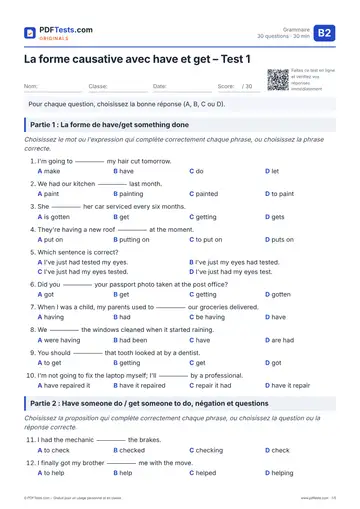
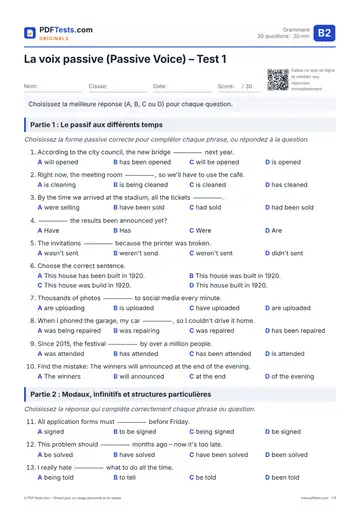
Aperçu de la page 1 : La voix passive – Test 2 Ouvrir le PDF

Faire le test en ligne

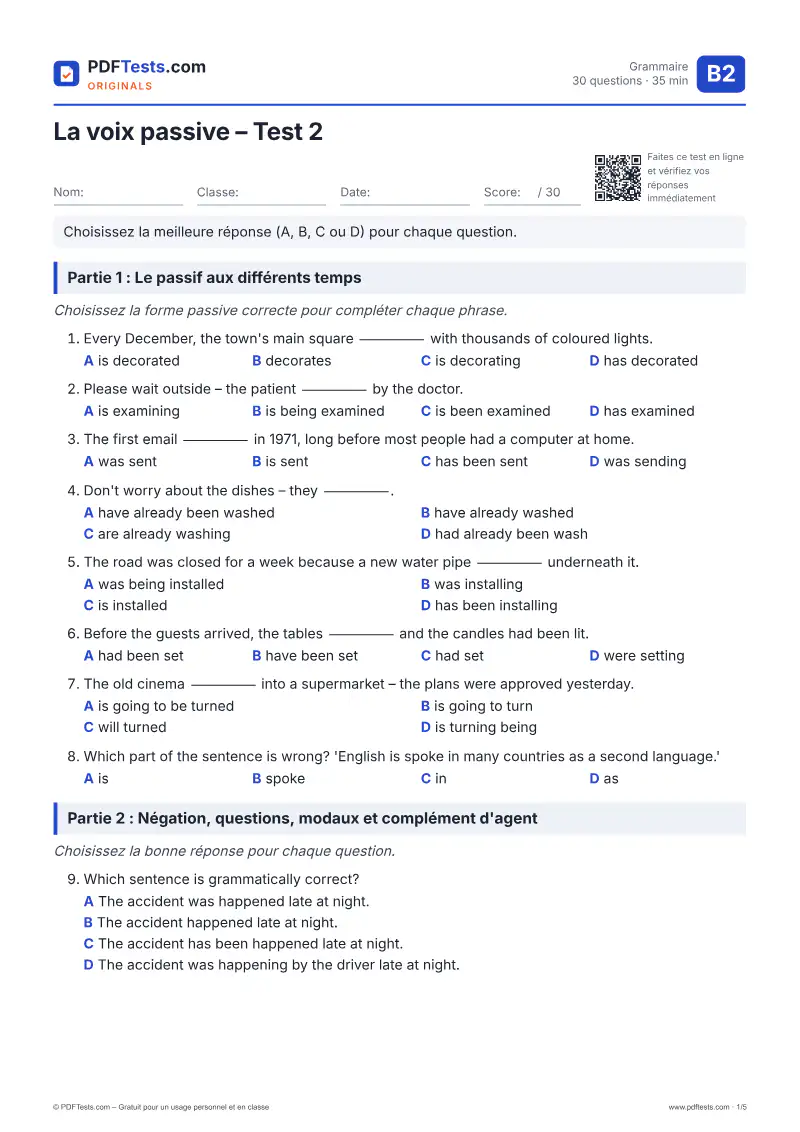
Choisissez la meilleure réponse (A, B, C ou D) pour chaque question. Choisissez vos réponses, puis cliquez sur « Vérifier mes réponses ».

Partie 1 : Le passif aux différents temps

Choisissez la forme passive correcte pour compléter chaque phrase.

  1. Every December, the town's main square _____ with thousands of coloured lights.

  2. Please wait outside – the patient _____ by the doctor.

  3. The first email _____ in 1971, long before most people had a computer at home.

  4. Don't worry about the dishes – they _____.

  5. The road was closed for a week because a new water pipe _____ underneath it.

  6. Before the guests arrived, the tables _____ and the candles had been lit.

  7. The old cinema _____ into a supermarket – the plans were approved yesterday.

  8. Which part of the sentence is wrong? 'English is spoke in many countries as a second language.'

Partie 2 : Négation, questions, modaux et complément d'agent

Choisissez la bonne réponse pour chaque question.

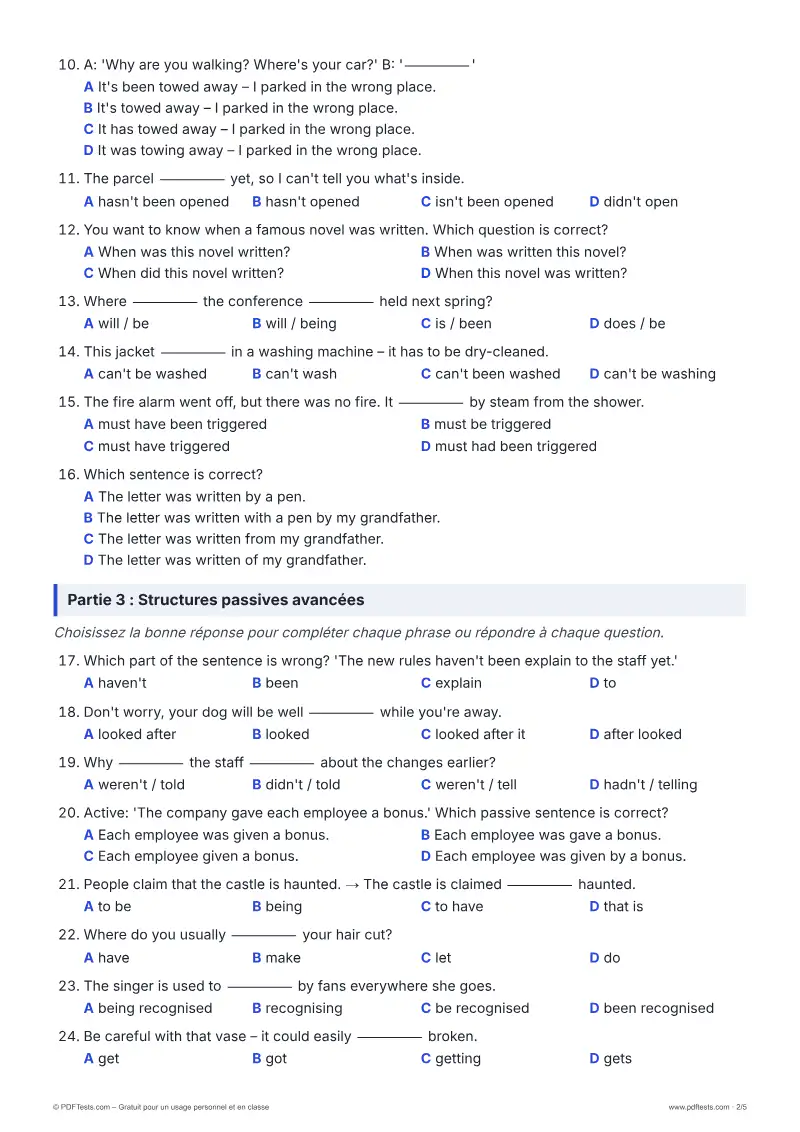
  1. Which sentence is grammatically correct?

  2. A: 'Why are you walking? Where's your car?' B: '_____'

  3. The parcel _____ yet, so I can't tell you what's inside.

  4. You want to know when a famous novel was written. Which question is correct?

  5. Where _____ the conference _____ held next spring?

  6. This jacket _____ in a washing machine – it has to be dry-cleaned.

  7. The fire alarm went off, but there was no fire. It _____ by steam from the shower.

  8. Which sentence is correct?

Partie 3 : Structures passives avancées

Choisissez la bonne réponse pour compléter chaque phrase ou répondre à chaque question.

  1. Which part of the sentence is wrong? 'The new rules haven't been explain to the staff yet.'

  2. Don't worry, your dog will be well _____ while you're away.

  3. Why _____ the staff _____ about the changes earlier?

  4. Active: 'The company gave each employee a bonus.' Which passive sentence is correct?

  5. People claim that the castle is haunted. → The castle is claimed _____ haunted.

  6. Where do you usually _____ your hair cut?

  7. The singer is used to _____ by fans everywhere she goes.

  8. Be careful with that vase – it could easily _____ broken.

Partie 4 : Compréhension écrite – le passif en contexte

Lisez le texte et choisissez la meilleure réponse à chaque question.

For more than a century, the old map of the Velden valley was thought to have been destroyed in a fire. Last spring, however, it was found by chance in a box of papers that had been kept in the basement of the town museum since the 1950s.

The discovery was made by Priya Nandakumar, a student who was being paid to sort through the museum's archives during her summer holidays. 'I knew immediately that it was something special,' she says. 'It had been folded very carefully and wrapped in cloth.'

Experts have since confirmed that the map was drawn in 1874. It is believed to be the only surviving record of several villages that were later flooded when a dam was built. Because the paper had been damaged by damp, the museum had the map restored by a specialist team in another city.

The map is now being displayed in a special exhibition, and copies can be ordered online. The museum hopes that the original will be seen by thousands of visitors before it has to be returned to storage to protect it from light.

  1. According to the text, before last spring people believed that the map _____ in a fire.

  2. Which sentence means the same as 'the museum had the map restored by a specialist team'?

  3. 'It is believed to be the only surviving record...' Which sentence has the same meaning?

  4. What does 'a student who was being paid to sort through the museum's archives' tell us?

  5. Which phrase from the text contains a passive with a modal verb?

  6. Which question about the text is grammatically correct?

Aperçu

À propos de ce test

Ce test de grammaire anglaise de niveau B2 évalue votre capacité à former et à employer la voix passive à différents temps, avec les verbes modaux, ainsi qu'à la forme négative et interrogative. Il aborde aussi des structures plus avancées comme le causatif have/get, le gérondif passif, le passif avec les verbes de déclaration (reporting passives) et les verbes prépositionnels, et se termine par un court texte de compréhension. Il s'adresse aux apprenants de niveau intermédiaire avancé, aux candidats aux examens et aux enseignants qui cherchent une fiche de révision ou d'évaluation prête à l'emploi.

Thèmes abordés

Le passif aux différents tempsNégation et questionsLe passif avec les modauxLe complément d'agent : by ou withLe causatif have/getLe passif avec les verbes de déclarationLe gérondif passifErreurs fréquentes

Comment utiliser ce test

  1. Téléchargez le PDF et imprimez-le, ou faites le test en ligne ci-dessous.
  2. Répondez à toutes les questions sans dictionnaire et sans vous presser.
  3. Vérifiez vos réponses et notez les points à revoir.

Notes pour l’enseignant

Utilisez ce test après avoir étudié les formes passives aux différents temps, ou comme évaluation diagnostique avant d'aborder les structures de discours rapporté. Les distracteurs ciblent les erreurs typiques du niveau B2 : participes passés erronés, oubli de « be » ou « been », passif de verbes intransitifs, mauvais ordre des mots dans les questions et confusion entre « by » et « with ». En prolongement, demandez aux élèves de réécrire le texte de lecture à la voix active, puis de discuter de la version qui paraît la plus naturelle et pourquoi.