PDFTests Originals

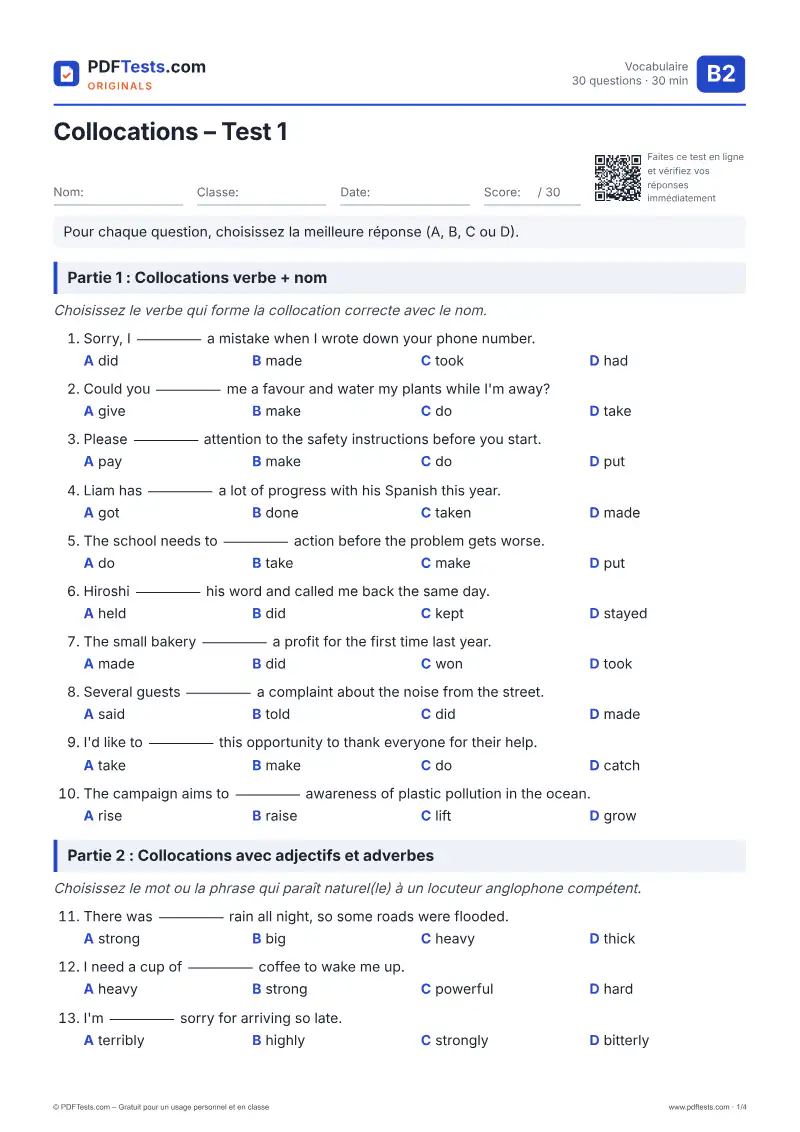
Collocations – Test 1

B2 Intermédiaire avancé VocabulaireAnglais

Ce test de vocabulaire de niveau B2 évalue votre maîtrise des collocations anglaises courantes : associations verbe + nom comme make progress et take action, combinaisons avec adjectifs et adverbes comme heavy rain et highly unlikely, ainsi que des collocations employées dans un texte de lecture. Il s'adresse aux apprenants de niveau intermédiaire avancé, aux candidats aux examens et aux enseignants qui souhaitent vérifier rapidement, sur papier, la maîtrise des associations de mots naturelles.
Questions
30
Durée
30 min
PDF
4 pages
Corrigé
Inclus
  • 100 % gratuit
  • Sans inscription
  • PDF A4 prêt à imprimer
Aperçu de la page 1 : Collocations – Test 1 Ouvrir le PDF

Faire le test en ligne

Pour chaque question, choisissez la meilleure réponse (A, B, C ou D). Choisissez vos réponses, puis cliquez sur « Vérifier mes réponses ».

Partie 1 : Collocations verbe + nom

Choisissez le verbe qui forme la collocation correcte avec le nom.

  1. Sorry, I _____ a mistake when I wrote down your phone number.

  2. Could you _____ me a favour and water my plants while I'm away?

  3. Please _____ attention to the safety instructions before you start.

  4. Liam has _____ a lot of progress with his Spanish this year.

  5. The school needs to _____ action before the problem gets worse.

  6. Hiroshi _____ his word and called me back the same day.

  7. The small bakery _____ a profit for the first time last year.

  8. Several guests _____ a complaint about the noise from the street.

  9. I'd like to _____ this opportunity to thank everyone for their help.

  10. The campaign aims to _____ awareness of plastic pollution in the ocean.

Partie 2 : Collocations avec adjectifs et adverbes

Choisissez le mot ou la phrase qui paraît naturel(le) à un locuteur anglophone compétent.

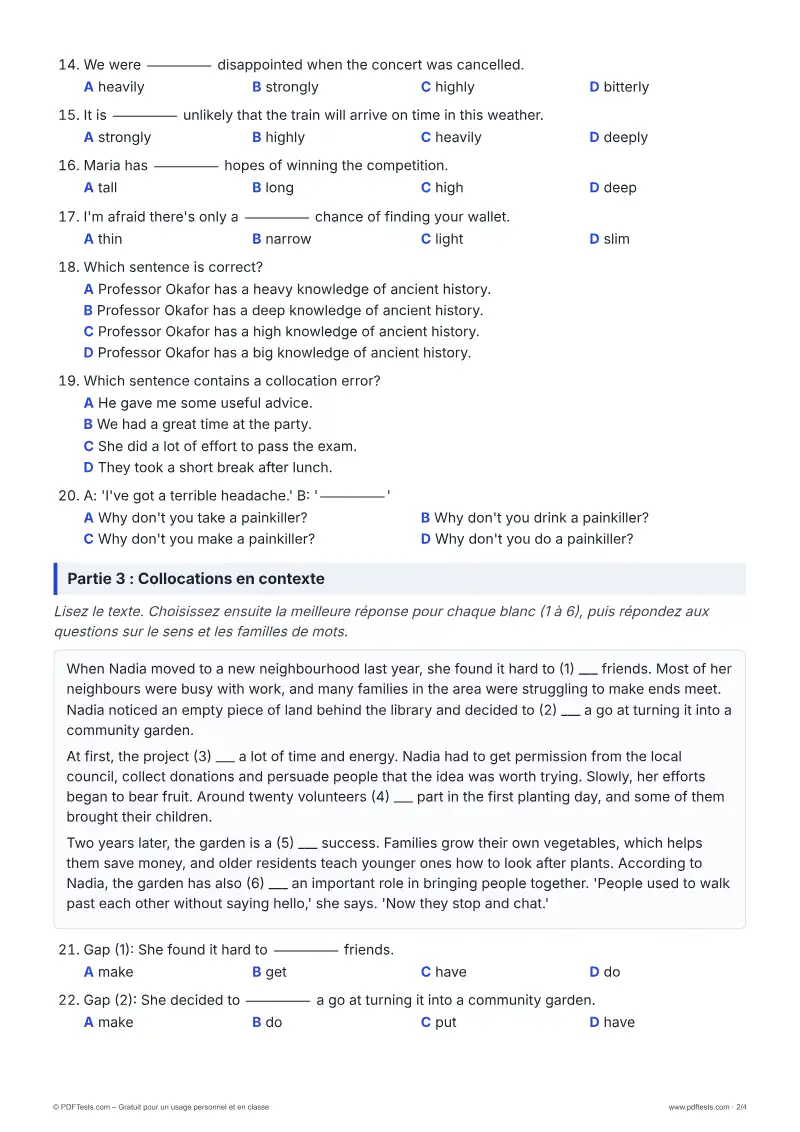
  1. There was _____ rain all night, so some roads were flooded.

  2. I need a cup of _____ coffee to wake me up.

  3. I'm _____ sorry for arriving so late.

  4. We were _____ disappointed when the concert was cancelled.

  5. It is _____ unlikely that the train will arrive on time in this weather.

  6. Maria has _____ hopes of winning the competition.

  7. I'm afraid there's only a _____ chance of finding your wallet.

  8. Which sentence is correct?

  9. Which sentence contains a collocation error?

  10. A: 'I've got a terrible headache.' B: '_____'

Partie 3 : Collocations en contexte

Lisez le texte. Choisissez ensuite la meilleure réponse pour chaque blanc (1 à 6), puis répondez aux questions sur le sens et les familles de mots.

When Nadia moved to a new neighbourhood last year, she found it hard to (1) ___ friends. Most of her neighbours were busy with work, and many families in the area were struggling to make ends meet. Nadia noticed an empty piece of land behind the library and decided to (2) ___ a go at turning it into a community garden.

At first, the project (3) ___ a lot of time and energy. Nadia had to get permission from the local council, collect donations and persuade people that the idea was worth trying. Slowly, her efforts began to bear fruit. Around twenty volunteers (4) ___ part in the first planting day, and some of them brought their children.

Two years later, the garden is a (5) ___ success. Families grow their own vegetables, which helps them save money, and older residents teach younger ones how to look after plants. According to Nadia, the garden has also (6) ___ an important role in bringing people together. 'People used to walk past each other without saying hello,' she says. 'Now they stop and chat.'

  1. Gap (1): She found it hard to _____ friends.

  2. Gap (2): She decided to _____ a go at turning it into a community garden.

  3. Gap (3): At first, the project _____ a lot of time and energy.

  4. Gap (4): Around twenty volunteers _____ part in the first planting day.

  5. Gap (5): Two years later, the garden is a _____ success.

  6. Gap (6): The garden has also _____ an important role in bringing people together.

  7. In the text, families 'struggling to make ends meet' are families who…

  8. In the text, 'her efforts began to bear fruit' means her efforts…

  9. Nadia is a very _____ person; she never gives up easily. (DETERMINE)

  10. Each volunteer made a _____ contribution to the project. (SIGNIFY)

Aperçu

À propos de ce test

Ce test de vocabulaire de niveau B2 évalue votre maîtrise des collocations anglaises courantes : associations verbe + nom comme make progress et take action, combinaisons avec adjectifs et adverbes comme heavy rain et highly unlikely, ainsi que des collocations employées dans un texte de lecture. Il s'adresse aux apprenants de niveau intermédiaire avancé, aux candidats aux examens et aux enseignants qui souhaitent vérifier rapidement, sur papier, la maîtrise des associations de mots naturelles.

Thèmes abordés

Collocations verbe + nomMake, do, take et haveCollocations adjectif + nomCollocations adverbe + adjectifExpressions idiomatiques en contexteFamilles de mots

Comment utiliser ce test

  1. Téléchargez le PDF et imprimez-le, ou faites le test en ligne ci-dessous.
  2. Répondez à toutes les questions sans dictionnaire et sans vous presser.
  3. Vérifiez vos réponses et notez les points à revoir.

Notes pour l’enseignant

Le test progresse des collocations verbe + nom les plus courantes vers les combinaisons avec adjectifs et adverbes, puis se termine par des collocations et des expressions idiomatiques dans un texte de lecture. Il cible les erreurs typiques des apprenants, comme l'emploi de do au lieu de make, de strong au lieu de heavy, ou la traduction mot à mot de collocations depuis la langue maternelle (par exemple « faire une erreur » traduit par do a mistake). En prolongement, demandez aux élèves de tenir un carnet de collocations classées par verbes clés, ou de rédiger un court paragraphe réutilisant cinq collocations sur lesquelles ils se sont trompés.