PDFTests Originals

Être and Avoir – Worksheet 1

A1 Beginner WorksheetFrench

This worksheet practises the two most important French verbs, être (to be) and avoir (to have), in the present tense. A1 learners conjugate both verbs, choose the right one in everyday expressions like avoir faim and avoir vingt ans, and form negatives and simple questions.
items
39
Time
30 min
PDF
5 pages
Answer key
Included
  • 100% free
  • No sign-up or email
  • Print-ready A4 PDF
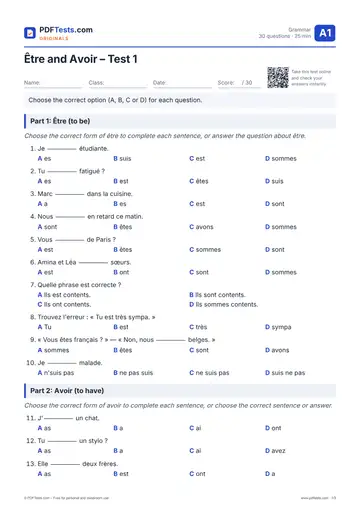
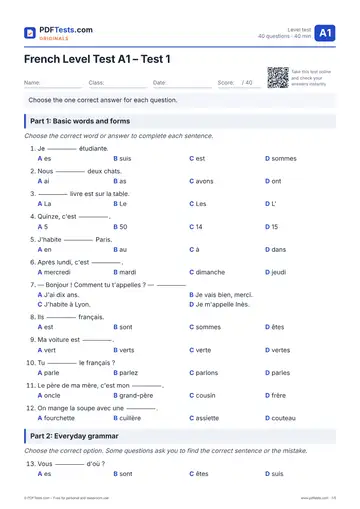
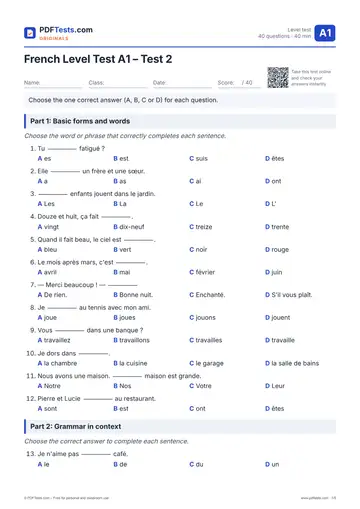
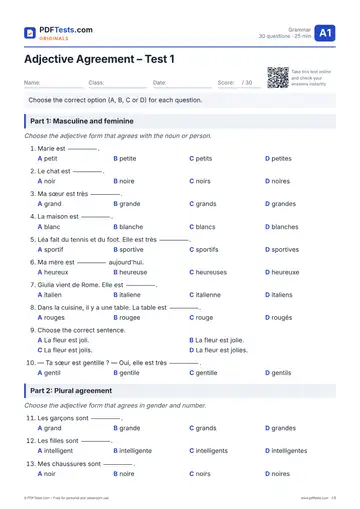
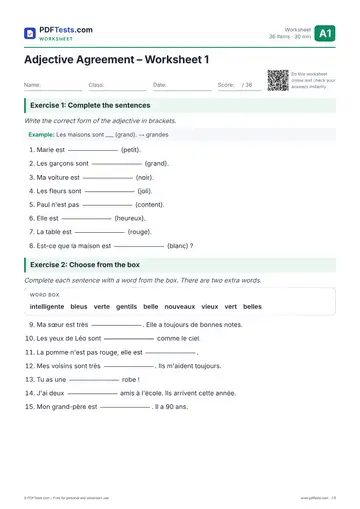
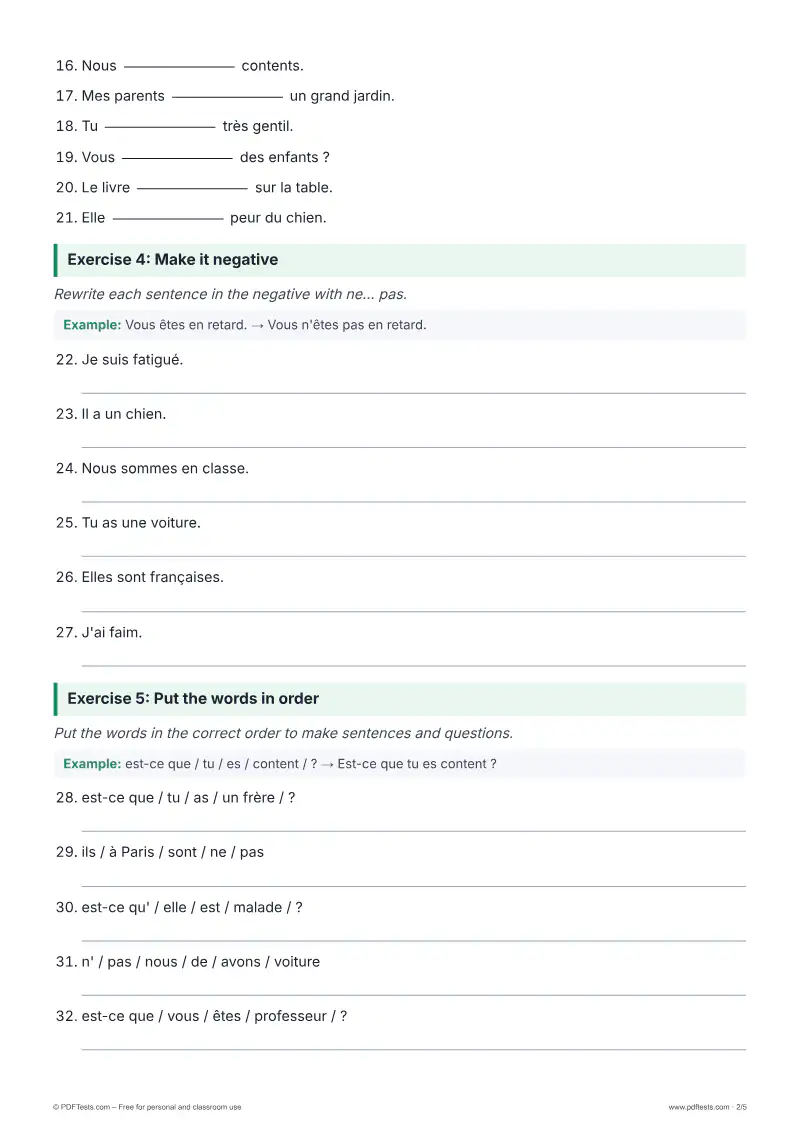
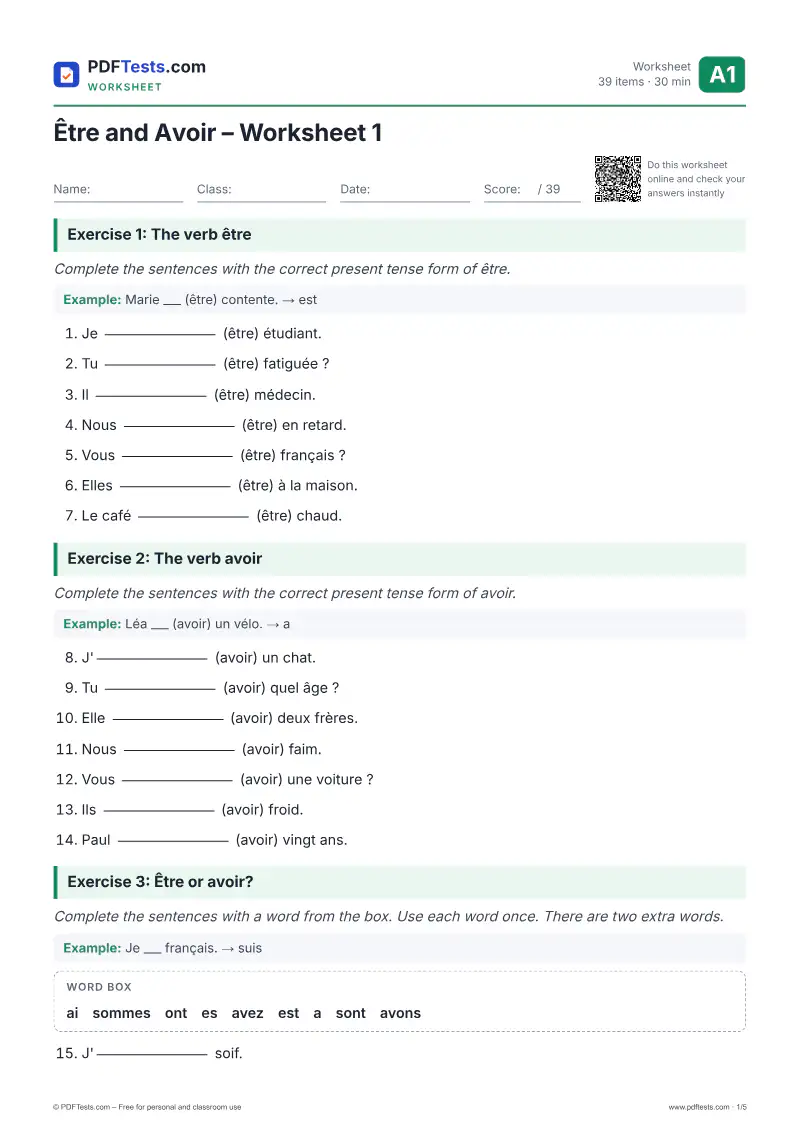
Preview of page 1 of Être and Avoir – Worksheet 1 Open PDF
New to this topic? Read the guide first: Être and Avoir: French Present Tense, Uses and Common Mistakes

Do the worksheet online

Type your answers, then press “Check my answers”. Alternative correct answers are accepted.

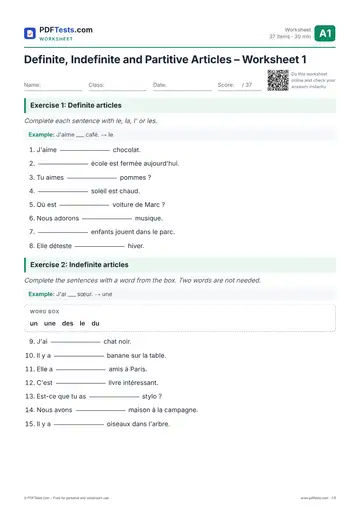
Exercise 1: The verb être

Complete the sentences with the correct present tense form of être.

Example: Marie ___ (être) contente. → est

  1. Je (être) étudiant.

  2. Tu (être) fatiguée ?

  3. Il (être) médecin.

  4. Nous (être) en retard.

  5. Vous (être) français ?

  6. Elles (être) à la maison.

  7. Le café (être) chaud.

Exercise 2: The verb avoir

Complete the sentences with the correct present tense form of avoir.

Example: Léa ___ (avoir) un vélo. → a

  1. J' (avoir) un chat.

  2. Tu (avoir) quel âge ?

  3. Elle (avoir) deux frères.

  4. Nous (avoir) faim.

  5. Vous (avoir) une voiture ?

  6. Ils (avoir) froid.

  7. Paul (avoir) vingt ans.

Exercise 3: Être or avoir?

Complete the sentences with a word from the box. Use each word once. There are two extra words.

Example: Je ___ français. → suis

Word box aisommesontesavezestasontavons

  1. J' soif.

  2. Nous contents.

  3. Mes parents un grand jardin.

  4. Tu très gentil.

  5. Vous des enfants ?

  6. Le livre sur la table.

  7. Elle peur du chien.

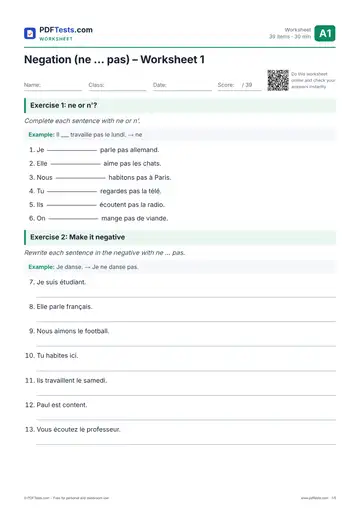
Exercise 4: Make it negative

Rewrite each sentence in the negative with ne… pas.

Example: Vous êtes en retard. → Vous n'êtes pas en retard.

  1. Je suis fatigué.

  2. Il a un chien.

  3. Nous sommes en classe.

  4. Tu as une voiture.

  5. Elles sont françaises.

  6. J'ai faim.

Exercise 5: Put the words in order

Put the words in the correct order to make sentences and questions.

Example: est-ce que / tu / es / content / ? → Est-ce que tu es content ?

  1. est-ce que / tu / as / un frère / ?

  2. ils / à Paris / sont / ne / pas

  3. est-ce qu' / elle / est / malade / ?

  4. n' / pas / nous / de / avons / voiture

  5. est-ce que / vous / êtes / professeur / ?

  6. ma sœur / ans / a / douze

Exercise 6: Find the mistake

Each sentence has one mistake. Write the correct sentence.

Example: Je suis faim. → J'ai faim.

  1. Je suis vingt ans.

  2. Nous avons fatigués.

  3. Tu est mon ami.

  4. Ils ont pas de chat.

  5. Elle n'a pas une sœur.

  6. Vous sont dans le bus.

Was this page helpful?

Report a mistake

Spotted a wrong answer, a typo or an unclear explanation? Tell us and we will fix it.

Preview

About this test

Printable A1 French worksheet on être and avoir in the present tense: conjugation, negatives, questions and common mistakes, with answers.

Topics covered

être (present tense)avoir (present tense)Negatives with ne… pasQuestions with est-ce queExpressions with avoir (age, hunger, cold)

Notes for teachers

Start with the two conjugation drills as a quick warm-up, then move to the mixed exercises where learners must choose between the verbs. Typical mistakes include using être for age (je suis vingt ans), forgetting elision (je n'ai, il n'est) and keeping un/une after a negative avoir (il n'a pas un chien instead of de). As a follow-up, have pairs interview each other with est-ce que questions about age, family and pets.

All French A1 tests →