PDFTests Originals

Passé Composé vs Imparfait – Test 2

A2 Elementary GrammarFrench

This A2 French grammar test checks whether learners can form and choose between the passé composé and the imparfait. It covers auxiliaries, past participle agreement, negatives, questions, habits, descriptions, interrupted actions and sequences of events, with a short reading text. It suits learners at A2 level, and teachers who need a ready-to-print practice or assessment sheet.
Questions
30
Time
30 min
PDF
5 pages
Answer key
Included
  • 100% free
  • No sign-up or email
  • Print-ready A4 PDF
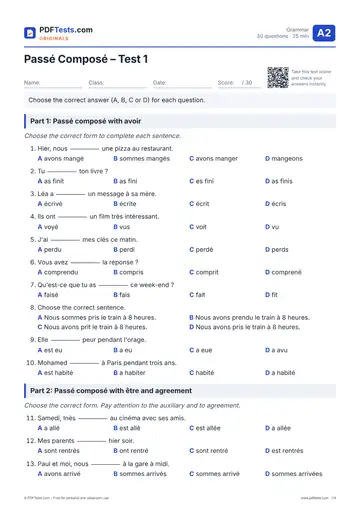
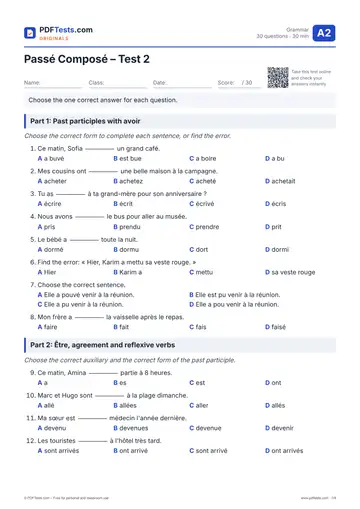
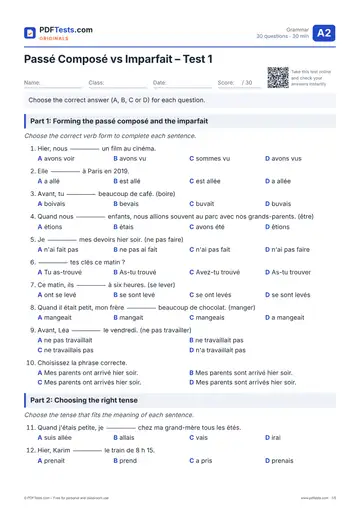
Preview of page 1 of Passé Composé vs Imparfait – Test 2 Open PDF
New to this topic? Read the guide first: Passé Composé vs Imparfait: When to Use Each French Past Tense

Take the test online

Choose the one correct option for each question. Choose your answers, then press “Check my answers”.

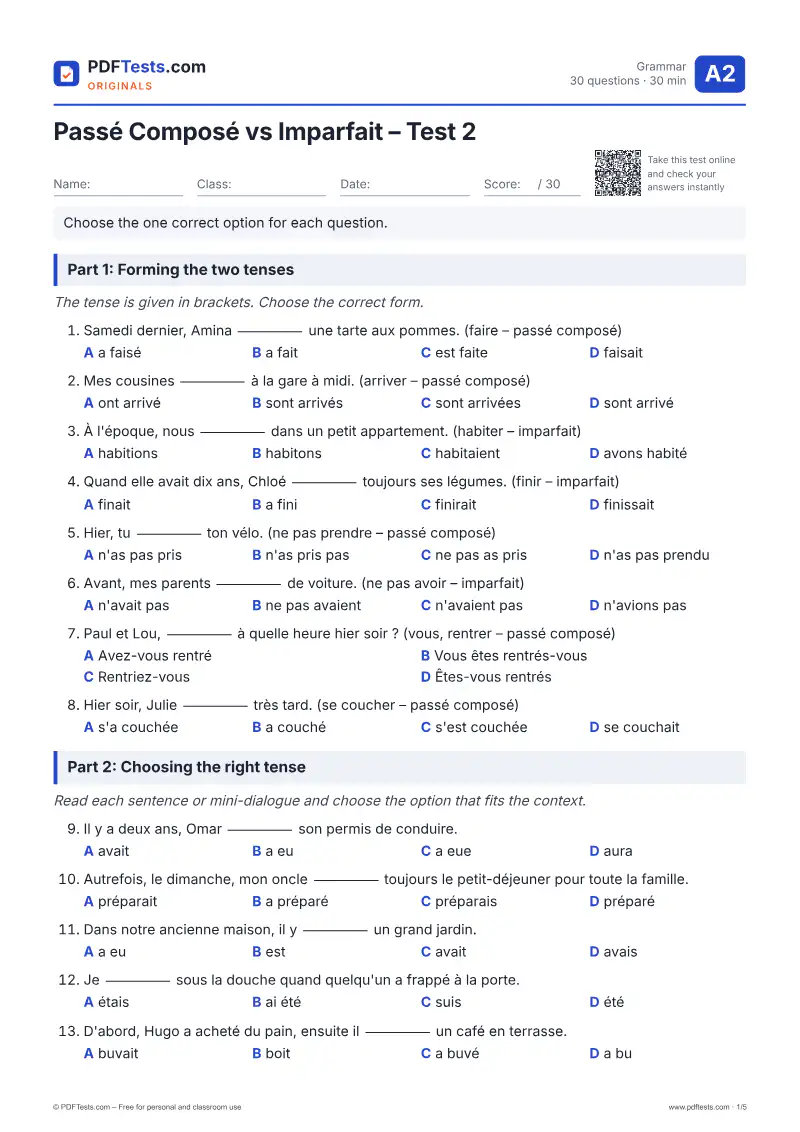
Part 1: Forming the two tenses

The tense is given in brackets. Choose the correct form.

  1. Samedi dernier, Amina _____ une tarte aux pommes. (faire – passé composé)

  2. Mes cousines _____ à la gare à midi. (arriver – passé composé)

  3. À l'époque, nous _____ dans un petit appartement. (habiter – imparfait)

  4. Quand elle avait dix ans, Chloé _____ toujours ses légumes. (finir – imparfait)

  5. Hier, tu _____ ton vélo. (ne pas prendre – passé composé)

  6. Avant, mes parents _____ de voiture. (ne pas avoir – imparfait)

  7. Paul et Lou, _____ à quelle heure hier soir ? (vous, rentrer – passé composé)

  8. Hier soir, Julie _____ très tard. (se coucher – passé composé)

Part 2: Choosing the right tense

Read each sentence or mini-dialogue and choose the option that fits the context.

  1. Il y a deux ans, Omar _____ son permis de conduire.

  2. Autrefois, le dimanche, mon oncle _____ toujours le petit-déjeuner pour toute la famille.

  3. Dans notre ancienne maison, il y _____ un grand jardin.

  4. Je _____ sous la douche quand quelqu'un a frappé à la porte.

  5. D'abord, Hugo a acheté du pain, ensuite il _____ un café en terrasse.

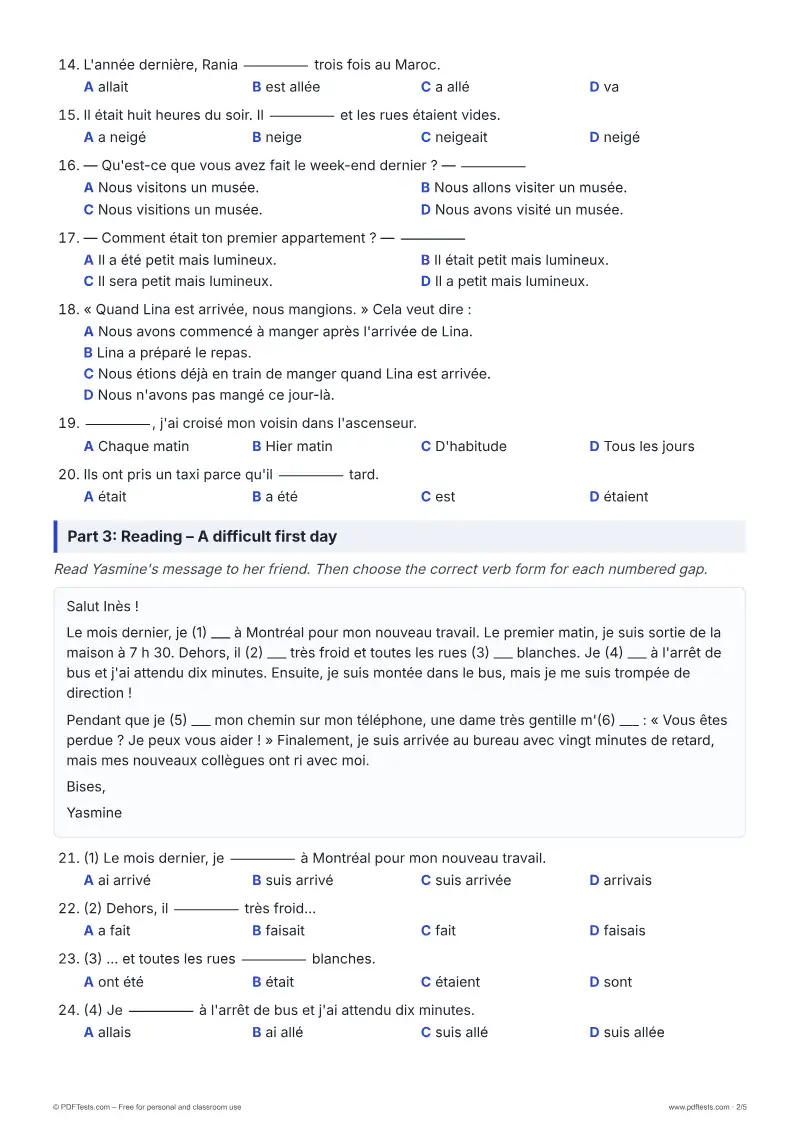
  6. L'année dernière, Rania _____ trois fois au Maroc.

  7. Il était huit heures du soir. Il _____ et les rues étaient vides.

  8. — Qu'est-ce que vous avez fait le week-end dernier ? — _____

  9. — Comment était ton premier appartement ? — _____

  10. « Quand Lina est arrivée, nous mangions. » Cela veut dire :

  11. _____, j'ai croisé mon voisin dans l'ascenseur.

  12. Ils ont pris un taxi parce qu'il _____ tard.

Part 3: Reading – A difficult first day

Read Yasmine's message to her friend. Then choose the correct verb form for each numbered gap.

Salut Inès !

Le mois dernier, je (1) ___ à Montréal pour mon nouveau travail. Le premier matin, je suis sortie de la maison à 7 h 30. Dehors, il (2) ___ très froid et toutes les rues (3) ___ blanches. Je (4) ___ à l'arrêt de bus et j'ai attendu dix minutes. Ensuite, je suis montée dans le bus, mais je me suis trompée de direction !

Pendant que je (5) ___ mon chemin sur mon téléphone, une dame très gentille m'(6) ___ : « Vous êtes perdue ? Je peux vous aider ! » Finalement, je suis arrivée au bureau avec vingt minutes de retard, mais mes nouveaux collègues ont ri avec moi.

Bises,

Yasmine

  1. (1) Le mois dernier, je _____ à Montréal pour mon nouveau travail.

  2. (2) Dehors, il _____ très froid…

  3. (3) … et toutes les rues _____ blanches.

  4. (4) Je _____ à l'arrêt de bus et j'ai attendu dix minutes.

  5. (5) Pendant que je _____ mon chemin sur mon téléphone…

  6. (6) … une dame très gentille m'_____ : « Vous êtes perdue ? »

Part 4: Spot the mistake

Find the part of the sentence that contains a mistake, or choose the correct sentence.

  1. Trouvez l'erreur : « Pendant les vacances, nous nous levions tard et nous avons nagé tous les après-midi. »

  2. Quelle phrase est correcte ?

  3. Trouvez l'erreur : « Quand je suis entré dans la salle, les invités ont été déjà là et la musique jouait. »

  4. Trouvez l'erreur : « Ce matin, Nadia a écrit un message, puis elle a mettu son manteau et elle est sortie. »

Was this page helpful?

Report a mistake

Spotted a wrong answer, a typo or an unclear explanation? Tell us and we will fix it.

Practise with a worksheet: Passé Composé vs Imparfait – Worksheet 1

Preview

About this test

This A2 French grammar test checks whether learners can form and choose between the passé composé and the imparfait. It covers auxiliaries, past participle agreement, negatives, questions, habits, descriptions, interrupted actions and sequences of events, with a short reading text. It suits learners at A2 level, and teachers who need a ready-to-print practice or assessment sheet.

Topics covered

Passé composé formsImparfait formsÊtre vs avoir as auxiliaryNegatives and questions in the pastHabits and descriptionsInterrupted actionsSequences of eventsError correction

How to use this test

  1. Download the PDF and print it, or take the test online below.
  2. Answer every question without a dictionary or time pressure.
  3. Check your answers and note the topics you need to review.

Notes for teachers

Part 1 tests form only. The tense is given in brackets, so students can focus on auxiliaries, participles, agreement and negation. Parts 2 to 4 ask students to choose the tense from context. They target typical A2 errors: using the passé composé for habits or descriptions, using 'avoir' with verbs of movement, missing agreement with 'être', and invented participles such as 'mettu'. For follow-up, ask students to rewrite the reading text from another character's point of view. They should keep the imparfait for the scene and use the passé composé for the events.