PDFTests Originals

Passé Composé vs Imparfait – Worksheet 1

A2 Elementary WorksheetFrench

This A2 worksheet helps learners of French form the imparfait and the passé composé and choose between them. It covers habits and descriptions in the past, single completed actions, interrupted actions, negatives and questions. It suits teenage and adult learners in class or at home.
items
40
Time
35 min
PDF
5 pages
Answer key
Included
  • 100% free
  • No sign-up or email
  • Print-ready A4 PDF
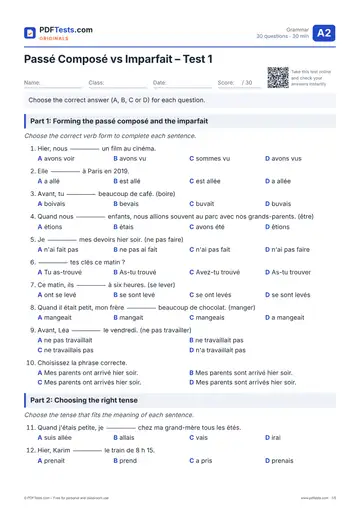
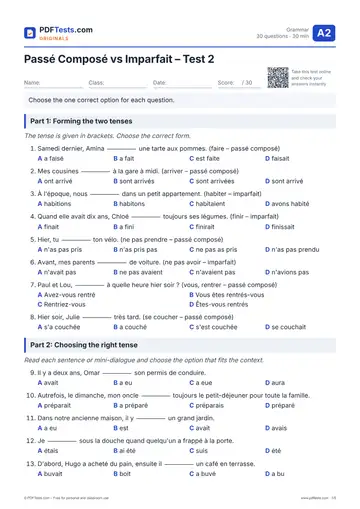
Preview of page 1 of Passé Composé vs Imparfait – Worksheet 1 Open PDF
New to this topic? Read the guide first: Passé Composé vs Imparfait: When to Use Each French Past Tense

Do the worksheet online

Type your answers, then press “Check my answers”. Alternative correct answers are accepted.

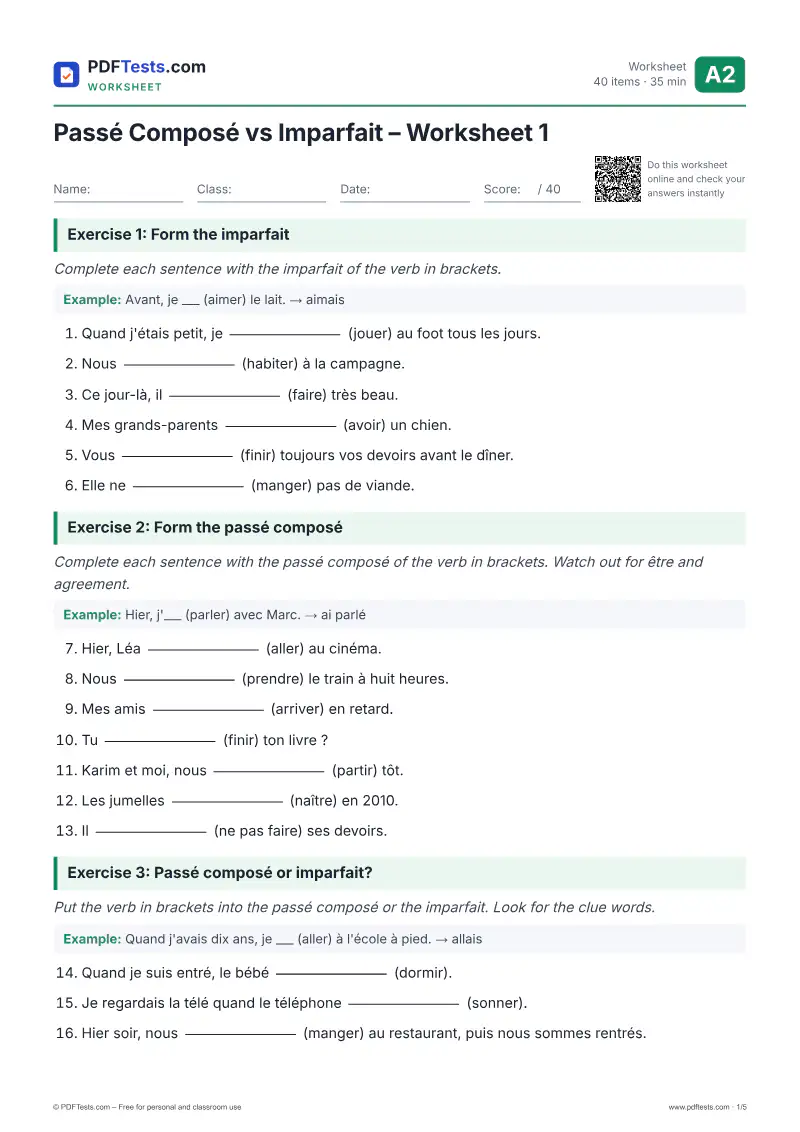
Exercise 1: Form the imparfait

Complete each sentence with the imparfait of the verb in brackets.

Example: Avant, je ___ (aimer) le lait. → aimais

  1. Quand j'étais petit, je (jouer) au foot tous les jours.

  2. Nous (habiter) à la campagne.

  3. Ce jour-là, il (faire) très beau.

  4. Mes grands-parents (avoir) un chien.

  5. Vous (finir) toujours vos devoirs avant le dîner.

  6. Elle ne (manger) pas de viande.

Exercise 2: Form the passé composé

Complete each sentence with the passé composé of the verb in brackets. Watch out for être and agreement.

Example: Hier, j'___ (parler) avec Marc. → ai parlé

  1. Hier, Léa (aller) au cinéma.

  2. Nous (prendre) le train à huit heures.

  3. Mes amis (arriver) en retard.

  4. Tu (finir) ton livre ?

  5. Karim et moi, nous (partir) tôt.

  6. Les jumelles (naître) en 2010.

  7. Il (ne pas faire) ses devoirs.

Exercise 3: Passé composé or imparfait?

Put the verb in brackets into the passé composé or the imparfait. Look for the clue words.

Example: Quand j'avais dix ans, je ___ (aller) à l'école à pied. → allais

  1. Quand je suis entré, le bébé (dormir).

  2. Je regardais la télé quand le téléphone (sonner).

  3. Hier soir, nous (manger) au restaurant, puis nous sommes rentrés.

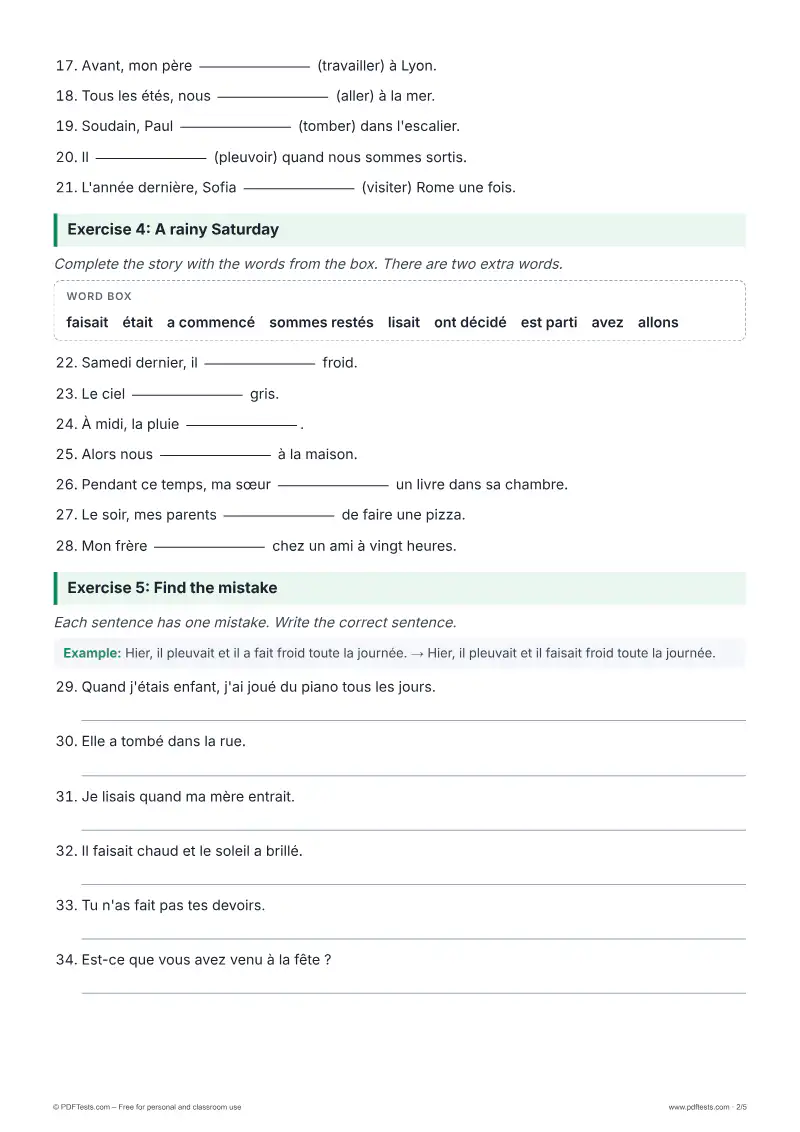
  4. Avant, mon père (travailler) à Lyon.

  5. Tous les étés, nous (aller) à la mer.

  6. Soudain, Paul (tomber) dans l'escalier.

  7. Il (pleuvoir) quand nous sommes sortis.

  8. L'année dernière, Sofia (visiter) Rome une fois.

Exercise 4: A rainy Saturday

Complete the story with the words from the box. There are two extra words.

Word box faisaitétaita commencésommes restéslisaitont décidéest partiavezallons

  1. Samedi dernier, il froid.

  2. Le ciel gris.

  3. À midi, la pluie .

  4. Alors nous à la maison.

  5. Pendant ce temps, ma sœur un livre dans sa chambre.

  6. Le soir, mes parents de faire une pizza.

  7. Mon frère chez un ami à vingt heures.

Exercise 5: Find the mistake

Each sentence has one mistake. Write the correct sentence.

Example: Hier, il pleuvait et il a fait froid toute la journée. → Hier, il pleuvait et il faisait froid toute la journée.

  1. Quand j'étais enfant, j'ai joué du piano tous les jours.

  2. Elle a tombé dans la rue.

  3. Je lisais quand ma mère entrait.

  4. Il faisait chaud et le soleil a brillé.

  5. Tu n'as fait pas tes devoirs.

  6. Est-ce que vous avez venu à la fête ?

Exercise 6: Negatives and questions

Put the words in the correct order to make sentences.

Example: ai / n' / je / pas / dormi → Je n'ai pas dormi.

  1. je / n' / ai / pas / mangé / ce matin

  2. est-ce que / tu / as / vu / Marie / ?

  3. quand / est-ce qu' / ils / sont / arrivés / ?

  4. nous / ne / sommes / pas / sortis / hier soir

  5. où / est-ce que / tu / habitais / quand / tu / étais / petit / ?

  6. pendant que / je / dormais / est arrivé / mon frère

Was this page helpful?

Report a mistake

Spotted a wrong answer, a typo or an unclear explanation? Tell us and we will fix it.

Preview

About this test

Printable A2 French worksheet on passé composé vs imparfait: forms, uses, negatives and questions, with answers.

Topics covered

Imparfait formsPassé composé with avoir and êtreBackground vs completed actionsNegatives in the pastQuestions in the past

Notes for teachers

Start by reviewing time clues such as 'tous les jours', 'avant' and 'quand j'étais petit' (imparfait) against 'hier', 'soudain' and 'une fois' (passé composé). Learners often forget être verbs and past participle agreement, and they place 'pas' after the participle. In Exercise 3, ask students to underline the clue word before choosing the tense. As a follow-up, have pairs write a short story about a childhood memory using both tenses.

All French A2 tests →