The passé composé and the imparfait are both French past tenses, but they do different jobs. The passé composé tells you what happened: completed actions and events that move a story forward. The imparfait describes how things were: background, descriptions, habits and actions in progress.
The core idea: event or background
Imagine your past as a film. The imparfait is the scenery and the music: the weather, the place, what people were doing, what usually happened. The passé composé is the action: someone arrives, the phone rings, the train leaves.
- Hier, j’ai mangé une pizza. – Yesterday, I ate a pizza. (one finished event)
- Quand j’étais petit, je mangeais souvent des pizzas. – When I was little, I often ate pizza. (a habit)
Ask yourself: is this a finished event, or is it the background or a habit? That one question solves most choices.
When to use the passé composé
1. Completed actions at a specific time
- Samedi, nous avons visité le Louvre. – On Saturday, we visited the Louvre.
- Elle est partie à 8 heures. – She left at 8 o’clock.
2. A sequence of actions
Each action is finished before the next one starts.
- Je me suis levé, j’ai pris une douche et je suis sorti. – I got up, had a shower and went out.
3. Sudden events and interruptions
- Tout à coup, la lumière s’est éteinte. – Suddenly, the light went out.
4. Actions with a fixed duration or a number of times
Even a long action uses the passé composé if it has clear limits.
- J’ai attendu le bus pendant une heure. – I waited for the bus for an hour.
- Il a vu ce film trois fois. – He saw this film three times.
When to use the imparfait
1. Descriptions and background
Use it for weather, time, age, places, people and feelings.
- Il faisait beau et la plage était calme. – The weather was nice and the beach was quiet.
- J’avais dix ans et j’étais très timide. – I was ten and I was very shy.
2. Habits and repeated actions
- Le dimanche, on allait chez ma grand-mère. – On Sundays, we used to go to my grandmother’s.
- Avant, je ne buvais pas de café. – Before, I didn’t drink coffee.
3. Actions in progress
The imparfait often translates English was/were + -ing.
- À 20 heures, je regardais la télé. – At 8 pm, I was watching TV.
4. Two actions happening at the same time
- Pendant que je cuisinais, mon fils faisait ses devoirs. – While I was cooking, my son was doing his homework.
How to form the two tenses
Here is a side-by-side view with regarder (to watch) and aller (to go).
| Passé composé | Imparfait | |
|---|---|---|
| Affirmative | J’ai regardé / Je suis allé(e) | Je regardais / J’allais |
| Negative | Je n’ai pas regardé / Je ne suis pas allé(e) | Je ne regardais pas / Je n’allais pas |
| Question | Est-ce que tu as regardé ? / Tu es allé(e) ? | Est-ce que tu regardais ? / Tu allais ? |
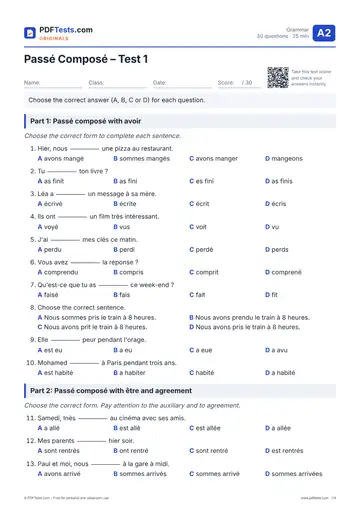
Passé composé = present tense of avoir or être + past participle. Verbs of movement like aller, venir, partir, arriver and all reflexive verbs use être, and the participle agrees with the subject: elle est allée, ils sont partis. For the full rules, see our Passé Composé grammar guide.
Imparfait = the nous form of the present tense minus -ons, plus these endings:
| Subject | Ending | finir (nous finissons) | faire (nous faisons) |
|---|---|---|---|
| je | -ais | je finissais | je faisais |
| tu | -ais | tu finissais | tu faisais |
| il / elle / on | -ait | il finissait | il faisait |
| nous | -ions | nous finissions | nous faisions |
| vous | -iez | vous finissiez | vous faisiez |
| ils / elles | -aient | ils finissaient | ils faisaient |
The only exception is être: the stem is ét- (j’étais, nous étions).
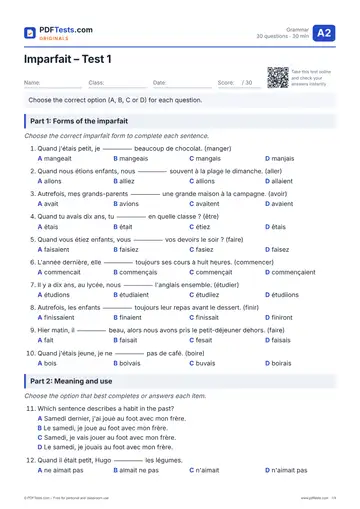
Spelling note: verbs in -ger and -cer keep their soft sound before a: je mangeais, il commençait, but nous mangions, nous commencions. The -ais, -ait and -aient endings all sound the same. More details are in our Imparfait grammar guide.
Using both tenses in one sentence
The most common pattern is an action in progress (imparfait) interrupted by an event (passé composé).
- Je dormais quand le téléphone a sonné. – I was sleeping when the phone rang.
- Quand je suis arrivé, il pleuvait. – When I arrived, it was raining.
The tense can change the meaning completely:
- Quand Paul est arrivé, nous avons mangé. – When Paul arrived, we ate. (we started eating after he arrived)
- Quand Paul est arrivé, nous mangions. – When Paul arrived, we were eating. (we were already eating)
Signal words
These words often point to one tense. They are hints, not strict rules, so always check the meaning.
| Passé composé | Imparfait |
|---|---|
| hier (yesterday), la semaine dernière (last week) | d’habitude (usually) |
| un jour (one day), ce matin-là (that morning) | tous les jours (every day), chaque été (every summer) |
| soudain, tout à coup (suddenly) | souvent (often), toujours (always) |
| d’abord, ensuite, puis, enfin (first, then, finally) | le lundi (on Mondays), autrefois, avant (in the past) |
| une fois, deux fois (once, twice) | quand j’étais petit(e) (when I was little) |
| pendant deux heures (for two hours, finished) | pendant que (while) |
Common verbs in descriptions
Some verbs describe states rather than actions, so they appear mostly in the imparfait when you set a scene: être, avoir, il y a, faire (for weather), vouloir, pouvoir, savoir, penser, aimer.
- C’était génial. – It was great.
- Il y avait beaucoup de monde. – There were lots of people.
- Je voulais rentrer. – I wanted to go home.
Use the passé composé with these verbs when something changes or happens at a precise moment:
- J’ai eu peur quand j’ai entendu le bruit. – I got scared when I heard the noise.
- Il y a eu un accident. – There was an accident. (an event)
A short story: both tenses working together
Samedi dernier, il faisait beau et le ciel était bleu. Je me promenais dans le parc avec mon chien. Il y avait beaucoup de monde. Tout à coup, mon chien a vu un chat. Il a couru après lui et j’ai lâché la laisse. Finalement, je l’ai retrouvé sous un banc.
Last Saturday, the weather was nice and the sky was blue. I was walking in the park with my dog. There were lots of people. Suddenly, my dog saw a cat. He ran after it and I let go of the lead. In the end, I found him under a bench.
The first three sentences use the imparfait to set the scene: weather, an action in progress, a description. From tout à coup, the passé composé takes over for the events that drive the story.
Common mistakes
- ✗ Hier, je mangeais au restaurant avec Paul. → ✓ Hier, j’ai mangé au restaurant avec Paul. A single finished event on a specific day needs the passé composé.
- ✗ Quand j’étais enfant, j’ai joué au tennis tous les week-ends. → ✓ Quand j’étais enfant, je jouais au tennis tous les week-ends. A past habit takes the imparfait.
- ✗ J’habitais à Lyon pendant cinq ans. → ✓ J’ai habité à Lyon pendant cinq ans. A finished period with clear limits takes the passé composé.
- ✗ Je lisais quand mon frère entrait. → ✓ Je lisais quand mon frère est entré. The interrupting action is an event, so it takes the passé composé.
- ✗ Ce matin-là, il a fait froid et le ciel a été gris. → ✓ Ce matin-là, il faisait froid et le ciel était gris. Scene-setting descriptions use the imparfait.
- ✗ Elle a allé au marché. → ✓ Elle est allée au marché. Aller uses être, and the participle agrees with elle.
- ✗ Je mangais une pomme. → ✓ Je mangeais une pomme. -ger verbs keep the e before a in the imparfait.
Quick check
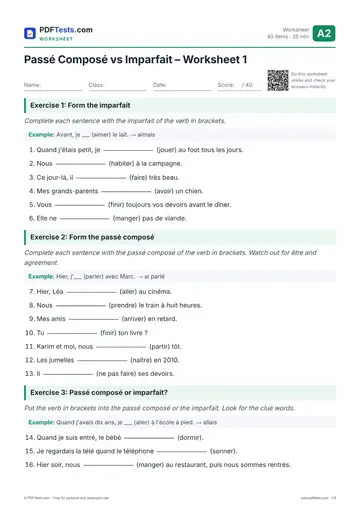
Choose the passé composé or the imparfait.
- Quand j’étais petit, je ___ (jouer) au foot tous les samedis.
- Hier soir, nous ___ (regarder) un film.
- Elle ___ (prendre) une douche quand le téléphone a sonné.
- Il ___ (faire) beau et les enfants ___ (être) contents.
- Tout à coup, Marie ___ (tomber).
Answers
- jouais – a repeated habit (tous les samedis).
- avons regardé – a finished event at a specific time (hier soir).
- prenait – an action in progress, interrupted by the phone.
- faisait, étaient – background description (weather, feelings).
- est tombée – a sudden event (tout à coup); tomber uses être and agrees with Marie.
Next step
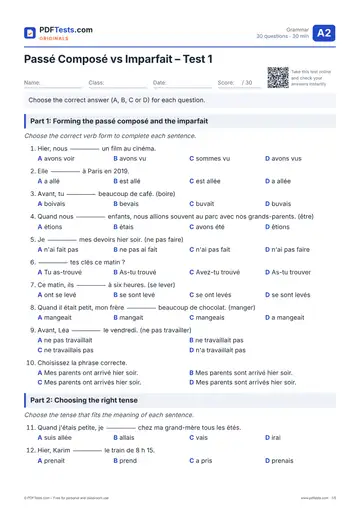
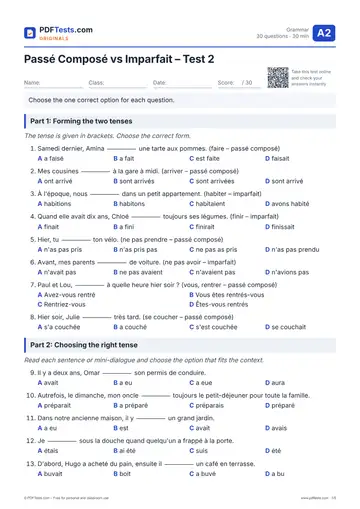
Now put the rules into practice: test yourself with our A2 Passé Composé vs Imparfait test, then try Test 2 to check that the choice is becoming automatic. Read each sentence and ask: event or background? Once you are confident with these two tenses, you are ready for the plus-que-parfait, which describes what had already happened before another past action.
Was this page helpful?
What was the problem?
Thank you for your feedback!