PDFTests Originals

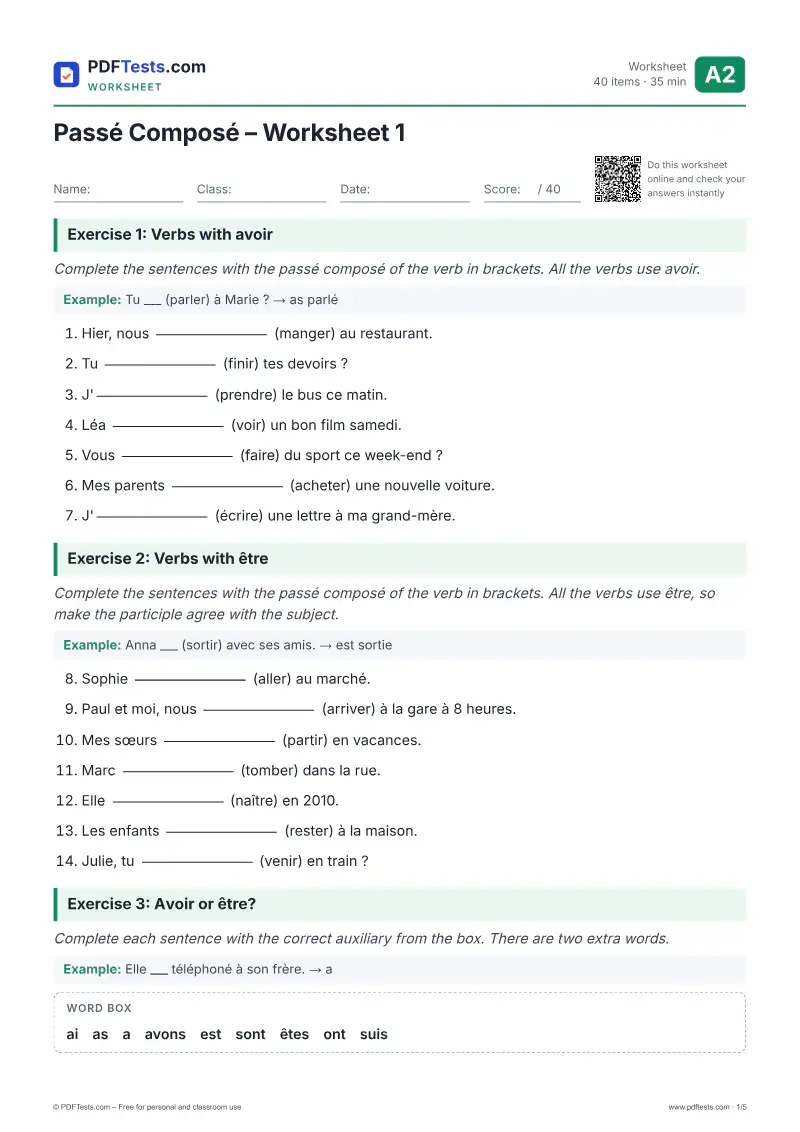
Passé Composé – Worksheet 1

A2 Elementary WorksheetFrench

This worksheet practises the French passé composé at A2 level: choosing avoir or être, forming regular and irregular past participles, and making the participle agree after être. Learners also make negative sentences and questions and correct typical mistakes. It suits classroom use or self-study.
items
40
Time
35 min
PDF
5 pages
Answer key
Included
  • 100% free
  • No sign-up or email
  • Print-ready A4 PDF
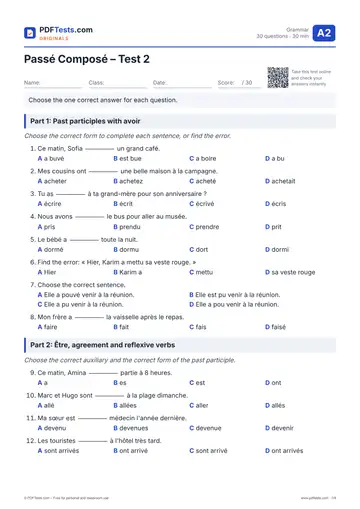
Preview of page 1 of Passé Composé – Worksheet 1 Open PDF
New to this topic? Read the guide first: Passé Composé in French: Rules, Examples and Common Mistakes

Do the worksheet online

Type your answers, then press “Check my answers”. Alternative correct answers are accepted.

Exercise 1: Verbs with avoir

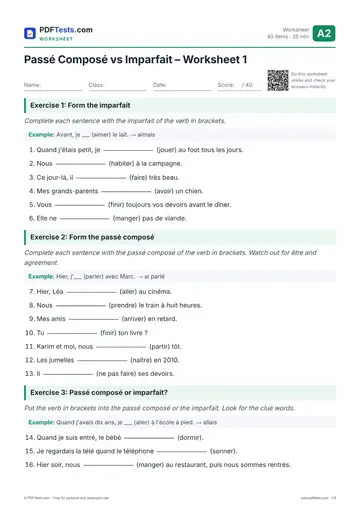
Complete the sentences with the passé composé of the verb in brackets. All the verbs use avoir.

Example: Tu ___ (parler) à Marie ? → as parlé

  1. Hier, nous (manger) au restaurant.

  2. Tu (finir) tes devoirs ?

  3. J' (prendre) le bus ce matin.

  4. Léa (voir) un bon film samedi.

  5. Vous (faire) du sport ce week-end ?

  6. Mes parents (acheter) une nouvelle voiture.

  7. J' (écrire) une lettre à ma grand-mère.

Exercise 2: Verbs with être

Complete the sentences with the passé composé of the verb in brackets. All the verbs use être, so make the participle agree with the subject.

Example: Anna ___ (sortir) avec ses amis. → est sortie

  1. Sophie (aller) au marché.

  2. Paul et moi, nous (arriver) à la gare à 8 heures.

  3. Mes sœurs (partir) en vacances.

  4. Marc (tomber) dans la rue.

  5. Elle (naître) en 2010.

  6. Les enfants (rester) à la maison.

  7. Julie, tu (venir) en train ?

Exercise 3: Avoir or être?

Complete each sentence with the correct auxiliary from the box. There are two extra words.

Example: Elle ___ téléphoné à son frère. → a

Word box aiasaavonsestsontêtesontsuis

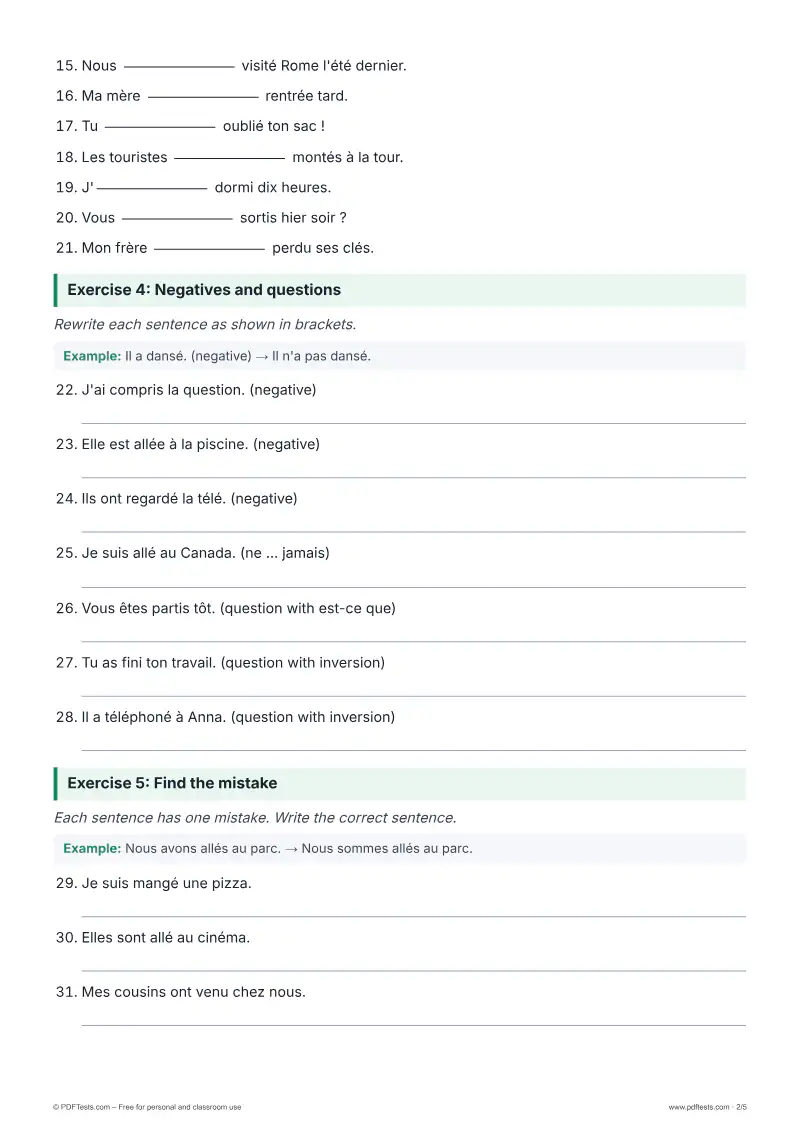
  1. Nous visité Rome l'été dernier.

  2. Ma mère rentrée tard.

  3. Tu oublié ton sac !

  4. Les touristes montés à la tour.

  5. J' dormi dix heures.

  6. Vous sortis hier soir ?

  7. Mon frère perdu ses clés.

Exercise 4: Negatives and questions

Rewrite each sentence as shown in brackets.

Example: Il a dansé. (negative) → Il n'a pas dansé.

  1. J'ai compris la question. (negative)

  2. Elle est allée à la piscine. (negative)

  3. Ils ont regardé la télé. (negative)

  4. Je suis allé au Canada. (ne … jamais)

  5. Vous êtes partis tôt. (question with est-ce que)

  6. Tu as fini ton travail. (question with inversion)

  7. Il a téléphoné à Anna. (question with inversion)

Exercise 5: Find the mistake

Each sentence has one mistake. Write the correct sentence.

Example: Nous avons allés au parc. → Nous sommes allés au parc.

  1. Je suis mangé une pizza.

  2. Elles sont allé au cinéma.

  3. Mes cousins ont venu chez nous.

  4. Il a prendu le train.

  5. Tu n'as fini pas tes devoirs.

  6. Hier, j'ai faisé une promenade.

Exercise 6: Put the words in order

Put the words in the correct order to make sentences.

Example: a / il / dormi / bien → Il a bien dormi.

  1. avons / nous / une maison / acheté

  2. venu / est / il / pas / n'

  3. est-ce que / parlé / avez / vous / au professeur / ?

  4. elle / à Paris / née / est / en 2005

  5. jamais / n' / ai / je / voyagé / en avion

  6. hier soir / sont / mes amis / sortis

Was this page helpful?

Report a mistake

Spotted a wrong answer, a typo or an unclear explanation? Tell us and we will fix it.

Preview

About this test

Printable A2 French worksheet on the passé composé: avoir and être, past participles, agreement, negatives and questions. Answers included.

Topics covered

Passé composé with avoirPassé composé with êtrePast participlesAgreement after êtreNegatives and questions

Notes for teachers

Start by reviewing the être verbs (aller, venir, arriver, partir, naître, tomber, rester…) and the most common irregular participles before Exercises 1 and 2. Typical mistakes include using avoir with movement verbs, forgetting agreement (elles sont allé), inventing participles (prendu, faisé) and placing pas after the participle. As a follow-up, ask pairs to interview each other about last weekend with Est-ce que tu as…? / Tu es allé(e)…? and report back in the third person.

All French A2 tests →