PDFTests Originals

Object Pronouns, Y and En – Worksheet 1

A2 Elementary WorksheetFrench

This worksheet practises French direct and indirect object pronouns (le, la, l', les, lui, leur, me, te, nous, vous) and the pronouns y and en. It is for A2 learners who need to choose the right pronoun, put it in the right place and use it in negatives, questions and with infinitives.
items
39
Time
35 min
PDF
5 pages
Answer key
Included
  • 100% free
  • No sign-up or email
  • Print-ready A4 PDF
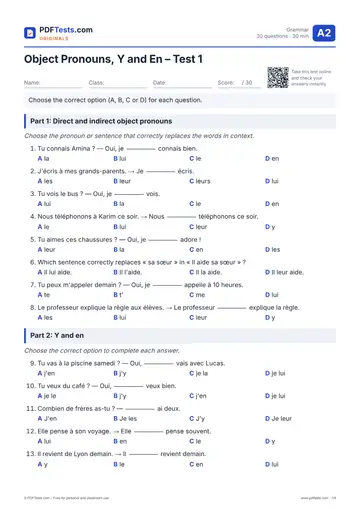
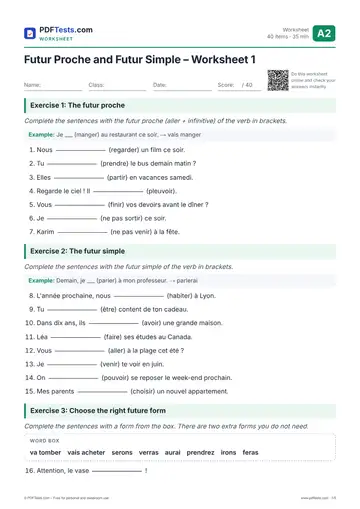
Preview of page 1 of Object Pronouns, Y and En – Worksheet 1 Open PDF
New to this topic? Read the guide first: French Object Pronouns, Y and En: Rules, Examples and Common Mistakes

Do the worksheet online

Type your answers, then press “Check my answers”. Alternative correct answers are accepted.

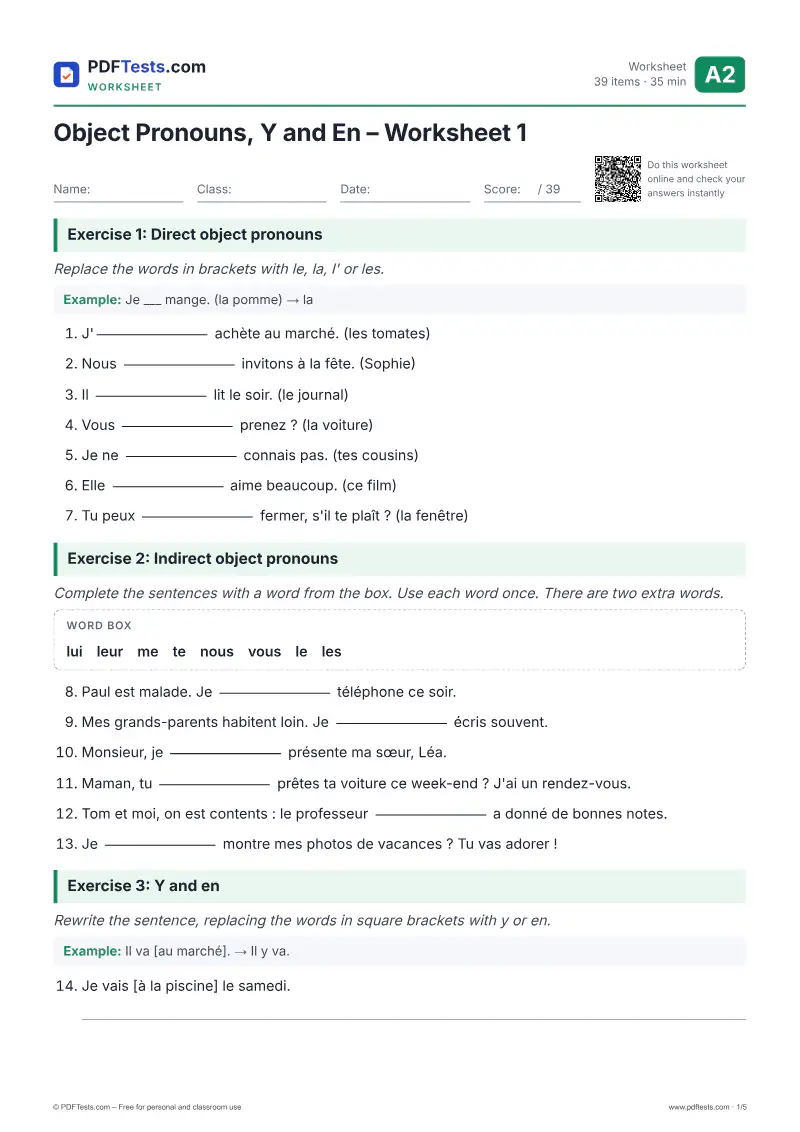
Exercise 1: Direct object pronouns

Replace the words in brackets with le, la, l' or les.

Example: Je ___ mange. (la pomme) → la

  1. J' achète au marché. (les tomates)

  2. Nous invitons à la fête. (Sophie)

  3. Il lit le soir. (le journal)

  4. Vous prenez ? (la voiture)

  5. Je ne connais pas. (tes cousins)

  6. Elle aime beaucoup. (ce film)

  7. Tu peux fermer, s'il te plaît ? (la fenêtre)

Exercise 2: Indirect object pronouns

Complete the sentences with a word from the box. Use each word once. There are two extra words.

Word box luileurmetenousvousleles

  1. Paul est malade. Je téléphone ce soir.

  2. Mes grands-parents habitent loin. Je écris souvent.

  3. Monsieur, je présente ma sœur, Léa.

  4. Maman, tu prêtes ta voiture ce week-end ? J'ai un rendez-vous.

  5. Tom et moi, on est contents : le professeur a donné de bonnes notes.

  6. Je montre mes photos de vacances ? Tu vas adorer !

Exercise 3: Y and en

Rewrite the sentence, replacing the words in square brackets with y or en.

Example: Il va [au marché]. → Il y va.

  1. Je vais [à la piscine] le samedi.

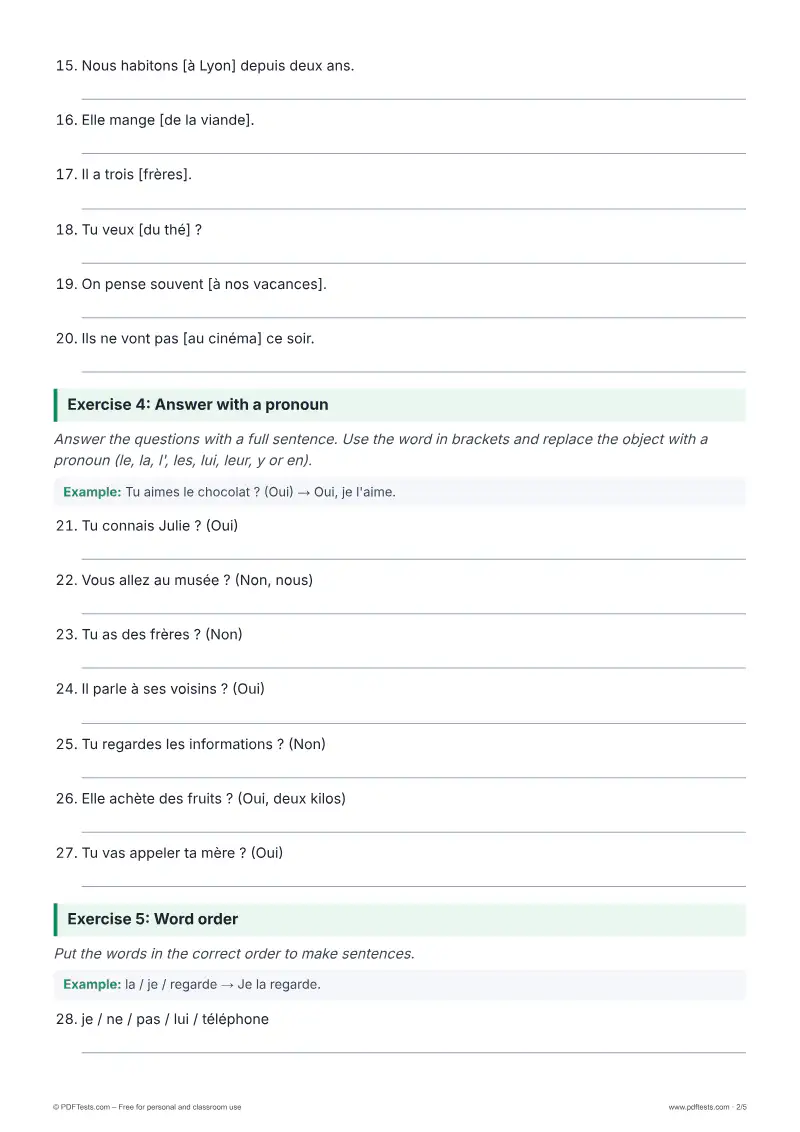
  2. Nous habitons [à Lyon] depuis deux ans.

  3. Elle mange [de la viande].

  4. Il a trois [frères].

  5. Tu veux [du thé] ?

  6. On pense souvent [à nos vacances].

  7. Ils ne vont pas [au cinéma] ce soir.

Exercise 4: Answer with a pronoun

Answer the questions with a full sentence. Use the word in brackets and replace the object with a pronoun (le, la, l', les, lui, leur, y or en).

Example: Tu aimes le chocolat ? (Oui) → Oui, je l'aime.

  1. Tu connais Julie ? (Oui)

  2. Vous allez au musée ? (Non, nous)

  3. Tu as des frères ? (Non)

  4. Il parle à ses voisins ? (Oui)

  5. Tu regardes les informations ? (Non)

  6. Elle achète des fruits ? (Oui, deux kilos)

  7. Tu vas appeler ta mère ? (Oui)

Exercise 5: Word order

Put the words in the correct order to make sentences.

Example: la / je / regarde → Je la regarde.

  1. je / ne / pas / lui / téléphone

  2. en / nous / voulons / deux

  3. y / tu / vas / ce soir / ?

  4. les / vais / je / inviter

  5. elle / l' / pas / ne / aime

  6. leur / vous / écrivez / souvent / ?

Exercise 6: Find the mistake

Each sentence has one mistake. Write the correct sentence.

Example: Je vais y demain. → J'y vais demain.

  1. Marc ? Je lui connais depuis l'école.

  2. Tu les téléphones ce soir ?

  3. Des pommes ? J'achète en trois.

  4. Nous allons y demain.

  5. Je la ne regarde pas.

  6. Ils le vont acheter.

Was this page helpful?

Report a mistake

Spotted a wrong answer, a typo or an unclear explanation? Tell us and we will fix it.

Preview

About this test

Printable A2 French worksheet on object pronouns (le, la, les, lui, leur), y and en, with negatives, questions, infinitives and answers.

Topics covered

Direct object pronounsIndirect object pronounsThe pronoun yThe pronoun enPronoun position in negatives and questionsPronouns with infinitives

Notes for teachers

Start by asking learners whether each verb takes a direct object (connaître, regarder, inviter) or uses à (téléphoner à, parler à, écrire à). The most common mistakes are using lui/leur with direct-object verbs, putting the pronoun after the verb, and putting ne after the pronoun instead of before it. Remind learners that le/la become l' before a vowel and that en keeps the number at the end (j'en ai trois). As a follow-up, learners can ask each other questions about their habits (Tu vas au cinéma ? Tu bois du café ?) and answer with pronouns.

All French A2 tests →