PDFTests Originals

Futur Proche and Futur Simple – Worksheet 1

A2 Elementary WorksheetFrench

This worksheet practises the two main ways to talk about the future in French: the futur proche (aller + infinitive) and the futur simple. Learners at A2 level build the forms, including common irregular verbs, then use negatives, questions and the right tense in context.
items
40
Time
35 min
PDF
5 pages
Answer key
Included
  • 100% free
  • No sign-up or email
  • Print-ready A4 PDF
Preview of page 1 of Futur Proche and Futur Simple – Worksheet 1 Open PDF
New to this topic? Read the guide first: Futur Proche and Futur Simple: Forms, Uses and Common Mistakes

Do the worksheet online

Type your answers, then press “Check my answers”. Alternative correct answers are accepted.

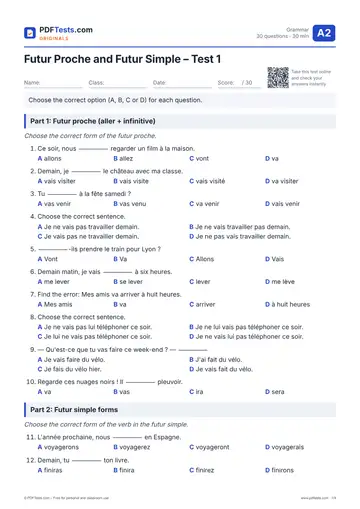
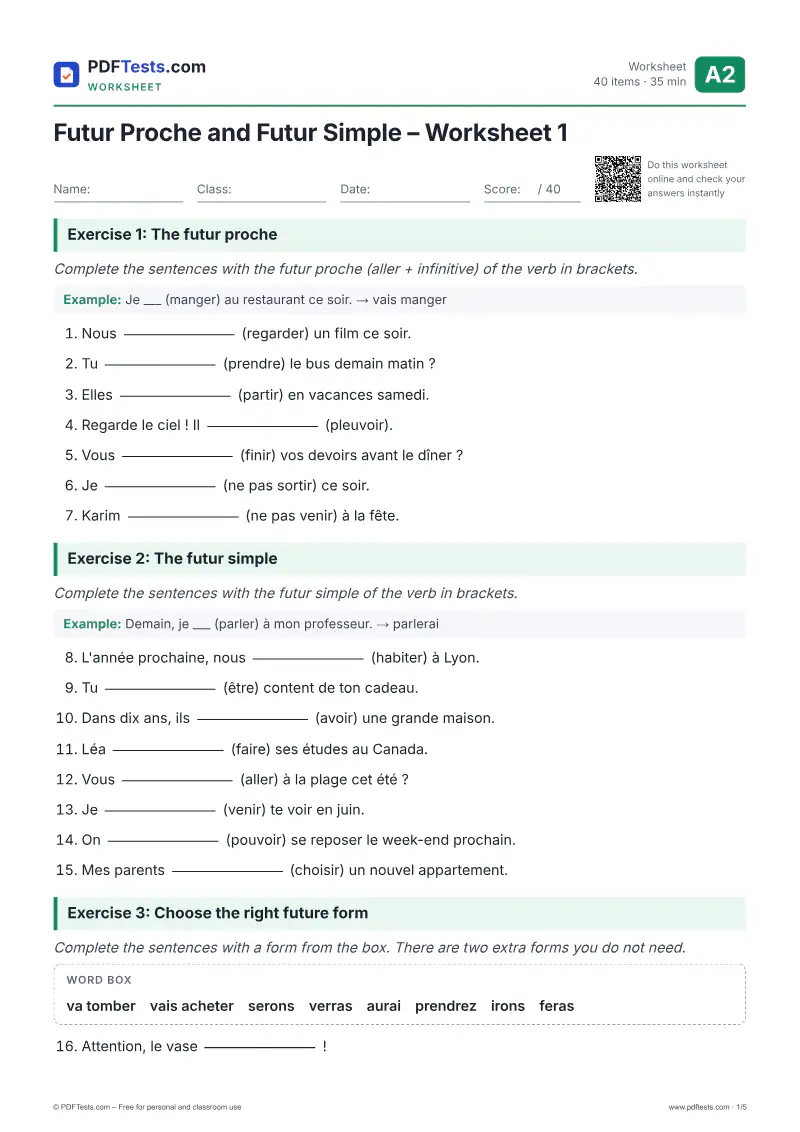
Exercise 1: The futur proche

Complete the sentences with the futur proche (aller + infinitive) of the verb in brackets.

Example: Je ___ (manger) au restaurant ce soir. → vais manger

  1. Nous (regarder) un film ce soir.

  2. Tu (prendre) le bus demain matin ?

  3. Elles (partir) en vacances samedi.

  4. Regarde le ciel ! Il (pleuvoir).

  5. Vous (finir) vos devoirs avant le dîner ?

  6. Je (ne pas sortir) ce soir.

  7. Karim (ne pas venir) à la fête.

Exercise 2: The futur simple

Complete the sentences with the futur simple of the verb in brackets.

Example: Demain, je ___ (parler) à mon professeur. → parlerai

  1. L'année prochaine, nous (habiter) à Lyon.

  2. Tu (être) content de ton cadeau.

  3. Dans dix ans, ils (avoir) une grande maison.

  4. Léa (faire) ses études au Canada.

  5. Vous (aller) à la plage cet été ?

  6. Je (venir) te voir en juin.

  7. On (pouvoir) se reposer le week-end prochain.

  8. Mes parents (choisir) un nouvel appartement.

Exercise 3: Choose the right future form

Complete the sentences with a form from the box. There are two extra forms you do not need.

Word box va tombervais acheterseronsverrasauraiprendrezironsferas

  1. Attention, le vase !

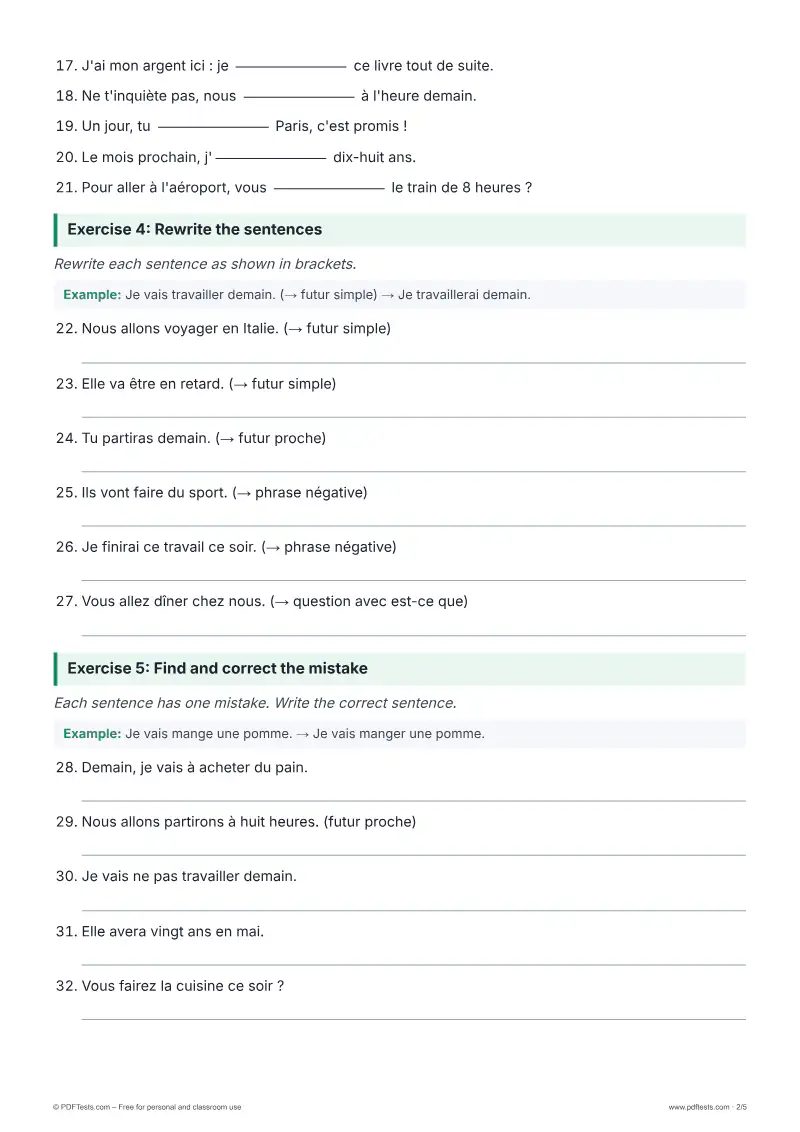
  2. J'ai mon argent ici : je ce livre tout de suite.

  3. Ne t'inquiète pas, nous à l'heure demain.

  4. Un jour, tu Paris, c'est promis !

  5. Le mois prochain, j' dix-huit ans.

  6. Pour aller à l'aéroport, vous le train de 8 heures ?

Exercise 4: Rewrite the sentences

Rewrite each sentence as shown in brackets.

Example: Je vais travailler demain. (→ futur simple) → Je travaillerai demain.

  1. Nous allons voyager en Italie. (→ futur simple)

  2. Elle va être en retard. (→ futur simple)

  3. Tu partiras demain. (→ futur proche)

  4. Ils vont faire du sport. (→ phrase négative)

  5. Je finirai ce travail ce soir. (→ phrase négative)

  6. Vous allez dîner chez nous. (→ question avec est-ce que)

Exercise 5: Find and correct the mistake

Each sentence has one mistake. Write the correct sentence.

Example: Je vais mange une pomme. → Je vais manger une pomme.

  1. Demain, je vais à acheter du pain.

  2. Nous allons partirons à huit heures. (futur proche)

  3. Je vais ne pas travailler demain.

  4. Elle avera vingt ans en mai.

  5. Vous fairez la cuisine ce soir ?

  6. Je venirai chez toi samedi.

  7. On va allé au cinéma.

Exercise 6: Put the words in order

Put the words in the correct order to make sentences.

Example: vais / je / dormir / bientôt → Je vais dormir bientôt.

  1. vais / je / téléphoner / te / demain

  2. elle / ne / va / pas / rester / ici

  3. est-ce que / tu / vas / venir / avec nous

  4. ils / seront / en vacances / la semaine prochaine

  5. nous / prendrons / le train / pour aller à Nice

  6. vont / mes amis / jouer / au football / samedi

Was this page helpful?

Report a mistake

Spotted a wrong answer, a typo or an unclear explanation? Tell us and we will fix it.

Preview

About this test

Printable A2 French worksheet on the futur proche and futur simple: forms, irregular verbs, negatives and questions, with answers.

Topics covered

Futur proche (aller + infinitive)Futur simple: regular verbsFutur simple: irregular stemsNegatives and questionsChoosing the right future

Notes for teachers

Start with the futur proche, which learners usually find easier, then move to the futur simple and its irregular stems (ser-, aur-, fer-, ir-, viendr-, pourr-). Typical mistakes include adding 'à' after aller, conjugating both verbs in the futur proche, placing 'ne… pas' around the infinitive, and inventing stems such as 'avera' or 'fairez'. As a follow-up, ask learners to write five sentences about their plans for next weekend (futur proche) and five predictions about their life in ten years (futur simple).

All French A2 tests →