PDFTests Originals

Pronominal (Reflexive) Verbs – Worksheet 1

A2 Elementary WorksheetFrench

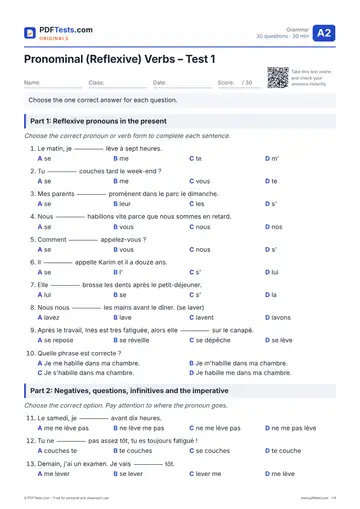
This worksheet practises French pronominal (reflexive) verbs such as se lever, s'habiller and s'amuser. Learners use the correct reflexive pronoun in the present tense, make negatives and questions, and form the passé composé with être and agreement. It is for A2 learners who know basic present-tense conjugation.
items
39
Time
35 min
PDF
5 pages
Answer key
Included
  • 100% free
  • No sign-up or email
  • Print-ready A4 PDF
Preview of page 1 of Pronominal (Reflexive) Verbs – Worksheet 1 Open PDF
New to this topic? Read the guide first: French Pronominal (Reflexive) Verbs: Rules, Examples and Common Mistakes

Do the worksheet online

Type your answers, then press “Check my answers”. Alternative correct answers are accepted.

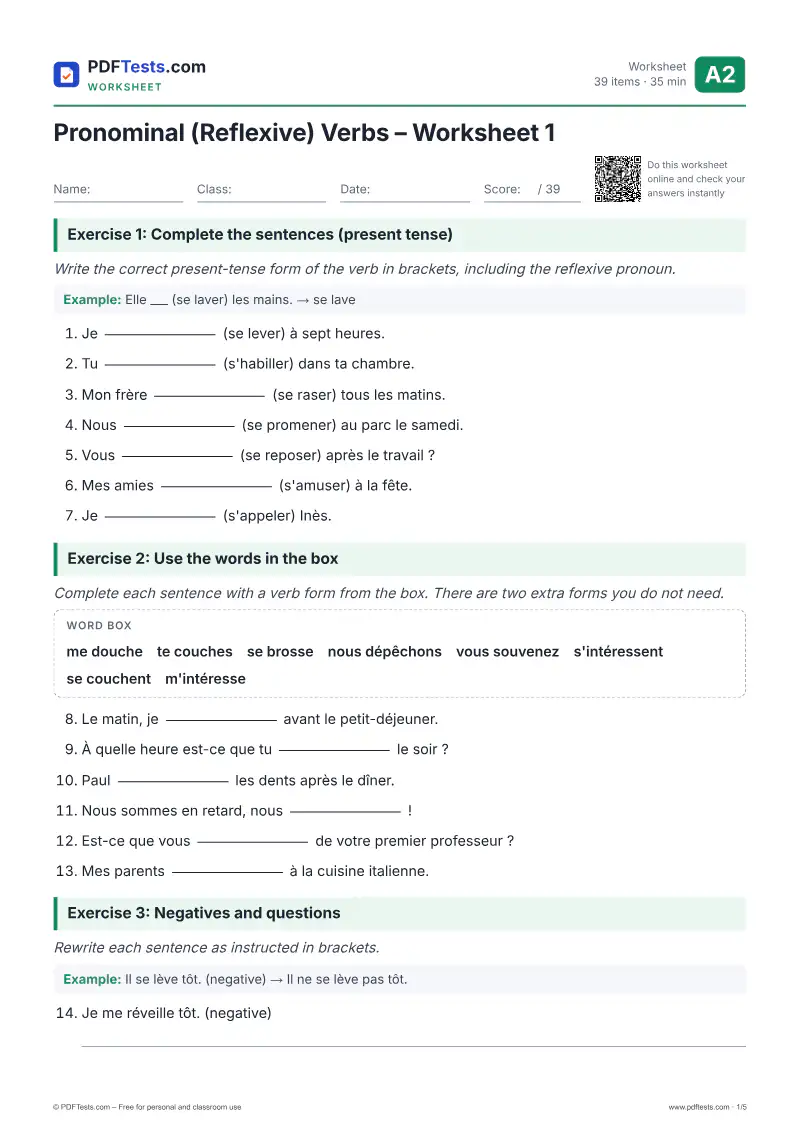
Exercise 1: Complete the sentences (present tense)

Write the correct present-tense form of the verb in brackets, including the reflexive pronoun.

Example: Elle ___ (se laver) les mains. → se lave

  1. Je (se lever) à sept heures.

  2. Tu (s'habiller) dans ta chambre.

  3. Mon frère (se raser) tous les matins.

  4. Nous (se promener) au parc le samedi.

  5. Vous (se reposer) après le travail ?

  6. Mes amies (s'amuser) à la fête.

  7. Je (s'appeler) Inès.

Exercise 2: Use the words in the box

Complete each sentence with a verb form from the box. There are two extra forms you do not need.

Word box me douchete couchesse brossenous dépêchonsvous souvenezs'intéressentse couchentm'intéresse

  1. Le matin, je avant le petit-déjeuner.

  2. À quelle heure est-ce que tu le soir ?

  3. Paul les dents après le dîner.

  4. Nous sommes en retard, nous !

  5. Est-ce que vous de votre premier professeur ?

  6. Mes parents à la cuisine italienne.

Exercise 3: Negatives and questions

Rewrite each sentence as instructed in brackets.

Example: Il se lève tôt. (negative) → Il ne se lève pas tôt.

  1. Je me réveille tôt. (negative)

  2. Elle s'ennuie en classe. (negative)

  3. Nous nous disputons souvent. (negative)

  4. Ils s'habillent en noir. (negative)

  5. Tu te couches tard. (question with est-ce que)

  6. Vous vous promenez le dimanche. (question with est-ce que)

  7. Elle s'appelle Chloé. (question with est-ce que)

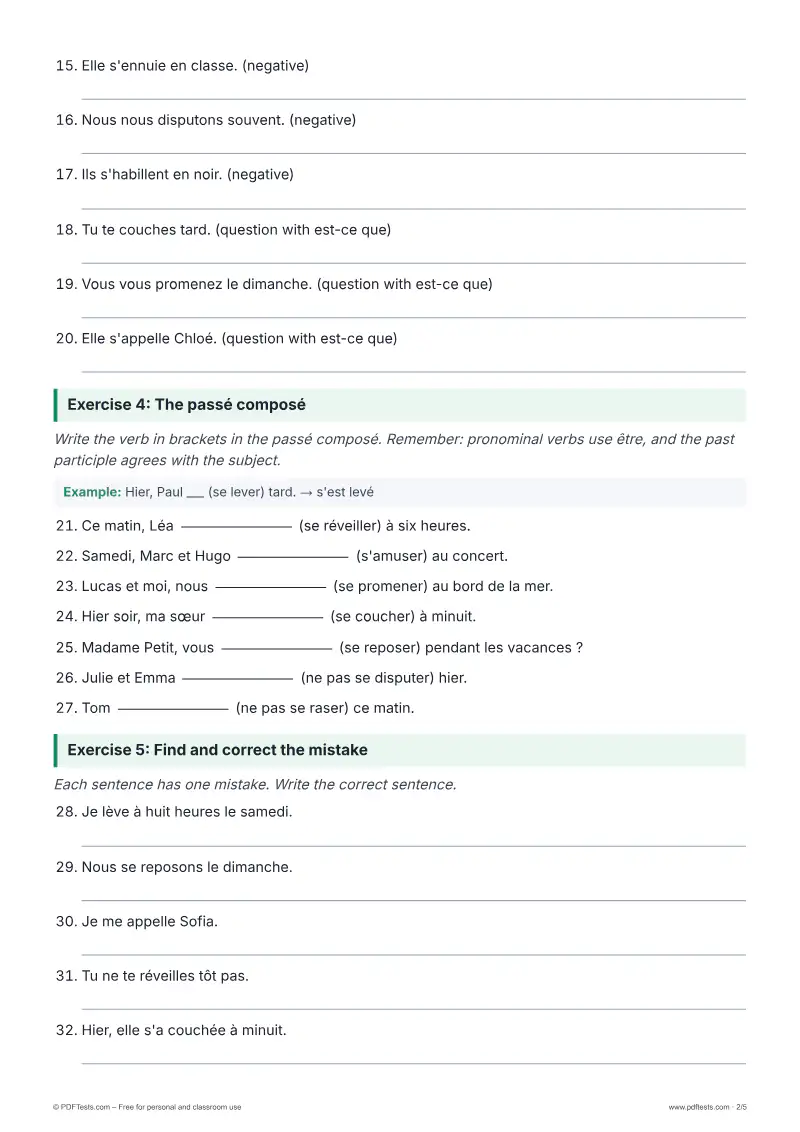
Exercise 4: The passé composé

Write the verb in brackets in the passé composé. Remember: pronominal verbs use être, and the past participle agrees with the subject.

Example: Hier, Paul ___ (se lever) tard. → s'est levé

  1. Ce matin, Léa (se réveiller) à six heures.

  2. Samedi, Marc et Hugo (s'amuser) au concert.

  3. Lucas et moi, nous (se promener) au bord de la mer.

  4. Hier soir, ma sœur (se coucher) à minuit.

  5. Madame Petit, vous (se reposer) pendant les vacances ?

  6. Julie et Emma (ne pas se disputer) hier.

  7. Tom (ne pas se raser) ce matin.

Exercise 5: Find and correct the mistake

Each sentence has one mistake. Write the correct sentence.

  1. Je lève à huit heures le samedi.

  2. Nous se reposons le dimanche.

  3. Je me appelle Sofia.

  4. Tu ne te réveilles tôt pas.

  5. Hier, elle s'a couchée à minuit.

  6. Mes sœurs se sont levé tard.

Exercise 6: Put the words in order

Put the words in the correct order to make a sentence or question.

Example: me / je / tôt / lève → Je me lève tôt.

  1. se / à / Tom / sept heures / réveille

  2. ne / pas / nous / nous / ennuyons

  3. est-ce que / vous / tôt / levez / vous

  4. se / sont / elles / promenées / hier

  5. t' / comment / tu / appelles

  6. pas / ne / s'est / il / rasé

Was this page helpful?

Report a mistake

Spotted a wrong answer, a typo or an unclear explanation? Tell us and we will fix it.

Preview

About this test

Printable A2 French worksheet on pronominal (reflexive) verbs: present tense, negatives, questions and the passé composé with être. Answers included.

Topics covered

Reflexive pronouns (me, te, se, nous, vous)Pronominal verbs in the present tenseNegatives with ne… pasQuestions with est-ce quePassé composé with être and agreementDaily routine vocabulary

Notes for teachers

Start by miming a daily routine (se réveiller, se lever, se doucher) to elicit the verbs, then work through the exercises in order. Typical mistakes are forgetting the reflexive pronoun, not eliding before a vowel (je me appelle instead of je m'appelle), putting pas in the wrong place, and using avoir or forgetting agreement in the passé composé. As a follow-up, ask learners to write five sentences about their routine yesterday and compare it with a partner's.

All French A2 tests →