The passé composé is the main French tense for talking about completed actions and events in the past. It answers the question What happened? and is formed with two words: the present tense of avoir or être plus a past participle (J’ai mangé, Elle est partie). In everyday speech and writing it is the tense you will use most often for past events.
When to use the passé composé
1. A completed action at a specific time
- Hier, j’ai téléphoné à ma mère. – Yesterday, I called my mother.
- Nous avons visité Lyon l’été dernier. – We visited Lyon last summer.
2. A sequence of events
Use it to tell a story step by step: first this happened, then that.
- Je suis rentré, j’ai pris une douche et je me suis couché. – I got home, had a shower and went to bed.
3. A sudden event or change
- Soudain, il a commencé à pleuvoir. – Suddenly, it started to rain.
- Le téléphone a sonné. – The phone rang.
4. Life experiences and results (often with déjà or jamais)
- Tu as déjà mangé des escargots ? – Have you ever eaten snails?
- J’ai perdu mes clés. – I’ve lost my keys.
Note that the passé composé covers both the English simple past (I ate) and the present perfect (I have eaten). French does not make that distinction here.
How to form the passé composé
The formula is: subject + avoir or être (present tense) + past participle.
If you need to revise the present tense of the two auxiliaries, see our guide to être and avoir.
With avoir (most verbs)
| Subject | avoir | Past participle | Translation |
|---|---|---|---|
| j’ | ai | parlé | I spoke |
| tu | as | parlé | you spoke |
| il / elle / on | a | parlé | he / she / we spoke |
| nous | avons | parlé | we spoke |
| vous | avez | parlé | you spoke |
| ils / elles | ont | parlé | they spoke |
With être (a small group of verbs)
| Subject | être | Past participle | Translation |
|---|---|---|---|
| je | suis | allé(e) | I went |
| tu | es | allé(e) | you went |
| il / elle / on | est | allé / allée / allé(e)s | he / she / we went |
| nous | sommes | allé(e)s | we went |
| vous | êtes | allé(e)(s) | you went |
| ils / elles | sont | allés / allées | they went |
With être, the participle agrees with the subject like an adjective: add -e for feminine and -s for plural. More on this below.
Past participles
Regular verbs
| Infinitive ending | Participle ending | Example |
|---|---|---|
| -er | -é | parler → parlé, manger → mangé |
| -ir (like finir) | -i | finir → fini, choisir → choisi |
| -re (like vendre) | -u | vendre → vendu, attendre → attendu |
- Elle a choisi une robe rouge. – She chose a red dress.
- J’ai attendu le bus pendant vingt minutes. – I waited for the bus for twenty minutes.
Common irregular participles
These must be learnt by heart. Many end in -u, -is or -it.
| Infinitive | Participle | Infinitive | Participle |
|---|---|---|---|
| avoir | eu | voir | vu |
| être | été | boire | bu |
| faire | fait | lire | lu |
| prendre | pris | pouvoir | pu |
| mettre | mis | vouloir | voulu |
| dire | dit | devoir | dû |
| écrire | écrit | savoir | su |
| ouvrir | ouvert | connaître | connu |
| venir | venu | recevoir | reçu |
| naître | né | mourir | mort |
- Qu’est-ce que tu as fait ce week-end ? – What did you do this weekend?
- Nous avons pris le train de 8 heures. – We took the 8 o’clock train.
- Il a eu un accident. – He had an accident.
Avoir or être?
Most verbs use avoir. Two groups use être.
Group 1: verbs of movement and change of state
About seventeen common verbs, many in opposite pairs:
| Verb | Participle | Opposite | Participle |
|---|---|---|---|
| aller | allé | venir | venu |
| arriver | arrivé | partir | parti |
| entrer | entré | sortir | sorti |
| monter | monté | descendre | descendu |
| naître | né | mourir | mort |
| rester | resté | tomber | tombé |
| retourner | retourné | passer (par) | passé |
Also: devenir (devenu), revenir (revenu), rentrer (rentré).
- Mes parents sont arrivés à midi. – My parents arrived at noon.
- Victor Hugo est né en 1802. – Victor Hugo was born in 1802.
- Elle est tombée dans la rue. – She fell in the street.
When sortir, monter, descendre, passer, rentrer or retourner have a direct object, they switch to avoir: J’ai sorti la poubelle. – I took the bin out. At A2, focus first on the basic être use.
Group 2: all pronominal (reflexive) verbs
Every verb with a reflexive pronoun (se lever, s’habiller, se promener) uses être. The pronoun goes before the auxiliary. Our guide to pronominal verbs explains these in more detail.
- Je me suis réveillé à 7 heures. – I woke up at 7 o’clock.
- Elles se sont bien amusées. – They had a great time.
Agreement with être
With être, the participle matches the subject in gender and number.
| Subject | Example | Translation |
|---|---|---|
| il | Il est parti. | He left. |
| elle | Elle est partie. | She left. |
| ils | Ils sont partis. | They left. |
| elles | Elles sont parties. | They left. (all female) |
A mixed group (men and women) takes the masculine plural: Paul et Léa sont partis. – Paul and Léa left.
With vous as a polite form for one person, there is no -s: Madame, vous êtes arrivée ? – Madam, have you arrived?
With avoir, the participle does not agree with the subject: Elle a mangé, never elle a mangée. (There is a rule about agreement with a direct object placed before the verb, but that is a more advanced topic.)
Negatives and questions
In the negative, ne … pas goes around the auxiliary, not around the participle. If you need a refresher, see our guide to negation.
| Type | Example | Translation |
|---|---|---|
| Affirmative | Tu as fini. | You finished. |
| Negative | Tu n’as pas fini. | You didn’t finish. |
| Question (intonation) | Tu as fini ? | Did you finish? |
| Question (est-ce que) | Est-ce que tu as fini ? | Did you finish? |
| Question (inversion) | As-tu fini ? | Did you finish? |
With être and reflexive verbs the pattern is the same:
- Elle n’est pas venue. – She didn’t come.
- Je ne me suis pas levé tôt. – I didn’t get up early.
- A-t-il compris ? – Did he understand? (add -t- between two vowels)
Where to put adverbs
Short common adverbs usually go between the auxiliary and the participle: bien, mal, déjà, encore, beaucoup, trop, vite, toujours.
- J’ai bien dormi. – I slept well.
- Tu as déjà vu ce film ? – Have you already seen this film?
- Je n’ai pas encore fini. – I haven’t finished yet.
Time expressions like hier or ce matin go at the start or end of the sentence: Hier, j’ai vu Paul. or J’ai vu Paul hier. – I saw Paul yesterday.
Signal words
These expressions often appear with the passé composé:
- hier, avant-hier – yesterday, the day before yesterday
- ce matin, samedi dernier – this morning, last Saturday
- la semaine dernière, l’année dernière – last week, last year
- il y a deux jours – two days ago
- en 2019 – in 2019
- soudain, tout à coup – suddenly
- d’abord, ensuite, puis, enfin – first, next, then, finally
- une fois, deux fois – once, twice
- déjà, ne … jamais – already / ever, never
Passé composé vs imparfait
Learners often confuse the passé composé with the imparfait, the other main past tense. In short:
-
Passé composé: completed actions, events, what happened.
-
Imparfait: descriptions, background, habits, what things were like.
-
Il pleuvait quand je suis sorti. – It was raining when I went out.
-
Quand j’étais petit, je jouais au foot. Un jour, je me suis cassé la jambe. – When I was little, I used to play football. One day, I broke my leg.
For a full comparison with practice, read our guide to passé composé vs imparfait.
Common mistakes
- ✗ Je suis mangé. → ✓ J’ai mangé. – I ate. Manger is not a movement or reflexive verb, so it takes avoir.
- ✗ J’ai allé au cinéma. → ✓ Je suis allé(e) au cinéma. – I went to the cinema. Aller always takes être.
- ✗ Elle est arrivé. → ✓ Elle est arrivée. – She arrived. With être, add -e for a feminine subject.
- ✗ Elle a mangée. → ✓ Elle a mangé. – She ate. With avoir, the participle does not agree with the subject.
- ✗ Je n’ai mangé pas. → ✓ Je n’ai pas mangé. – I didn’t eat. Ne … pas surrounds the auxiliary.
- ✗ J’ai prendu le bus. → ✓ J’ai pris le bus. – I took the bus. Prendre has the irregular participle pris.
- ✗ Il a né à Paris. → ✓ Il est né à Paris. – He was born in Paris. Naître takes être.
- ✗ Je suis levé à sept heures. → ✓ Je me suis levé(e) à sept heures. – I got up at seven. Keep the reflexive pronoun.
- ✗ Je ai fini. → ✓ J’ai fini. – I finished. Je becomes j’ before a vowel.
Quick check
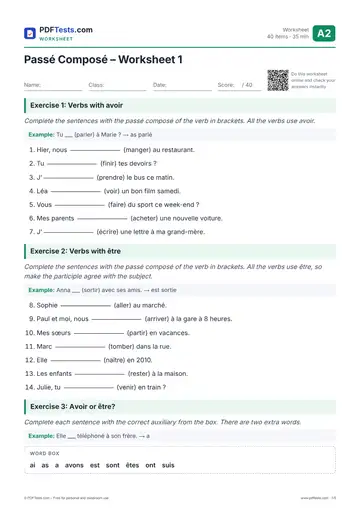
Put the verb in brackets into the passé composé.
- Hier, nous ___ (regarder) un film. – Yesterday, we watched a film.
- Marie ___ (partir) à huit heures. – Marie left at eight o’clock.
- Ils ___ (faire) leurs devoirs. – They did their homework.
- Make it negative: J’ai compris. – I understood.
- Elles ___ (se lever) tôt. – They got up early.
Answers
- avons regardé – regular -er verb with avoir.
- est partie – partir takes être; add -e for Marie.
- ont fait – faire has the irregular participle fait.
- Je n’ai pas compris. – ne … pas goes around ai.
- se sont levées – reflexive verb with être; feminine plural agreement.
Next step
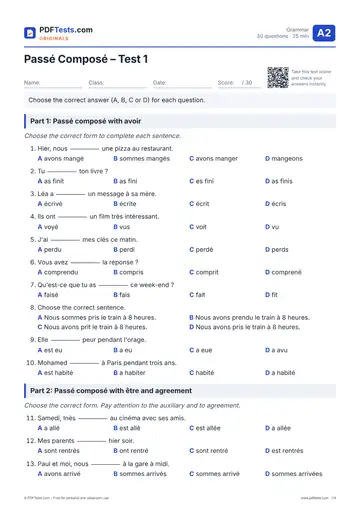
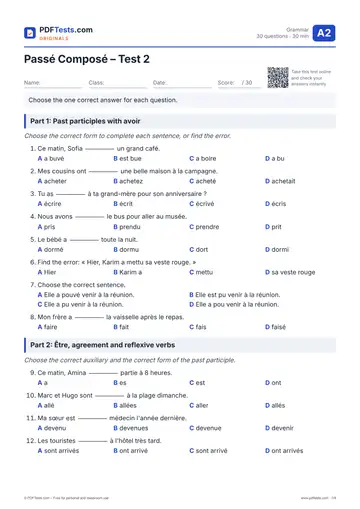
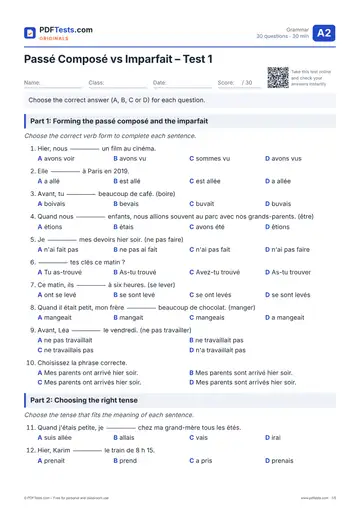
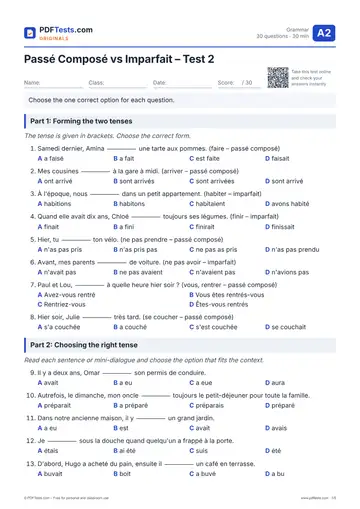
Now put the rules into practice: test yourself with our A2 Passé Composé test 1, which checks auxiliaries, participles and agreement, then move on to Passé Composé test 2 for more irregular verbs, negatives and reflexive verbs. Note every mistake you make, check it against the tables above, and once you score well, start comparing the passé composé with the imparfait.
Was this page helpful?
What was the problem?
Thank you for your feedback!