French object pronouns replace a noun so you don’t have to repeat it. You use le, la, les for direct objects, lui, leur for people after à, y for places and à + a thing, and en for de + a noun or a quantity. In most sentences these pronouns go before the verb: Je la vois means I see her.
The pronouns at a glance
| Person | Direct object | Indirect object (à + person) |
|---|---|---|
| je | me (m’) | me (m’) |
| tu | te (t’) | te (t’) |
| il / elle | le / la (l’) | lui |
| nous | nous | nous |
| vous | vous | vous |
| ils / elles | les | leur |
There are also two special pronouns:
- y replaces a place or à + a thing or idea.
- en replaces de + a noun, a partitive noun (du, de la, des) or a noun with a number or quantity.
Before a vowel or a silent h, me, te, le, la become m’, t’, l’.
Direct object pronouns: le, la, les
A direct object follows the verb with no preposition. The pronoun can replace a person or a thing.
- Tu vois Marie ? — Oui, je la vois. Do you see Marie? — Yes, I see her.
- J’adore ce film. Je **l’**ai vu trois fois. I love this film. I’ve seen it three times.
- Où sont mes clés ? Je les cherche. Where are my keys? I’m looking for them.
- Il **m’**appelle tous les soirs. He calls me every evening.
Verbs that are direct in French but not in English
Some verbs need a preposition in English but take a direct object in French. Use le, la, les with them:
| French verb | English | Example |
|---|---|---|
| écouter | listen to | Je **l’**écoute. I’m listening to it / him / her. |
| regarder | look at, watch | Tu les regardes ? Are you watching them? |
| attendre | wait for | On vous attend. We’re waiting for you. |
| chercher | look for | Je la cherche. I’m looking for her / it. |
| payer | pay for | Il les a payés. He paid for them. |
Indirect object pronouns: lui, leur
An indirect object is a person after à. Lui means (to) him or (to) her; leur means (to) them.
Common verbs: parler à, téléphoner à, écrire à, répondre à, dire à, demander à, donner quelque chose à, envoyer à, offrir à, plaire à.
- Tu as parlé à Paul ? — Oui, je lui ai parlé. Did you talk to Paul? — Yes, I talked to him.
- J’écris à mes grands-parents. → Je leur écris. I write to my grandparents. → I write to them.
- Je lui offre des fleurs. I’m giving her / him flowers.
- Ce cadeau me plaît. I like this present. (literally: this present pleases me)
The pronoun leur never takes an -s. Don’t confuse it with the possessive leurs (leurs enfants, their children).
Direct or indirect?
Ask yourself how the verb works with a noun. If you say verb + à + person, use lui / leur. If there is no à, use le / la / les.
| With a noun | With a pronoun |
|---|---|
| J’aide ma sœur. I help my sister. | Je **l’**aide. I help her. |
| Je téléphone à ma sœur. I phone my sister. | Je lui téléphone. I phone her. |
| J’invite mes amis. I invite my friends. | Je les invite. I invite them. |
| Je réponds à mes amis. I reply to my friends. | Je leur réponds. I reply to them. |
The pronoun y
1. A place
Y replaces a place introduced by à, en, chez, dans, sur, etc. It usually means there.
- Tu vas à la gare ? — Oui, j’y vais. Are you going to the station? — Yes, I’m going there.
- Elle habite en Espagne ? — Oui, elle y habite depuis deux ans. Does she live in Spain? — Yes, she’s lived there for two years.
- On va chez Léa ce soir ? — Oui, on y va. Are we going to Léa’s tonight? — Yes, let’s go.
2. À + a thing or an idea
With verbs like penser à, réfléchir à, répondre à (a message, a question), s’intéresser à, jouer à, y replaces à + a thing.
- Tu penses à ton examen ? — Oui, j’y pense. Are you thinking about your exam? — Yes, I’m thinking about it.
- Tu as répondu à son message ? — Non, je n’y ai pas encore répondu. Have you replied to his message? — No, I haven’t replied to it yet.
For people, penser à keeps à + a stressed pronoun: Je pense à ma mère. → Je pense à elle. I’m thinking about her.
Fixed expressions with y
- Il y a un problème. There is a problem.
- On y va ? Shall we go?
- Ça y est, j’ai fini. That’s it, I’ve finished.
The pronoun en
1. Partitive and indefinite nouns
En replaces a noun after du, de la, de l’, des. It often means some or any.
- Tu veux du café ? — Oui, j’en veux bien. Do you want some coffee? — Yes, I’d like some.
- Il y a des œufs ? — Non, il n’y en a pas. Are there any eggs? — No, there aren’t any.
2. Numbers and quantities
With a number or a quantity word, en replaces the noun, and the number or quantity stays at the end.
- J’ai deux frères. → J’en ai deux. I have two brothers. → I have two.
- Tu as une voiture ? — Oui, j’en ai une. Do you have a car? — Yes, I have one.
- Je voudrais un kilo de tomates. → J’en voudrais un kilo. I’d like a kilo of tomatoes. → I’d like a kilo.
- Tu as beaucoup de travail ? — Oui, j’en ai beaucoup. Do you have a lot of work? — Yes, I have a lot.
In the negative, un / une disappears: Non, je n’en ai pas. No, I don’t have one.
3. De + a thing or a place
With verbs and expressions built with de: parler de, avoir besoin de, avoir envie de, s’occuper de, venir de (a place).
- Tu as besoin de ton ordinateur ? — Oui, j’en ai besoin. Do you need your computer? — Yes, I need it.
- On parle du voyage ? — Oui, parlons-en. Shall we talk about the trip? — Yes, let’s talk about it.
- Tu reviens de la plage ? — Oui, j’en reviens. Are you coming back from the beach? — Yes, I’m coming back from there.
Le, la, les or en?
The article decides. A definite noun (le, la, les, ce, mon…) becomes le / la / les. An indefinite, partitive or counted noun becomes en. If articles still feel shaky, review our guide to definite, indefinite and partitive articles.
| Sentence | Pronoun |
|---|---|
| J’aime les pommes. I like apples. | Je les aime. I like them. |
| Je mange des pommes. I eat apples. | J’en mange. I eat some. |
| Tu prends la voiture ? Are you taking the car? | Oui, je la prends. Yes, I’m taking it. |
| Tu prends une voiture ? Are you taking a car? | Oui, j’en prends une. Yes, I’m taking one. |
Word order
Present tense and negation
The pronoun goes directly before the conjugated verb. In the negative, ne comes before the pronoun and pas after the verb (see our guide to negation with ne … pas).
- Je ne la connais pas. I don’t know her.
- Il n’y va pas. He isn’t going there.
- Je n’en veux pas. I don’t want any.
With an infinitive
When a verb like aller, vouloir, pouvoir, devoir is followed by an infinitive, the pronoun goes before the infinitive.
- Je vais lui téléphoner. I’m going to phone him.
- Tu peux les acheter ? Can you buy them?
- Je ne veux pas y aller. I don’t want to go there.
In the passé composé
The pronoun goes before the auxiliary (avoir or être). For the tense itself, see our passé composé guide.
- Je **l’**ai vu hier. I saw him yesterday.
- Je ne lui ai pas répondu. I didn’t reply to her.
- J’y suis allé en juin. I went there in June.
Agreement: with avoir, the past participle agrees with a direct object pronoun placed before it.
- Tu as vu Léa ? — Oui, je l’ai vue. Did you see Léa? — Yes, I saw her.
- Les photos ? Je les ai prises. The photos? I took them.
There is no agreement with lui, leur, y or en: Je leur ai parlé. I spoke to them. Des pommes ? J’en ai acheté. Apples? I bought some.
In the imperative
In affirmative commands, the pronoun goes after the verb with a hyphen, and me / te become moi / toi.
- Regarde-moi. Look at me.
- Prends-les. Take them.
- Téléphone-lui. Phone him.
The tu form of -er verbs and aller adds an -s before y and en: Vas-y. Go on. Manges-en. Eat some.
In negative commands, the normal order returns: Ne me regarde pas. Don’t look at me. N’y va pas. Don’t go there.
Two pronouns together
You will meet this order at A2, especially with il y en a:
| 1 | 2 | 3 | 4 | 5 |
|---|---|---|---|---|
| me, te, nous, vous | le, la, les | lui, leur | y | en |
- Je te le donne. I’m giving it to you.
- Je la lui ai envoyée. I sent it to him.
- Il y en a trois. There are three (of them).
Common mistakes
- ✗ Je vois la. → ✓ Je la vois. I see her. — The pronoun goes before the verb.
- ✗ Je lui aime. → ✓ Je **l’**aime. I love him. — Aimer takes a direct object.
- ✗ Je leur attends. → ✓ Je les attends. I’m waiting for them. — Attendre has no preposition in French.
- ✗ Je le téléphone. → ✓ Je lui téléphone. I’m phoning him. — Téléphoner à + person is indirect.
- ✗ Je leurs parle. → ✓ Je leur parle. I’m talking to them. — The pronoun leur never takes -s.
- ✗ Tu veux du pain ? — Oui, je le veux. → ✓ Oui, j’en veux. Yes, I want some. — Partitive nouns are replaced by en.
- ✗ J’ai deux. → ✓ J’en ai deux. I have two. — Keep en when you give a number.
- ✗ J’y vais aller. → ✓ Je vais y aller. I’m going to go there. — The pronoun goes before the infinitive.
- ✗ Je ne l’ai vu pas. → ✓ Je ne l’ai pas vu. I didn’t see him. — Pas goes after the auxiliary.
- ✗ Les lettres ? Je les ai écrit. → ✓ Je les ai écrites. I wrote them. — The participle agrees with a preceding direct object.
- ✗ Va-y. → ✓ Vas-y. Go on. — Add -s before y and en.
Quick check
Complete with the correct pronoun.
- Tu connais Julien ? — Oui, je ___ connais. Do you know Julien? — Yes, I know him.
- Tu as écrit à tes parents ? — Oui, je ___ ai écrit. Did you write to your parents? — Yes, I wrote to them.
- Vous allez au cinéma ce soir ? — Oui, nous ___ allons. Are you going to the cinema tonight? — Yes, we’re going there.
- Tu as des enfants ? — Oui, j’___ ai trois. Do you have children? — Yes, I have three.
- Put into the passé composé: Les chaussures ? Je les achète. The shoes? I’m buying them.
Answers
- le — connaître takes a direct object.
- leur — écrire à + people.
- y — a place after à.
- en — a noun with a number.
- Je les ai achetées — les (les chaussures, feminine plural) comes before avoir, so the participle agrees.
Next step
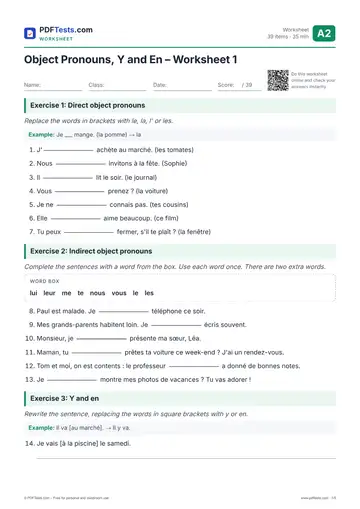
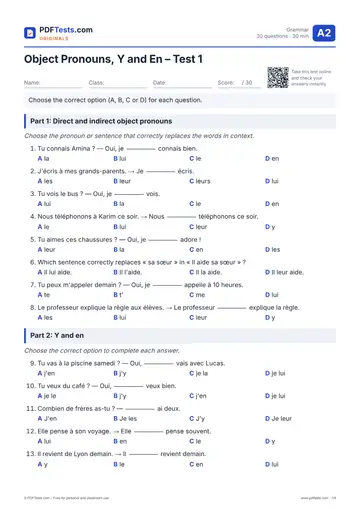
Now put the rules into practice: test yourself with our A2 Object Pronouns, Y and En test, and pay special attention to the choice between le / la / les and en, and between lui / leur and y. If word order in the past still causes trouble, revisit the passé composé before moving on to the other French A2 tests.
Practise this topic: French Object Pronouns, Y and En
Was this page helpful?
What was the problem?
Thank you for your feedback!