French has two common ways to talk about the future. The futur proche (aller + infinitive) is used for plans, intentions and things that are about to happen. The futur simple (one-word forms like je partirai) is used for predictions, promises, more distant or formal future, and after quand when the action is in the future.
The futur proche
Form: aller + infinitive
Conjugate aller in the present tense and add the infinitive of the main verb. The infinitive never changes.
| Subject | aller | Example |
|---|---|---|
| je | vais | Je vais manger. – I’m going to eat. |
| tu | vas | Tu vas sortir ce soir. – You’re going to go out tonight. |
| il / elle / on | va | Il va pleuvoir. – It’s going to rain. |
| nous | allons | Nous allons partir. – We’re going to leave. |
| vous | allez | Vous allez voir. – You’ll see. |
| ils / elles | vont | Elles vont arriver. – They’re going to arrive. |
If the forms of aller are still shaky, revise them in our guide to the present tense of irregular verbs.
Je vais aller is perfectly correct French: Je vais aller au cinéma. – I’m going to go to the cinema.
Negative and questions
| Type | Rule | Example |
|---|---|---|
| Negative | ne … pas goes around aller | Je ne vais pas travailler demain. – I’m not going to work tomorrow. |
| Question (intonation) | rising voice at the end | Tu vas venir ? – Are you going to come? |
| Question (est-ce que) | est-ce que + statement | Est-ce que vous allez rester ? – Are you going to stay? |
| Question (inversion) | aller + subject + infinitive | Va-t-elle accepter ? – Is she going to accept? |
Object pronouns and reflexive pronouns go before the infinitive, not before aller:
- Je vais le faire. – I’m going to do it.
- Nous allons nous lever tôt. – We’re going to get up early.
- Tu ne vas pas y aller ? – Aren’t you going to go there?
For more on where ne … pas goes, see our guide to negation (ne … pas).
When to use the futur proche
1. Plans and intentions already decided
Ce week-end, je vais repeindre ma chambre. – This weekend I’m going to repaint my room.
2. Something about to happen, or something you can see coming
Attention, le bus va partir. – Careful, the bus is about to leave.
Regarde ces nuages : il va pleuvoir. – Look at those clouds: it’s going to rain.
3. Everyday conversation
In spoken French, the futur proche is the default for many speakers, even for events that are not very close.
On va manger une pizza ce soir ? – Shall we have pizza tonight?
The futur simple
Form of regular verbs
Take the infinitive as the stem (for -re verbs, drop the final -e) and add the endings. The endings are the same for every verb in French.
| Subject | Ending | parler | finir | prendre |
|---|---|---|---|---|
| je | -ai | parlerai | finirai | prendrai |
| tu | -as | parleras | finiras | prendras |
| il / elle / on | -a | parlera | finira | prendra |
| nous | -ons | parlerons | finirons | prendrons |
| vous | -ez | parlerez | finirez | prendrez |
| ils / elles | -ont | parleront | finiront | prendront |
Two memory tips: the endings look like the present of avoir (ai, as, a, (av)ons, (av)ez, ont), and every futur simple form has an r just before the ending.
- Je te téléphonerai ce soir. – I’ll phone you tonight.
- Ils finiront le projet en juin. – They will finish the project in June.
Spelling changes in -er verbs
Some -er verbs change their spelling in the same way as the je form of the present, and keep that change in all persons.
| Infinitive | Futur simple | Translation |
|---|---|---|
| acheter | j’achèterai | I will buy |
| se lever | je me lèverai | I will get up |
| appeler | j’appellerai | I will call |
| jeter | je jetterai | I will throw |
| payer | je paierai (or je payerai) | I will pay |
| nettoyer | je nettoierai | I will clean |
Verbs like préférer traditionally keep é: je préférerai (préfèrerai is also accepted).
Irregular stems
The endings never change, but some common verbs have an irregular stem. Learn these as a list.
| Infinitive | Stem | Example |
|---|---|---|
| être | ser- | Je serai prêt à huit heures. – I’ll be ready at eight. |
| avoir | aur- | Tu auras le temps ? – Will you have time? |
| aller | ir- | Nous irons à la plage. – We’ll go to the beach. |
| faire | fer- | Il fera beau demain. – The weather will be nice tomorrow. |
| venir | viendr- | Elle viendra avec nous. – She’ll come with us. |
| voir | verr- | On verra. – We’ll see. |
| pouvoir | pourr- | Vous pourrez entrer. – You’ll be able to come in. |
| vouloir | voudr- | Ils voudront rester. – They’ll want to stay. |
| devoir | devr- | Tu devras attendre. – You’ll have to wait. |
| savoir | saur- | Je saurai demain. – I’ll know tomorrow. |
| envoyer | enverr- | J’enverrai le message. – I’ll send the message. |
| falloir | faudr- | Il faudra partir tôt. – We’ll have to leave early. |
| pleuvoir | pleuvr- | Il pleuvra ce week-end. – It will rain this weekend. |
Also useful: tenir → tiendr-, recevoir → recevr-, courir → courr-, mourir → mourr-.
Pronunciation notes
- In -er verbs, the e before -rai is often dropped in everyday speech: je parlerai sounds like je parl’rai.
- The je ending -ai is pronounced like é. The conditional je parlerais ends in -ais. Many speakers pronounce them almost the same, so be careful in writing.
Negative and questions
| Type | Example |
|---|---|
| Negative | Je ne viendrai pas. – I won’t come. |
| Intonation | Tu viendras ? – Will you come? |
| Est-ce que | Est-ce que vous serez là ? – Will you be there? |
| Inversion | Viendra-t-il ? – Will he come? |
In inversion, add -t- when the verb ends in a vowel and the pronoun starts with one: Parlera-t-elle ? Pronouns go before the verb: Je ne le ferai pas. – I won’t do it.
When to use the futur simple
1. Predictions and forecasts
Demain, il fera 25 degrés dans le sud. – Tomorrow it will be 25 degrees in the south.
2. Promises and firm statements
Je ne recommencerai pas, promis. – I won’t do it again, I promise.
3. A more distant or less certain future
Un jour, j’habiterai à Montréal. – One day I’ll live in Montreal.
4. Formal and written French
Le magasin sera fermé le 1er mai. – The shop will be closed on 1 May.
5. After quand, lorsque and dès que when the action is in the future
Quand tu arriveras, appelle-moi. – When you arrive, call me.
English uses the present after when; French uses the future. This is one of the most common mistakes for English speakers.
6. In the main clause after si + present
S’il pleut, nous resterons à la maison. – If it rains, we’ll stay at home.
Never put the future directly after si. Our guide to si clauses explains the full pattern.
Signal words
| Often with futur proche | Often with futur simple |
|---|---|
| tout de suite, dans cinq minutes, tout à l’heure, ce soir, bientôt | un jour, plus tard, à l’avenir, dans dix ans, quand…, si… + present |
Many time expressions work with both: demain, la semaine prochaine, l’année prochaine. The choice then depends on tone and meaning, not on the time word.
Futur proche or futur simple?
Often both are correct:
- Demain, je vais voir Paul. – Tomorrow I’m going to see Paul.
- Demain, je verrai Paul. – Tomorrow I’ll see Paul.
The difference is mainly style and how connected the event feels to the present.
| Futur proche | Futur simple |
|---|---|
| Very common in speech | Common in writing and formal speech, also used in conversation |
| Plans and intentions | Predictions and promises |
| Imminent events, visible signs | Distant or uncertain events |
| Feels linked to now | Feels more detached |
| — | Standard choice after quand, dès que |
Some situations clearly prefer one form:
- Attention, tu vas tomber. – Careful, you’re going to fall. (immediate danger: futur proche)
- Je te rendrai ton livre lundi. – I’ll give you your book back on Monday. (promise: futur simple sounds natural)
Common mistakes
- ✗ Je vais à manger. → ✓ Je vais manger. Aller is followed directly by the infinitive, with no preposition.
- ✗ Je vais mange. → ✓ Je vais manger. The second verb stays in the infinitive.
- ✗ Je ne vais manger pas. → ✓ Je ne vais pas manger. Ne … pas goes around aller, the conjugated verb.
- ✗ Je le vais faire. → ✓ Je vais le faire. The pronoun goes before the infinitive.
- ✗ J’allerai à Paris. → ✓ J’irai à Paris. Aller has the irregular stem ir-.
- ✗ Je prendreai le train. → ✓ Je prendrai le train. Drop the final -e of -re verbs.
- ✗ Quand je suis à Rome, je visiterai le Colisée. → ✓ Quand je serai à Rome, je visiterai le Colisée. Use the future after quand for a future action.
- ✗ S’il pleuvra, on restera ici. → ✓ S’il pleut, on restera ici. No future directly after si.
- ✗ Demain, je serais à la maison. → ✓ Demain, je serai à la maison. -ais is the conditional; see our conditionnel guide.
Quick check
- Regarde le ciel : il ______ (pleuvoir – futur proche).
- Quand j’______ (avoir) 18 ans, je passerai mon permis.
- L’été prochain, nous ______ (aller – futur simple) en Bretagne.
- Correct the sentence: Je ne vais regarder pas le film.
- S’il fait beau samedi, on ______ (faire – futur simple) un pique-nique.
Answers
- va pleuvoir – Look at the sky: it’s going to rain.
- aurai – When I’m 18, I’ll take my driving test.
- irons – Next summer we’ll go to Brittany.
- Je ne vais pas regarder le film. – I’m not going to watch the film.
- fera – If the weather is nice on Saturday, we’ll have a picnic.
Next step
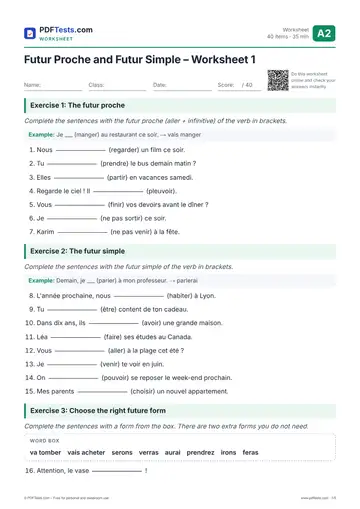
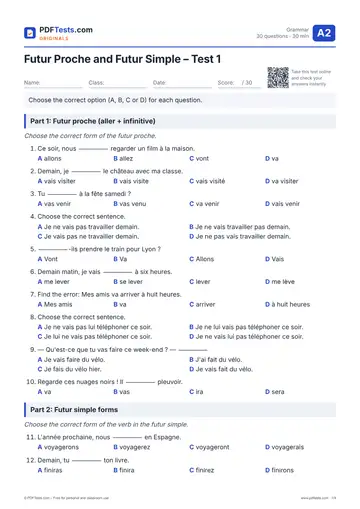
Now put both tenses into practice: test yourself with our A2 Futur Proche and Futur Simple test and check that you can choose the right form and spell the irregular stems without hesitating. If you score well, move on to the other French A2 tests to review the future alongside the passé composé and the imparfait.
Was this page helpful?
What was the problem?
Thank you for your feedback!