The French passive voice (la voix passive) is formed with être + past participle. You use it to put the focus on the person or thing affected by an action rather than on who did it. It is common in news reports, formal writing and descriptions of processes. In everyday speech, French often prefers on or other structures instead.
What the passive voice is
In an active sentence, the subject does the action. In a passive sentence, the direct object of the active sentence becomes the subject. The person or thing doing the action (the agent) moves to the end with par, or is left out.
- Le chef prépare le repas. – The chef prepares the meal. (active)
- Le repas est préparé par le chef. – The meal is prepared by the chef. (passive)
The tense stays the same: present active gives present passive, past gives past, and so on.
When to use the passive
1. To focus on what happens to someone or something
- Le suspect a été arrêté ce matin. – The suspect was arrested this morning.
- Trois personnes ont été blessées dans l’accident. – Three people were injured in the accident.
2. When the agent is unknown, obvious or unimportant
- Ma voiture a été réparée. – My car has been repaired.
- Ce château a été construit au XVIe siècle. – This castle was built in the 16th century.
3. In formal, written and news contexts
- Les nouvelles mesures seront annoncées lundi. – The new measures will be announced on Monday.
- Les candidats sont priés de se présenter à 9 heures. – Candidates are requested to arrive at 9 o’clock.
How to form the passive
The rule is simple: être (in the tense you need) + past participle of the main verb. The participle agrees with the subject.
Present passive: être invité
| Subject | Form | Translation |
|---|---|---|
| je | suis invité(e) | I am invited |
| tu | es invité(e) | you are invited |
| il / elle | est invité / invitée | he / she is invited |
| nous | sommes invité(e)s | we are invited |
| vous | êtes invité(e)(s) | you are invited |
| ils / elles | sont invités / invitées | they are invited |
The passive in different tenses
Only être changes. The participle stays in the same place.
| Tense | Passive sentence | Translation |
|---|---|---|
| Présent | Les résultats sont publiés. | The results are published. |
| Imparfait | Les résultats étaient publiés. | The results were (being) published. |
| Passé composé | Les résultats ont été publiés. | The results were / have been published. |
| Plus-que-parfait | Les résultats avaient été publiés. | The results had been published. |
| Futur simple | Les résultats seront publiés. | The results will be published. |
| Futur proche | Les résultats vont être publiés. | The results are going to be published. |
| Conditionnel | Les résultats seraient publiés. | The results would be published. |
| Subjonctif | Il faut que les résultats soient publiés. | The results must be published. |
Tip: to identify the tense of a passive sentence, look only at être. In ont été publiés, ont été is the passé composé of être, so the sentence is in the past.
Negative and question forms
In compound tenses, ne … pas goes around the first auxiliary (avoir), not around été.
| Form | Example | Translation |
|---|---|---|
| Affirmative | Le colis a été livré. | The parcel has been delivered. |
| Negative | Le colis n’a pas été livré. | The parcel hasn’t been delivered. |
| Question (intonation) | Le colis a été livré ? | Has the parcel been delivered? |
| Question (est-ce que) | Est-ce que le colis a été livré ? | Has the parcel been delivered? |
| Question (inversion) | Le colis a-t-il été livré ? | Has the parcel been delivered? |
Agreement of the past participle
In the passive, the past participle always agrees with the subject in gender and number, exactly like an adjective after être. If you need a refresher, see our guide to French adjective agreement.
| Subject | Example | Translation |
|---|---|---|
| masculine singular | Le film a été tourné à Lyon. | The film was shot in Lyon. |
| feminine singular | La lettre a été écrite à la main. | The letter was written by hand. |
| masculine plural | Les dossiers ont été envoyés. | The files have been sent. |
| feminine plural | Les fenêtres ont été ouvertes. | The windows have been opened. |
Note that été itself never changes. Only the main participle agrees.
Pronunciation note
With many verbs you cannot hear the agreement: invité and invitée sound the same. But with participles ending in a consonant, the feminine is audible: écrit / écrite, pris / prise, ouvert / ouverte, fait / faite, mis / mise.
- La décision a été prise hier. – The decision was made yesterday. (you hear the -s- sound)
For the more complex agreement rules with avoir and pronominal verbs, see our guide to past participle agreement.
Par or de for the agent
Most of the time, the agent is introduced by par:
- Ce roman a été écrit par Albert Camus. – This novel was written by Albert Camus.
Use de with:
-
verbs of feeling or opinion: aimer, adorer, détester, respecter, admirer, craindre, connaître
-
verbs describing a state or position: entourer, couvrir, remplir, composer, accompagner
-
Cette actrice est aimée de tous. – This actress is loved by everyone.
-
Le village est entouré de montagnes. – The village is surrounded by mountains.
-
La table était couverte de papiers. – The table was covered with papers.
With a real, single action, par is used even with these verbs: Le terrain a été entouré d’une clôture par les ouvriers. – The land was fenced in by the workers.
Which verbs can be passive
Only verbs with a direct object (no preposition) can become passive. Verbs that take à + person cannot: téléphoner à, parler à, demander à, dire à, répondre à, conseiller à, permettre à.
English says I was asked or She was told, but French cannot say ✗ J’ai été demandé. Use on instead:
- On m’a demandé de venir. – I was asked to come.
- On lui a dit la vérité. – She was told the truth.
Alternatives to the passive
French uses the passive less often than English. These three alternatives are very common.
1. On + active verb
This is the most natural choice in speech when there is no agent.
- On a volé mon vélo. – My bike was stolen.
- Ici, on parle anglais. – English is spoken here.
2. The pronominal passive: se + verb
Used with things (not people) for general truths, habits and rules. There is no agent. For the basics of these verbs, see our guide to pronominal verbs.
- Ce vin se boit frais. – This wine is drunk chilled.
- Le français se parle au Québec. – French is spoken in Quebec.
- Ça ne se fait pas. – That isn’t done.
3. Se faire + infinitive
Used mainly for people, often when something unpleasant happens to them.
- Il s’est fait voler son portefeuille. – He had his wallet stolen.
- Elle s’est fait renverser par une voiture. – She was knocked over by a car.
In this structure, fait does not agree: elle s’est fait renverser.
Passive or passé composé with être?
Learners often confuse two structures that both use être:
- Elle est partie. – She left. (active passé composé of a movement verb; she did the action)
- Elle est invitée. – She is invited. (present passive; someone invites her)
Ask yourself: is the subject doing the action or receiving it? Verbs like partir, arriver, tomber, venir form their passé composé with être, but they are not passive.
Était or a été?
English was + participle has two French equivalents:
- La maison a été vendue en mai. – The house was sold in May. (a completed event)
- La maison était vendue depuis longtemps. – The house had been sold for a long time / was already sold. (a state or background)
For a single finished action in the past, a été is usually the right choice.
Common mistakes
- ✗ La lettre a été écrit par Paul. → ✓ La lettre a été écrite par Paul. – The participle must agree with the feminine subject.
- ✗ Le musée est été construit en 1990. → ✓ Le musée a été construit en 1990. – The passé composé of être uses avoir: a été.
- ✗ Le gâteau est mangé hier. → ✓ Le gâteau a été mangé hier. – A finished past action needs the past tense of être.
- ✗ J’ai été téléphoné. → ✓ On m’a téléphoné. – Téléphoner à has no direct object, so it cannot be passive.
- ✗ La maison a été construite de mon grand-père. → ✓ La maison a été construite par mon grand-père. – Action verbs take par, not de.
- ✗ Les résultats ont été pas publiés. → ✓ Les résultats n’ont pas été publiés. – Ne … pas goes around the first auxiliary.
- ✗ Elle s’est faite voler son sac. → ✓ Elle s’est fait voler son sac. – Fait is invariable before an infinitive.
Quick check
- Make passive: Le jury choisira le gagnant.
- Complete: Ces chansons ont été ___ (écrire) par Brel.
- Par or de? Le directeur est respecté ___ tous ses employés.
- Rewrite with on: Mon vélo a été volé.
- Correct the sentence: Nous avons été parlés de ce projet.
Answers
- Le gagnant sera choisi par le jury. – The winner will be chosen by the jury.
- écrites – feminine plural, agreeing with ces chansons.
- de – respecter expresses a feeling, so de is preferred.
- On a volé mon vélo. – My bike was stolen.
- On nous a parlé de ce projet. – We were told about this project. (parler à cannot be passive)
Next step
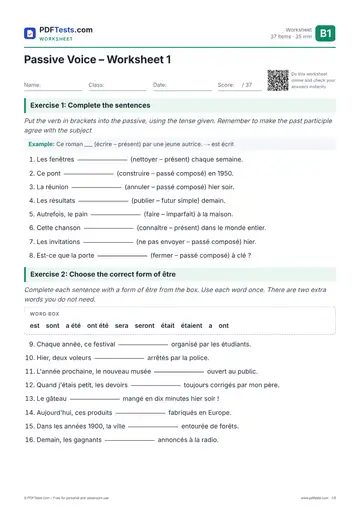
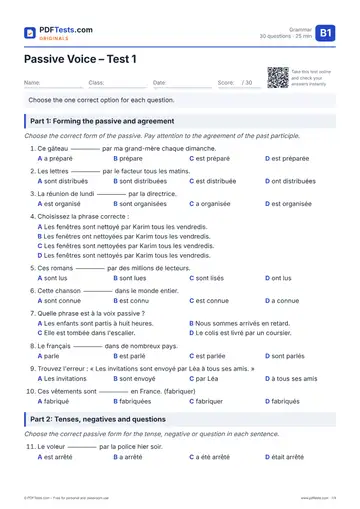
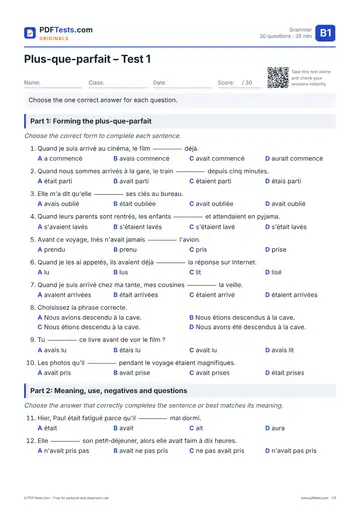
Now put the rules into practice: test yourself with our B1 Passive Voice test and check that you can choose the right tense of être, make the participle agree and decide between par, de, on and se. When you are confident, explore the other French B1 tests to see how the passive combines with the other tenses you know.
Was this page helpful?
What was the problem?
Thank you for your feedback!