Possessive articles are the German words for my, your, his, her, its, our and their: mein, dein, sein, ihr, unser, euer and formal Ihr. They go in front of a noun and show who it belongs to, as in mein Handy (my phone) or deine Schwester (your sister). Their endings work exactly like ein and kein, so they change with the gender of the noun and with the case.
The possessive articles at a glance
Every personal pronoun has its own possessive article.
| Pronoun | Possessive | English |
|---|---|---|
| ich | mein | my |
| du | dein | your (informal, one person) |
| er | sein | his / its |
| sie | ihr | her / its |
| es | sein | its |
| wir | unser | our |
| ihr | euer | your (informal, two or more people) |
| sie | ihr | their |
| Sie | Ihr | your (formal) |
- Das ist mein Bruder. – This is my brother.
- Wo ist dein Rucksack? – Where is your backpack?
- Unser Hund heißt Bello. – Our dog is called Bello.
The forms in the table (mein, dein, sein…) are the stems. You add an ending to the stem, and that ending depends on the noun that follows, not on the owner.
Two questions to ask every time
To choose the correct form, ask yourself two questions:
- Who is the owner? This gives you the stem: mein-, dein-, sein-, ihr-, unser-, euer-, Ihr-.
- What noun follows, and what is its job in the sentence? The gender (der, die, das or plural) and the case (nominative or accusative at A1) give you the ending.
Example: my sister. The owner is ich, so the stem is mein-. Schwester is feminine (die Schwester), so the form is meine.
- Meine Schwester wohnt in Hamburg. – My sister lives in Hamburg.
If you are not sure about the gender of a noun, review our guide to German articles der, die, das. Possessive articles are impossible to get right without knowing the gender.
Nominative: the subject and after sein
Use the nominative when the noun is the subject of the sentence, and after sein (to be) and heißen (to be called). The endings are simple: no ending for masculine and neuter, -e for feminine and plural.
| Owner | der Vater (m) | die Mutter (f) | das Kind (n) | die Eltern (pl) |
|---|---|---|---|---|
| ich | mein | meine | mein | meine |
| du | dein | deine | dein | deine |
| er / es | sein | seine | sein | seine |
| sie | ihr | ihre | ihr | ihre |
| wir | unser | unsere | unser | unsere |
| ihr | euer | eure | euer | eure |
| sie / Sie | ihr / Ihr | ihre / Ihre | ihr / Ihr | ihre / Ihre |
- Mein Vater ist Lehrer. – My father is a teacher.
- Ist das deine Jacke? – Is that your jacket?
- Sein Zimmer ist sehr klein. – His room is very small.
- Unsere Kinder spielen im Garten. – Our children are playing in the garden.
- Wie ist Ihre Telefonnummer? – What is your phone number?
Accusative: the direct object
Use the accusative when the noun is the direct object, for example after verbs like haben, sehen, suchen, kaufen, brauchen, besuchen, lieben, finden and after es gibt. The good news: only the masculine form changes. It gets -en. Feminine, neuter and plural stay the same as in the nominative.
| Owner | den Vater (m) | die Mutter (f) | das Kind (n) | die Eltern (pl) |
|---|---|---|---|---|
| ich | meinen | meine | mein | meine |
| du | deinen | deine | dein | deine |
| er / es | seinen | seine | sein | seine |
| sie | ihren | ihre | ihr | ihre |
| wir | unseren | unsere | unser | unsere |
| ihr | euren | eure | euer | eure |
| sie / Sie | ihren / Ihren | ihre / Ihre | ihr / Ihr | ihre / Ihre |
- Ich besuche meinen Opa. – I’m visiting my grandpa.
- Hast du deinen Schlüssel? – Do you have your key?
- Wir verkaufen unser Auto. – We’re selling our car.
- Sie liebt ihre Katze. – She loves her cat.
- Ich suche meine Brille. – I’m looking for my glasses.
For more on when to use this case, see our guide to the German accusative case.
Same endings as ein and kein
If you already know ein and kein, you already know the endings of possessive articles. Just replace the first part of the word.
| Case | Masculine | Feminine | Neuter | Plural |
|---|---|---|---|---|
| Nominative | ein / kein / mein | eine / keine / meine | ein / kein / mein | – / keine / meine |
| Accusative | einen / keinen / meinen | eine / keine / meine | ein / kein / mein | – / keine / meine |
- Das ist kein Hund, das ist mein Hund. – That isn’t a dog, that’s my dog. (joke, but the endings match)
- Ich habe keinen Bruder, aber ich habe meinen Cousin. – I don’t have a brother, but I have my cousin.
Our guide to nicht and kein shows the same ending pattern in negative sentences.
sein or ihr: it depends on the owner
This works like English his and her. The owner decides the stem: a male owner (er) gives sein-, a female owner (sie) gives ihr-. Then the noun after it decides the ending.
- Tom und seine Schwester – Tom and his sister
- Lisa und ihr Bruder – Lisa and her brother
- Lisa und ihre Schwester – Lisa and her sister
Be careful: in Lisa und ihr Bruder, Bruder is masculine, but the word is still ihr, because Lisa is the owner.
One difference from English: German uses sein and ihr for things and animals too, based on their grammatical gender. Its can be sein or ihr.
- Die Katze frisst ihr Futter. – The cat is eating its food. (die Katze → ihr)
- Der Hund sucht seinen Ball. – The dog is looking for its ball. (der Hund → sein)
- Das Baby trinkt seine Milch. – The baby is drinking its milk. (das Baby → sein)
The many meanings of ihr
The small word ihr causes a lot of confusion because it has several jobs.
| Word | Meaning | Example |
|---|---|---|
| ihr (possessive) | her | Anna ruft ihre Mutter an. – Anna calls her mother. |
| ihr (possessive) | their | Die Kinder suchen ihre Schuhe. – The children are looking for their shoes. |
| Ihr (possessive, capital I) | your (formal) | Herr Weber, ist das Ihr Koffer? – Mr Weber, is this your suitcase? |
| ihr (personal pronoun) | you (plural) | Ihr seid sehr nett. – You are very nice. |
The last one is not a possessive article. The possessive for ihr (you plural) is euer: Ihr habt euer Ticket. – You have your ticket. In writing, the formal Ihr always has a capital letter, even in the middle of a sentence. In speech, context tells you which meaning is meant.
Spelling note: euer and unser
When euer gets an ending, it usually loses its second e: eure, euren (not euere, eueren).
- Wo ist eure Wohnung? – Where is your flat?
- Habt ihr euren Hund dabei? – Do you have your dog with you?
Unser keeps all its letters: unsere, unseren. The -er at the end of unser and euer is part of the stem, not an ending.
- Wir besuchen unseren Onkel. – We’re visiting our uncle.
Questions and answers
In conversations, the possessive often changes between the question and the answer, because the speaker changes.
| Question | Answer |
|---|---|
| Ist das dein Handy? – Is that your phone? | Ja, das ist mein Handy. – Yes, that’s my phone. |
| Ist das Ihre Tasche? – Is that your bag? (formal) | Nein, das ist nicht meine Tasche. – No, that’s not my bag. |
| Ist das euer Auto? – Is that your car? (plural) | Ja, das ist unser Auto. – Yes, that’s our car. |
So dein / Ihr in the question becomes mein in the answer, and euer becomes unser. The ending stays the same because the noun does not change.
Useful A1 phrases: Wie ist Ihr Name? (What is your name?), Meine Adresse ist … (My address is …), Wie alt ist deine Tochter? (How old is your daughter?).
Looking ahead: the dative
After prepositions like mit, bei and von, possessive articles take dative endings: mit meinem Bruder (with my brother), bei meiner Oma (at my grandma’s), von meinen Freunden (from my friends). You will meet these at A2 in our guide to the German dative case. At A1, focus on the nominative and accusative.
Common mistakes
- ✗ Das ist meine Vater. → ✓ Das ist mein Vater. Vater is masculine, so there is no ending in the nominative.
- ✗ Ich besuche mein Bruder. → ✓ Ich besuche meinen Bruder. A masculine direct object needs -en in the accusative.
- ✗ Ich habe meinen Tasche. → ✓ Ich habe meine Tasche. Tasche is feminine; only masculine nouns take -en.
- ✗ Anna liebt seinen Hund. (meaning her dog) → ✓ Anna liebt ihren Hund. The owner is female, so use ihr-.
- ✗ Wo ist euere Mutter? → ✓ Wo ist eure Mutter? Euer drops the second e when it has an ending.
- ✗ Herr Weber, ist das ihr Koffer? → ✓ Herr Weber, ist das Ihr Koffer? Formal your is written with a capital I.
- ✗ Ihr habt ihr Ticket. (meaning your) → ✓ Ihr habt euer Ticket. The possessive for plural you is euer.
Quick check
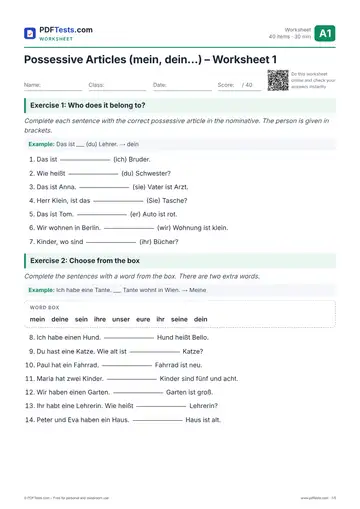
Fill in the correct possessive article. The owner is given in brackets.
- Das ist ___ Schwester. (ich)
- Ich suche ___ Schlüssel. (ich) – der Schlüssel
- Lukas ruft ___ Mutter an. (er)
- Kinder, wo sind ___ Jacken? (ihr)
- Frau Klein, ist das ___ Auto? (Sie)
Answers
- meine – feminine, nominative.
- meinen – masculine, accusative.
- seine – the owner is Lukas (er), and Mutter is feminine.
- eure – plural noun, and euer drops its e.
- Ihr – formal, neuter, capital I.
Next step
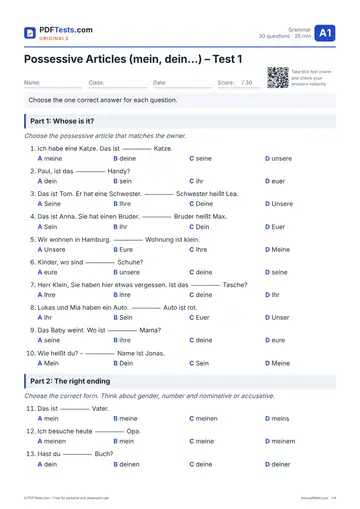
Now put the endings into practice: test yourself with our A1 Possessive Articles test, which mixes nominative and accusative forms and the tricky choice between sein and ihr. Possessive articles appear constantly when you talk about people and things around you, so the A1 Everyday Vocabulary test on family, home and daily routine is a natural follow-up to combine the grammar with the words you will use most.
Practise this topic: German Possessive Articles (mein, dein…)
Was this page helpful?
What was the problem?
Thank you for your feedback!