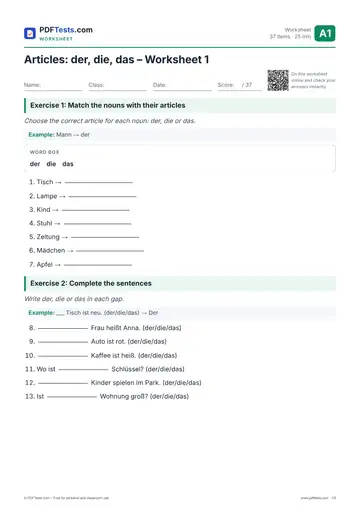
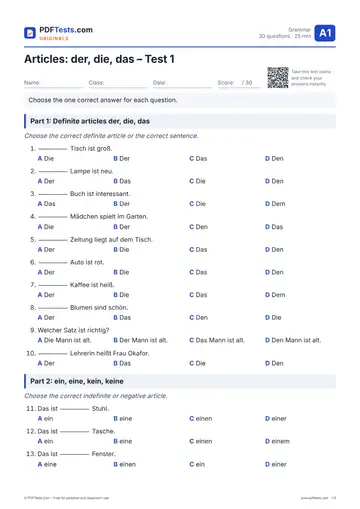
German has three words for the: der, die and das. Every German noun has a grammatical gender: masculine (der), feminine (die) or neuter (das). In the plural, all nouns use die.
You use these articles like English the: for specific things that you and the listener both know. Choosing the right one is one of the first big steps in German, because the article also shapes pronouns, adjective endings and cases later on.
The three genders
Gender in German is grammatical, not biological. A table is not really male, and a girl is not really neutral, but the grammar treats them that way.
| Gender | Article | Example | Translation |
|---|---|---|---|
| Masculine | der | der Tisch | the table |
| Feminine | die | die Lampe | the lamp |
| Neuter | das | das Buch | the book |
| Plural (all genders) | die | die Bücher | the books |
A classic example shows how random gender can look:
- der Löffel – the spoon
- die Gabel – the fork
- das Messer – the knife
Three pieces of cutlery, three different genders. And one famous surprise: das Mädchen – the girl – is neuter, because all nouns ending in -chen are neuter.
Learn every noun with its article
The most useful habit you can build at A1 is this: never learn a noun alone. Learn der Tisch, not just Tisch. Write the article in your vocabulary list, say it out loud, and use colours if they help you (for example blue for der, red for die, green for das).
Spelling note: nouns start with a capital letter
All German nouns are capitalised, not only names: der Tisch, die Stadt, das Wasser. The article itself is written in lower case unless it starts the sentence.
- Der Kaffee ist heiß. – The coffee is hot.
- Ich finde den Kaffee gut. – I think the coffee is good.
When to use der, die, das
1. Something specific or already known
Use the definite article when both speakers know which thing you mean.
- Die Tasche ist teuer. – The bag is expensive.
- Wo ist das Handy? – Where is the phone?
2. Something mentioned before
The first time you mention something, you usually say ein/eine (a). After that, you switch to der/die/das.
- Da ist ein Café. Das Café ist neu. – There is a café. The café is new.
- Hier ist eine Bäckerei. Die Bäckerei ist gut. – Here is a bakery. The bakery is good.
3. Unique things
Things that exist only once take the definite article.
- Die Sonne scheint. – The sun is shining.
- Der Mond ist schön heute. – The moon is beautiful today.
4. Days, months and seasons
These are all masculine, and German often uses the article where English does not.
- Der Sommer ist warm. – Summer is warm.
- Der Montag ist mein Lieblingstag. – Monday is my favourite day.
5. A few countries
Most countries have no article (Deutschland, Spanien), but some do, and you must learn them:
- Die Schweiz ist schön. – Switzerland is beautiful.
- Die Türkei, die USA – Turkey, the USA
Patterns that help you guess the gender
There is no rule for every noun, but many endings and word groups are reliable. These patterns cover a large number of everyday words.
Usually masculine (der)
| Group or ending | Examples |
|---|---|
| Male people | der Mann, der Vater, der Bruder |
| Days, months, seasons | der Montag, der Mai, der Winter |
| Weather | der Regen, der Schnee, der Wind |
| -er for people/jobs | der Lehrer, der Bäcker, der Fahrer |
| -ling | der Frühling, der Schmetterling |
- Der Lehrer ist nett. – The teacher is nice.
Be careful: not every noun in -er is masculine. Das Fenster (the window) and die Butter (the butter) are exceptions.
Usually feminine (die)
| Group or ending | Examples |
|---|---|
| Female people | die Frau, die Mutter, die Schwester |
| -in (female jobs) | die Lehrerin, die Ärztin |
| -ung | die Wohnung, die Zeitung |
| -heit / -keit | die Freiheit, die Möglichkeit |
| -schaft | die Freundschaft |
| -ion | die Information, die Station |
| -tät | die Universität |
| -ie | die Familie, die Energie |
| most nouns in -e | die Lampe, die Straße, die Tasche |
- Die Wohnung ist groß. – The flat is big.
The -e rule is strong but has well-known exceptions: der Junge (the boy), der Name (the name), der Käse (the cheese), das Auge (the eye).
Usually neuter (das)
| Group or ending | Examples |
|---|---|
| -chen / -lein | das Mädchen, das Brötchen, das Fräulein |
| -um | das Museum, das Zentrum |
| -ment | das Dokument, das Medikament |
| Verbs used as nouns | das Essen, das Schwimmen |
| Many words ending in -o | das Auto, das Kino, das Büro |
| Young people and animals | das Kind, das Baby |
- Das Brötchen ist frisch. – The bread roll is fresh.
One exception to note: der Moment (the moment) is masculine.
Compound nouns: the last word decides
German builds long nouns by joining shorter ones. The gender always comes from the last part.
- das Haus + die Tür → die Haustür – the front door
- die Kinder + der Garten → der Kindergarten – the kindergarten
- die Bahn + der Hof → der Bahnhof – the station
The plural is always die
This is the good news: in the plural, you never have to choose. Every noun takes die, and the verb is plural too.
-
der Mann → die Männer – the men
-
das Kind → die Kinder – the children
-
die Frau → die Frauen – the women
-
Die Kinder sind im Park. – The children are in the park.
The plural forms of the nouns themselves vary, so learn them with the noun: der Tisch, die Tische.
der, die, das and the pronouns er, sie, es
The gender also decides the pronoun. In English, objects are all it, but in German the pronoun matches the article.
| Article | Pronoun | Example |
|---|---|---|
| der | er | Der Tisch ist neu. Er ist schön. – The table is new. It is nice. |
| die | sie | Die Lampe ist alt. Sie ist kaputt. – The lamp is old. It is broken. |
| das | es | Das Buch ist gut. Es ist spannend. – The book is good. It is exciting. |
| die (pl.) | sie | Die Äpfel sind rot. Sie sind süß. – The apples are red. They are sweet. |
der, die, das vs. ein, eine
Learners often mix up the definite article (the) and the indefinite article (a/an). The indefinite article also follows the gender:
| Gender | Definite (the) | Indefinite (a/an) | Negative (no/not a) |
|---|---|---|---|
| Masculine | der Hund | ein Hund | kein Hund |
| Feminine | die Katze | eine Katze | keine Katze |
| Neuter | das Haus | ein Haus | kein Haus |
| Plural | die Hunde | – Hunde | keine Hunde |
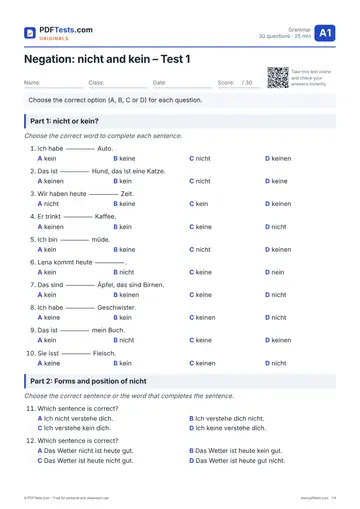
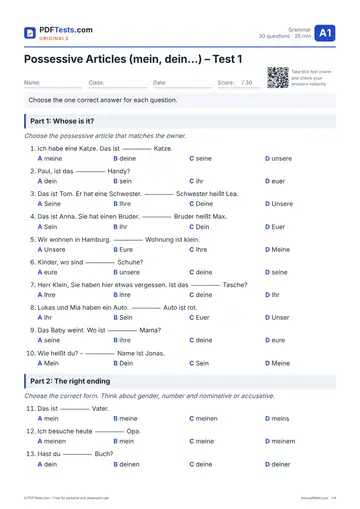
Notice that there is no plural of ein: Ich habe Kinder. – I have children. For more on kein, see our guide to negation with nicht and kein. The same endings appear in mein, dein, sein, explained in our guide to possessive articles.
Das ist … is not the article das
In the phrase Das ist … (This is / That is …), das means this/that. It does not change with gender.
- Das ist der Bahnhof. – That is the station.
- Das ist eine Lampe. – That is a lamp.
- Das sind die Kinder. – Those are the children.
A first look at cases
The forms above are the nominative, used for the subject of the sentence. When a noun is the direct object (accusative), only the masculine article changes: der → den, ein → einen.
- Der Hund ist süß. – The dog is cute. (subject)
- Ich sehe den Hund. – I see the dog. (object)
- Ich sehe die Katze / das Haus. – I see the cat / the house. (no change)
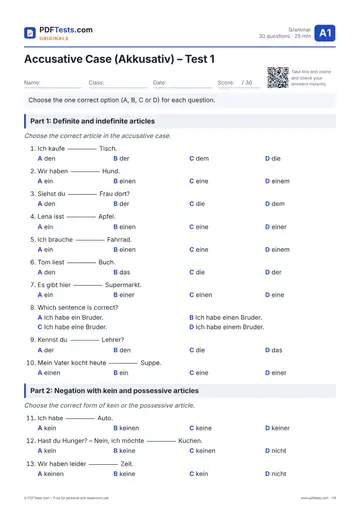
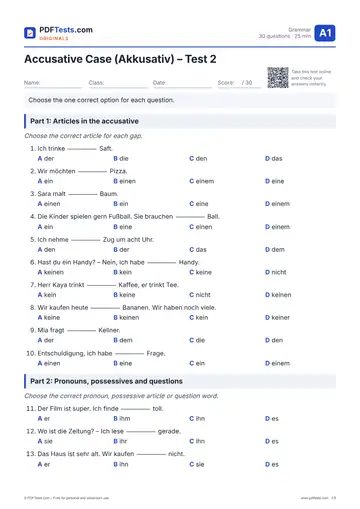
You will practise this in detail in our guide to the accusative case.
Common mistakes
- ✗ Der Mädchen ist nett. → ✓ Das Mädchen ist nett. – Nouns ending in -chen are always neuter.
- ✗ Die Haus ist groß. → ✓ Das Haus ist groß. – Haus is neuter; learn every noun with its article.
- ✗ Die Kinder ist laut. → ✓ Die Kinder sind laut. – Plural die needs a plural verb.
- ✗ Der Tisch ist neu. Sie ist schön. → ✓ Der Tisch ist neu. Er ist schön. – The pronoun must match the gender of the noun.
- ✗ die Haustür → der Haustür? ✓ die Haustür – In compounds, the last word (die Tür) decides the gender.
- ✗ Das ist ein Lampe. → ✓ Das ist eine Lampe. – Feminine nouns need eine, not ein.
- ✗ der tisch → ✓ der Tisch – All German nouns start with a capital letter.
- ✗ Ich sehe der Hund. → ✓ Ich sehe den Hund. – A masculine direct object needs den.
Quick check
Choose der, die or das.
- ___ Zeitung liegt auf dem Tisch. – The newspaper is on the table.
- ___ Brötchen ist lecker. – The bread roll is tasty.
- ___ Winter in Berlin ist kalt. – Winter in Berlin is cold.
- ___ Bücher sind neu. – The books are new.
- ___ Museum ist heute geschlossen. – The museum is closed today.
Answers
- Die Zeitung – nouns ending in -ung are feminine.
- Das Brötchen – nouns ending in -chen are neuter.
- Der Winter – seasons are masculine.
- Die Bücher – the plural always takes die.
- Das Museum – nouns ending in -um are usually neuter.
Next step
Now put the rules into practice: test yourself with our A1 Articles: der, die, das test and note every noun you get wrong, together with its article. When you feel confident, move on to how articles change for objects in the accusative, or explore more practice for your level in our German A1 tests.
Was this page helpful?
What was the problem?
Thank you for your feedback!