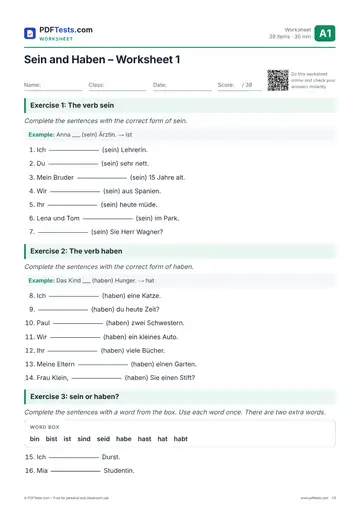
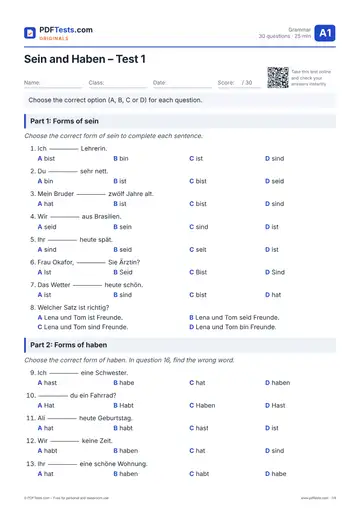
Sein (to be) and haben (to have) are the two most important verbs in German, and both are irregular. You use sein to say who someone is, where they are and what they are like. You use haben for possession, family, time and a set of fixed expressions such as being hungry or afraid.
Sein and haben at a glance
- sein links the subject to a name, job, origin, place, age or adjective: Ich bin müde. – I am tired.
- haben is followed by a noun, usually something you own or experience: Ich habe Hunger. – I am hungry (literally: I have hunger).
- Both verbs are irregular, so you need to learn every form by heart.
- In several common phrases, English uses to be where German uses haben. These are the phrases learners get wrong most often.
Sein: present tense forms
| Pronoun | sein | Example | English |
|---|---|---|---|
| ich | bin | Ich bin Anna. | I am Anna. |
| du | bist | Du bist nett. | You are nice. |
| er / sie / es | ist | Sie ist zu Hause. | She is at home. |
| wir | sind | Wir sind Freunde. | We are friends. |
| ihr | seid | Ihr seid spät. | You (all) are late. |
| sie / Sie | sind | Sie sind aus Wien. | They are / You are from Vienna. |
Pronunciation and spelling notes
- seid (you all are) and seit (since) sound exactly the same. Only the spelling is different: Seid ihr fertig? – Are you ready?
- The d in sind and seid is pronounced like a t at the end of the word.
- ist (is) is short and has no h. Do not confuse it with isst (eats), which sounds the same.
Haben: present tense forms
| Pronoun | haben | Example | English |
|---|---|---|---|
| ich | habe | Ich habe einen Bruder. | I have a brother. |
| du | hast | Du hast ein Fahrrad. | You have a bike. |
| er / sie / es | hat | Er hat Zeit. | He has time. |
| wir | haben | Wir haben Hunger. | We are hungry. |
| ihr | habt | Ihr habt Glück. | You (all) are lucky. |
| sie / Sie | haben | Sie haben Kinder. | They have / You have children. |
Notes on haben
- The b disappears in du hast and er hat. These are the two irregular forms.
- In spoken German, ich habe often becomes ich hab: Ich hab keine Zeit. – I haven’t got time. Write habe in tests and formal texts.
- Sie (formal you) and sie (they) always use the same verb form: Sie haben / Sie sind.
For how these forms fit with other irregular verbs, see our guide to the German present tense.
When to use sein
Names and identity
Ich bin Tom. Das ist meine Schwester. – I’m Tom. This is my sister.
Origin and nationality
Wir sind aus Polen. – We are from Poland. Er ist Deutscher. – He is German.
Jobs
With jobs, German uses no article:
Sie ist Ärztin. – She is a doctor. Ich bin Student. – I am a student.
Descriptions with adjectives
Die Wohnung ist klein. – The flat is small. Bist du müde? – Are you tired?
Place
Wir sind im Büro. – We are in the office. Wo ist der Bahnhof? – Where is the station?
Age
Age always uses sein, never haben:
Ich bin 25 (Jahre alt). – I am 25 (years old). Wie alt bist du? – How old are you?
When to use haben
Possession
Ich habe ein Auto. – I have a car. Hast du ein Handy? – Do you have a mobile phone?
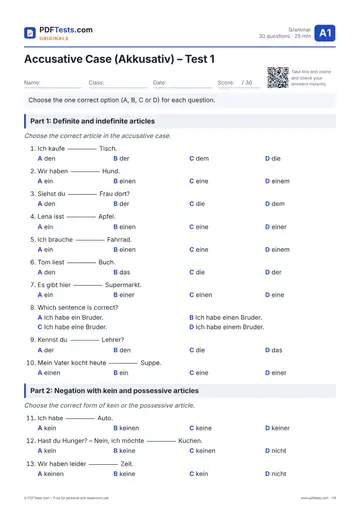
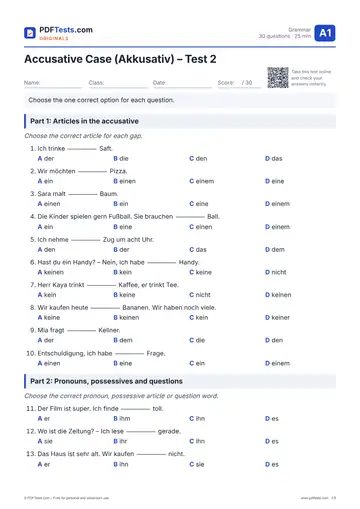
The noun after haben is in the accusative, so masculine ein becomes einen: Er hat einen Hund. – He has a dog. Our guide to the accusative case explains this in detail.
Family and friends
Ich habe zwei Schwestern. – I have two sisters. Sie hat viele Freunde. – She has a lot of friends.
Time, appointments and lessons
Hast du heute Zeit? – Do you have time today? Wir haben am Montag Deutsch. – We have German on Monday. Ich habe um drei einen Termin. – I have an appointment at three.
Body and feelings (haben + noun)
Ich habe Hunger / Durst. – I am hungry / thirsty. Er hat Kopfschmerzen. – He has a headache. Das Kind hat Angst. – The child is afraid.
Sein vs haben: where English and German differ
This table shows common phrases where English uses to be but German uses haben, plus a few useful contrasts.
| English | German | Verb |
|---|---|---|
| I am hungry. | Ich habe Hunger. | haben |
| I am thirsty. | Ich habe Durst. | haben |
| I am afraid. | Ich habe Angst. | haben |
| I am lucky. | Ich habe Glück. | haben |
| I am right. | Ich habe recht. | haben |
| It’s my birthday. | Ich habe Geburtstag. | haben |
| I am 30. | Ich bin 30. | sein |
| I am ill. | Ich bin krank. | sein |
| I am cold. | Mir ist kalt. | sein |
A simple rule helps: sein + adjective, haben + noun. Hunger, Durst and Angst are nouns, so they take haben. Müde, krank and glücklich are adjectives, so they take sein.
The phrase Mir ist kalt (I feel cold) is a fixed expression with mir (to me). Ich bin kalt means you are a cold, unfriendly person.
Negatives and questions
Negatives
Use nicht with adjectives, places and names. Use kein with nouns that have ein or no article.
| sein | haben | |
|---|---|---|
| Affirmative | Ich bin müde. – I am tired. | Ich habe ein Auto. – I have a car. |
| Negative | Ich bin nicht müde. – I’m not tired. | Ich habe kein Auto. – I don’t have a car. |
| Negative with noun | Das ist kein Problem. – That’s no problem. | Wir haben keine Zeit. – We have no time. |
For the full rules, read our guide to nicht and kein.
Questions
In yes/no questions, the verb goes first:
Bist du zu Hause? – Are you at home? Habt ihr Hunger? – Are you (all) hungry?
In W-questions, the question word comes first and the verb second:
Woher sind Sie? – Where are you from? Was hast du? – What’s wrong with you? (literally: What do you have?)
Note that German does not use a helper verb like do: Hast du einen Stift? – Do you have a pen?
Word order
In a normal statement, sein and haben are in position 2. If you start with a time or place, the subject moves after the verb:
Heute habe ich keine Zeit. – Today I don’t have time. In Berlin ist es kalt. – It is cold in Berlin.
A preview: sein and haben as helper verbs
Later, you will use sein and haben to form the past tense (Perfekt): Ich habe gegessen. – I have eaten / I ate. Ich bin gefahren. – I have driven / I drove. Most verbs use haben; verbs of movement and change usually use sein. You can explore this in our guide to the Perfect tense when you are ready.
Common mistakes
- ✗ Ich habe 20 Jahre. → ✓ Ich bin 20 Jahre alt. – Age uses sein.
- ✗ Ich bin Hunger. → ✓ Ich habe Hunger. – Hunger is a noun, so use haben.
- ✗ Du habst ein Auto. → ✓ Du hast ein Auto. – The du form is irregular: hast.
- ✗ Er habt Zeit. → ✓ Er hat Zeit. – er/sie/es takes hat; habt is for ihr.
- ✗ Ihr sind müde. → ✓ Ihr seid müde. – ihr always takes seid.
- ✗ Seit ihr aus Spanien? → ✓ Seid ihr aus Spanien? – seit means since; the verb is spelled seid.
- ✗ Ich bin ein Lehrer. → ✓ Ich bin Lehrer. – No article with jobs after sein.
- ✗ Ich habe nicht ein Auto. → ✓ Ich habe kein Auto. – Negate nouns with ein using kein.
- ✗ Wie alt hast du? → ✓ Wie alt bist du? – Asking about age also uses sein.
- ✗ Ich bin kalt. → ✓ Mir ist kalt. – To say you feel cold, use the fixed phrase Mir ist kalt.
Quick check
Fill in the correct form of sein or haben.
- Ich ___ Durst.
- ___ ihr aus Italien?
- Mein Bruder ___ 16 Jahre alt.
- Du ___ eine Katze.
- Correct the sentence: Wir sind keine Zeit.
Answers
- Ich habe Durst. – I am thirsty.
- Seid ihr aus Italien? – Are you (all) from Italy?
- Mein Bruder ist 16 Jahre alt. – My brother is 16 years old.
- Du hast eine Katze. – You have a cat.
- Wir haben keine Zeit. – We have no time. (Zeit is a noun, so use haben.)
Next step
Now put these forms into practice: test yourself with our A1 Sein and Haben test, which mixes all the forms and the tricky phrases from this guide. If you score well, move on to other beginner topics in our German A1 tests, and keep this guide open for the tables until bin, bist, ist and habe, hast, hat come to you automatically.
Practise this topic: Sein and Haben
Was this page helpful?
What was the problem?
Thank you for your feedback!