Separable verbs (trennbare Verben) are German verbs with a prefix such as an-, auf- or ein- that splits off from the verb in most sentences. In a normal statement or question, the conjugated verb takes its usual place and the prefix moves to the very end: aufstehen → Ich stehe um sieben auf. (I get up at seven.) You need them from your first weeks of German, because everyday actions like getting up, shopping, phoning and watching TV are all separable verbs.
What is a separable verb?
A separable verb is a prefix + a basic verb. The prefix usually changes the meaning of the basic verb.
| Basic verb | Separable verb | Meaning |
|---|---|---|
| stehen (to stand) | aufstehen | to get up |
| kaufen (to buy) | einkaufen | to go shopping |
| kommen (to come) | mitkommen | to come along |
| rufen (to call, shout) | anrufen | to phone |
| sehen (to see) | fernsehen | to watch TV |
In the dictionary and in the infinitive, the verb is written as one word: aufstehen, anrufen, fernsehen.
The stress is on the prefix
Separable prefixes are always stressed: AUFstehen, ANrufen, EINkaufen. This is a useful clue when you hear a new verb. If the first syllable is stressed and it looks like a small word such as an, auf or mit, the verb is probably separable.
Common separable prefixes
These prefixes appear in many A1 verbs:
| Prefix | Example verb | Meaning |
|---|---|---|
| ab- | abholen | to pick up (a person) |
| an- | ankommen | to arrive |
| auf- | aufmachen | to open |
| aus- | ausgehen | to go out |
| ein- | einladen | to invite |
| fern- | fernsehen | to watch TV |
| mit- | mitbringen | to bring along |
| nach- | nachsprechen | to repeat (after someone) |
| vor- | vorhaben | to plan, to have planned |
| weg- | weggehen | to go away, to leave |
| zu- | zumachen | to close |
| zurück- | zurückkommen | to come back |
Many of these prefixes look like prepositions (an, auf, aus, mit, nach, vor, zu). In a separable verb, however, they belong to the verb and do not take a noun after them.
Word order: the prefix goes to the end
This is the key rule. In a main clause:
- Conjugate the basic verb and put it in position 2.
- Put the prefix at the very end of the clause.
- Everything else goes in the middle.
The verb and its prefix form a kind of bracket around the rest of the sentence. Germans call this the Satzklammer (sentence bracket).
| Position 1 | Verb | Middle | End | English |
|---|---|---|---|---|
| Ich | stehe | jeden Tag um sieben | auf. | I get up at seven every day. |
| Wir | kaufen | am Samstag im Supermarkt | ein. | We go shopping at the supermarket on Saturday. |
| Der Zug | kommt | um 9:15 Uhr | an. | The train arrives at 9:15. |
| Heute Abend | sehe | ich | fern. | I’m watching TV this evening. |
The middle can be long, but the prefix still waits until the end:
- Ich rufe morgen nach der Arbeit meine Oma an. – I’ll call my grandma tomorrow after work.
- Was hast du am Wochenende vor? – What are you planning to do at the weekend?
Present tense forms
The basic verb takes the normal present tense endings. The prefix does not change.
| Person | aufstehen | einkaufen |
|---|---|---|
| ich | stehe … auf | kaufe … ein |
| du | stehst … auf | kaufst … ein |
| er / sie / es | steht … auf | kauft … ein |
| wir | stehen … auf | kaufen … ein |
| ihr | steht … auf | kauft … ein |
| sie / Sie | stehen … auf | kaufen … ein |
If the basic verb is irregular, the separable verb is irregular in the same way. Sehen becomes du siehst, so fernsehen becomes du siehst fern.
| Infinitive | du | er / sie / es |
|---|---|---|
| fernsehen | siehst … fern | sieht … fern |
| anfangen | fängst … an | fängt … an |
| einladen | lädst … ein | lädt … ein |
| abfahren | fährst … ab | fährt … ab |
| mitnehmen | nimmst … mit | nimmt … mit |
- Der Film fängt um acht an. – The film starts at eight.
- Lädst du Tom zur Party ein? – Are you inviting Tom to the party?
For a full review of endings and stem changes, see our guide to the German present tense.
Statements, negatives, questions and commands
In every main-clause type, the prefix stays at the end.
| Sentence type | Example | English |
|---|---|---|
| Affirmative | Du rufst Lena an. | You call Lena. |
| Negative | Du rufst Lena nicht an. | You don’t call Lena. |
| Yes/no question | Rufst du Lena an? | Are you calling Lena? |
| W-question | Wann rufst du Lena an? | When are you calling Lena? |
| Command (du) | Ruf Lena an! | Call Lena. |
| Command (ihr) | Ruft Lena an! | Call Lena. |
| Command (Sie) | Rufen Sie Lena an! | Call Lena. |
In yes/no questions and commands, the verb is in position 1, but the prefix still goes to the end:
- Kommst du heute Abend mit? – Are you coming along this evening?
- Mach bitte das Fenster zu! – Please close the window.
Where does nicht go?
With separable verbs, nicht normally stands directly before the prefix:
- Ich stehe am Sonntag nicht früh auf. – I don’t get up early on Sunday.
- Er kommt heute nicht mit. – He isn’t coming along today.
For more on when to use nicht and when to use kein, read our guide to negation with nicht and kein.
Separable verbs with modal verbs
When a modal verb such as können, müssen or wollen is in position 2, the separable verb goes to the end as an infinitive, written as one word. Nothing separates.
- Ich muss morgen früh aufstehen. – I have to get up early tomorrow.
- Kannst du mich vom Bahnhof abholen? – Can you pick me up from the station?
- Wir wollen am Freitag ausgehen. – We want to go out on Friday.
The modal verb is conjugated; the separable verb is not. Our guide to German modal verbs explains the forms of können, müssen and the others.
A quick look ahead
You will study these structures properly at A2, but it helps to recognise them now.
Subordinate clauses
In clauses with dass, weil or wenn, the conjugated verb goes to the end. There, the prefix and the verb join back together:
- Ich weiß, dass der Film um acht anfängt. – I know that the film starts at eight.
- Ich bin müde, weil ich um fünf aufstehe. – I’m tired because I get up at five.
The Perfekt
In the past participle, ge- goes between the prefix and the verb: aufgestanden, eingekauft, angerufen, ferngesehen.
- Ich habe gestern eingekauft. – I went shopping yesterday.
The Perfekt guide covers this in detail.
Separable or inseparable?
Some prefixes never separate. These inseparable prefixes are unstressed:
be-, emp-, ent-, er-, ge-, miss-, ver-, zer-
Verbs with these prefixes behave like normal verbs: verstehen → Ich verstehe das nicht. (I don’t understand that.)
| Separable (prefix splits) | Inseparable (prefix stays) |
|---|---|
| aufstehen → Ich stehe früh auf. | verstehen → Ich verstehe dich. |
| ankommen → Der Bus kommt an. | bekommen → Ich bekomme eine E-Mail. |
| einkaufen → Wir kaufen ein. | verkaufen → Er verkauft sein Auto. |
| anfangen → Der Kurs fängt an. | beginnen → Der Kurs beginnt. |
Other common inseparable verbs at A1: bezahlen (to pay), besuchen (to visit), erklären (to explain), vergessen (to forget), gehören (to belong).
Tip: learn the short list be-, emp-, ent-, er-, ge-, miss-, ver-, zer- by heart. If a verb starts with one of these, it does not split.
Common mistakes
- ✗ Ich aufstehe um sieben. → ✓ Ich stehe um sieben auf. The prefix separates and goes to the end in a main clause.
- ✗ Ich stehe auf um sieben. → ✓ Ich stehe um sieben auf. The prefix comes after the time and other information, at the very end.
- ✗ Ich rufe an dich. → ✓ Ich rufe dich an. An is part of the verb here, not a preposition, so the object goes in the middle.
- ✗ Ich muss früh stehe auf. → ✓ Ich muss früh aufstehen. After a modal verb, use the full infinitive as one word at the end.
- ✗ Du fahrst um acht ab. → ✓ Du fährst um acht ab. Abfahren keeps the stem change of fahren.
- ✗ Ich stehe das nicht ver. → ✓ Ich verstehe das nicht. Ver- is an inseparable prefix.
- ✗ Ich habe geeinkauft. → ✓ Ich habe eingekauft. In the participle, ge- goes between the prefix and the verb.
Quick check
Complete or correct the sentences.
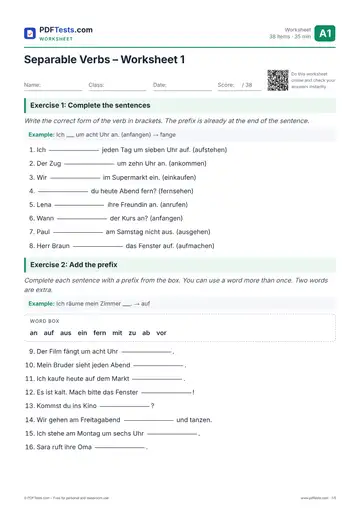
- (aufstehen) Ich ___ am Montag um sechs Uhr ___.
- Make a question: du / mich / heute / anrufen?
- (fernsehen) Mein Bruder ___ jeden Abend ___.
- (müssen, einkaufen) Wir ___ heute noch ___.
- Correct or wrong? Ich zahle die Rechnung be.
Answers
- Ich stehe am Montag um sechs Uhr auf. – I get up at six on Monday.
- Rufst du mich heute an? – Are you calling me today?
- Mein Bruder sieht jeden Abend fern. – My brother watches TV every evening. (stem change: sieht)
- Wir müssen heute noch einkaufen. – We still have to go shopping today.
- Wrong. Be- is inseparable: Ich bezahle die Rechnung. – I’m paying the bill.
Next step
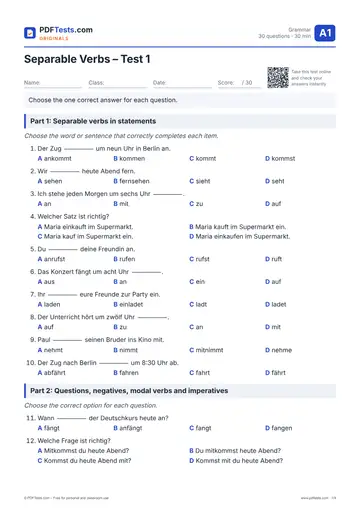
Now put the rule into practice: test yourself with our A1 Separable Verbs test and check that you place the prefix correctly in statements, questions and sentences with modal verbs. Many separable verbs describe daily routines, so the A1 everyday vocabulary test on family, home and daily routine is a good follow-up for building the words you need to talk about your day.
Was this page helpful?
What was the problem?
Thank you for your feedback!