The German present tense (das Präsens) is the tense you use most at A1. It describes what is happening now, what happens regularly, and often what will happen soon. Most verbs follow one pattern of endings. A small group of common verbs changes its vowel in the du and er/sie/es forms.
When to use the present tense
Actions happening now
German has only one present tense. English has two, I learn and I am learning. So Ich lerne can mean I learn, I am learning or I do learn.
- Ich lerne gerade Deutsch. — I am learning German right now.
- Was machst du? — What are you doing?
Habits and routines
- Wir frühstücken jeden Morgen um sieben. — We have breakfast every morning at seven.
- Lena spielt oft Tennis. — Lena often plays tennis.
Facts and general truths
- Anna wohnt in Wien. — Anna lives in Vienna.
- Wasser kocht bei 100 Grad. — Water boils at 100 degrees.
Future plans
When a time word makes the future clear, German normally uses the present tense.
- Morgen fahre ich nach Hamburg. — Tomorrow I’m going to Hamburg.
- Am Samstag besuchen wir Oma. — On Saturday we’re visiting Grandma.
Situations that started in the past and continue (with seit)
- Ich wohne seit drei Jahren in München. — I have lived in Munich for three years.
English uses have lived here. German uses the present tense because the situation is still true.
Regular verbs: the basic endings
The infinitive of most verbs ends in -en: machen, wohnen, spielen. Remove -en to get the stem (mach-, wohn-, spiel-). Then add the ending for each person.
| Person | Ending | machen (to do, make) | wohnen (to live) |
|---|---|---|---|
| ich | -e | mache | wohne |
| du | -st | machst | wohnst |
| er / sie / es | -t | macht | wohnt |
| wir | -en | machen | wohnen |
| ihr | -t | macht | wohnt |
| sie / Sie | -en | machen | wohnen |
Two useful patterns:
- The wir, sie (they) and Sie (formal you) forms always look like the infinitive.
- The er/sie/es and ihr forms are the same for regular verbs: er macht, ihr macht.
Watch the little word sie. With -t it means she. With -en it means they or, written as Sie, formal you.
- Sie macht Yoga. — She does yoga.
- Sie machen Yoga. — They do yoga. / You (formal) do yoga.
Statements, negatives and questions
| Type | Example | Translation |
|---|---|---|
| Affirmative | Du spielst Gitarre. | You play the guitar. |
| Negative | Du spielst nicht Gitarre. | You don’t play the guitar. |
| Yes/no question | Spielst du Gitarre? | Do you play the guitar? |
| W-question | Was spielst du? | What do you play? |
German has no helper verb like English do or am. To make a yes/no question, put the verb first. To make a negative statement, add nicht.
Spelling notes
1. Stems ending in -t or -d. Add an extra -e- before the endings -st and -t so the word is easy to say.
| Person | arbeiten (to work) | finden (to find) |
|---|---|---|
| ich | arbeite | finde |
| du | arbeitest | findest |
| er / sie / es | arbeitet | findet |
| wir | arbeiten | finden |
| ihr | arbeitet | findet |
| sie / Sie | arbeiten | finden |
The same happens with some stems ending in a consonant + -m or -n: du öffnest (you open), es regnet (it’s raining).
2. Stems ending in -s, -ß, -z or -x. The du form adds only -t, because the stem already ends in an s sound.
- Wie heißt du? — What’s your name?
- Du tanzt sehr gut. — You dance very well.
- Du reist gern. — You like travelling.
3. Verbs ending in -ern or -eln. The wir and sie/Sie forms end in -n, just like the infinitive: wir wandern (we hike), sie wandern (they hike). The other forms are regular: ich wandere, du wanderst, er wandert.
Irregular verbs: vowel changes
Many common verbs change their stem vowel in the present tense. The change happens only in the du and er/sie/es forms. The endings stay the same, and ich, wir, ihr and sie/Sie stay regular.
| Person | fahren (to drive, go) | sprechen (to speak) | lesen (to read) |
|---|---|---|---|
| ich | fahre | spreche | lese |
| du | fährst | sprichst | liest |
| er / sie / es | fährt | spricht | liest |
| wir | fahren | sprechen | lesen |
| ihr | fahrt | sprecht | lest |
| sie / Sie | fahren | sprechen | lesen |
There are three main types of change:
| Change | Infinitive | du | er / sie / es |
|---|---|---|---|
| a → ä | schlafen (to sleep) | schläfst | schläft |
| a → ä | tragen (to carry, wear) | trägst | trägt |
| au → äu | laufen (to run, walk) | läufst | läuft |
| e → i | essen (to eat) | isst | isst |
| e → i | helfen (to help) | hilfst | hilft |
| e → i | geben (to give) | gibst | gibt |
| e → ie | sehen (to see) | siehst | sieht |
- Fährst du heute mit dem Bus? — Are you taking the bus today?
- Mein Bruder spricht drei Sprachen. — My brother speaks three languages.
- Das Baby schläft. — The baby is sleeping.
Special cases to remember
- nehmen (to take): the consonants change too, so it is du nimmst, er nimmt.
- halten (to hold, stop): du hältst, er hält. There is no extra -et here.
- essen and lesen: the stem ends in an s sound, so the du form ends in only -t, as in du isst, du liest.
There is no rule that tells you which verbs change. Learn the er/sie/es form with the infinitive: fahren – er fährt, sprechen – er spricht.
sein, haben, werden and wissen
These four verbs are irregular in several forms. You need them from your first lessons.
| Person | sein (to be) | haben (to have) | werden (to become) | wissen (to know) |
|---|---|---|---|---|
| ich | bin | habe | werde | weiß |
| du | bist | hast | wirst | weißt |
| er / sie / es | ist | hat | wird | weiß |
| wir | sind | haben | werden | wissen |
| ihr | seid | habt | werdet | wisst |
| sie / Sie | sind | haben | werden | wissen |
- Ich bin müde. — I’m tired.
- Hast du Zeit? — Do you have time?
- Ich weiß es nicht. — I don’t know.
For more practice with the two most important ones, read our guide to sein and haben.
Word order: the verb in position 2
In a German statement, the conjugated verb is always the second element. If you start with a time word or another phrase, the subject moves after the verb.
- Ich spiele heute Tennis. — I’m playing tennis today.
- Heute spiele ich Tennis. — Today I’m playing tennis.
Some verbs split into two parts in the present tense. The prefix goes to the end of the sentence:
- Ich stehe um sieben Uhr auf. — I get up at seven o’clock.
These are explained in our guide to separable verbs.
Signal words
These words often appear with the present tense:
- jetzt, gerade (now, right now): Ich koche gerade. — I’m cooking right now.
- immer, oft, manchmal, nie (always, often, sometimes, never): Er kommt nie pünktlich. — He’s never on time.
- jeden Tag, am Montag, am Wochenende (every day, on Monday, at the weekend): Am Wochenende schlafe ich lange. — At the weekend I sleep in.
- heute, morgen, bald (today, tomorrow, soon): Morgen arbeitet sie zu Hause. — Tomorrow she’s working from home.
- seit (for, since): Wir lernen seit Januar Deutsch. — We’ve been learning German since January.
Present tense or past tense?
At A1, learners sometimes use the present tense for finished actions, because they don’t know a past form yet. For finished events, German usually uses the Perfekt: Gestern habe ich Pizza gegessen. (Yesterday I ate pizza.) You can learn it later with our guide to the Perfect Tense. For now, keep the present tense for now, routines, facts and plans.
Common mistakes
- ✗ Ich bin lerne Deutsch. → ✓ Ich lerne Deutsch. — I’m learning German. German has no form like am learning.
- ✗ Er fahrt nach Berlin. → ✓ Er fährt nach Berlin. — He’s going to Berlin. Fahren changes a → ä in the er form.
- ✗ Ich spriche Englisch. → ✓ Ich spreche Englisch. — I speak English. The ich form never changes its vowel.
- ✗ Wir fähren zusammen. → ✓ Wir fahren zusammen. — We’re going together. Plural forms keep the infinitive vowel.
- ✗ Du nehmst den Bus. → ✓ Du nimmst den Bus. — You take the bus. Nehmen becomes nimm- in the du and er forms.
- ✗ Er arbeit in Köln. → ✓ Er arbeitet in Köln. — He works in Cologne. Stems ending in -t need an extra -e-.
- ✗ Wie heißst du? → ✓ Wie heißt du? — What’s your name? After -ß, the du form adds only -t.
- ✗ Morgen ich fahre nach Wien. → ✓ Morgen fahre ich nach Wien. — Tomorrow I’m going to Vienna. The verb must be in position 2.
- ✗ Machst du Deutsch lernen? → ✓ Lernst du Deutsch? — Are you learning German? Questions don’t need a helper verb; just put the main verb first.
Quick check
Complete or correct each sentence.
- Du ___ (fahren) heute nach Berlin. — You’re going to Berlin today.
- Mein Vater ___ (arbeiten) in einem Café. — My father works in a café.
- Wir ___ (sprechen) ein bisschen Deutsch. — We speak a little German.
- ___ (lesen) du gern Bücher? — Do you like reading books?
- Correct the word order: Heute ich spiele Fußball. — Today I’m playing football.
Answers
- fährst (a → ä in the du form)
- arbeitet (extra -e- after a stem ending in -t)
- sprechen (no vowel change in the wir form)
- Liest (e → ie, and only -t after the s sound)
- Heute spiele ich Fußball. (verb in position 2)
Next step
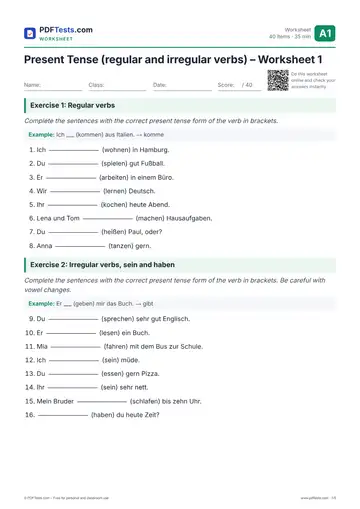
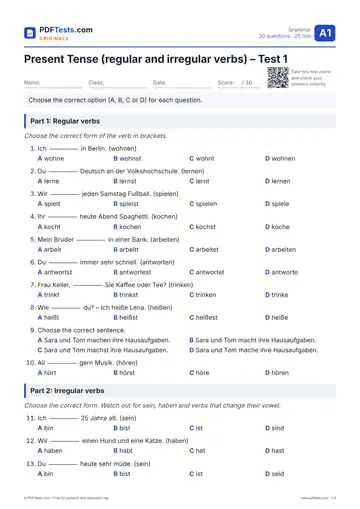
Now put the endings and vowel changes into practice: test yourself with our A1 Present Tense test, and check any mistakes against the tables above. Then practise the two most frequent irregular verbs with the A1 Sein and Haben test, or browse all our German A1 tests to review the present tense alongside articles, negation and vocabulary.
Was this page helpful?
What was the problem?
Thank you for your feedback!