The infinitive with zu (Infinitiv mit zu) is a verb in its base form with zu in front of it. It comes at the end of a short clause: Ich versuche, pünktlich zu sein. – I try to be on time. You use it after many verbs, adjectives and nouns, and in phrases with um, ohne and statt. It often matches English to + verb, but German has strict rules about where zu goes and when you leave it out.
What an infinitive clause looks like
A sentence with an infinitive clause has two parts:
- Ich habe vergessen, dich anzurufen. – I forgot to call you.
The first part (Ich habe vergessen) is a normal main clause. The second part (dich anzurufen) is the infinitive clause. It has no subject and no conjugated verb. The subject is understood from the main clause: here it is ich.
The key rule: zu + infinitive always goes at the very end of its clause.
Form: where does zu go?
| Verb type | Infinitive | With zu | Example |
|---|---|---|---|
| Simple verb | kaufen | zu kaufen | Ich plane, ein Fahrrad zu kaufen. – I’m planning to buy a bike. |
| Separable verb | anrufen | anzurufen | Vergiss nicht, Oma anzurufen. – Don’t forget to call Grandma. |
| Separable verb | aufstehen | aufzustehen | Es ist schwer, früh aufzustehen. – It’s hard to get up early. |
| Inseparable verb | verstehen | zu verstehen | Ich versuche, dich zu verstehen. – I’m trying to understand you. |
| Reflexive verb | sich beeilen | sich zu beeilen | Du brauchst dich nicht zu beeilen. – You don’t need to hurry. |
| Verb + verb | kennenlernen | kennenzulernen | Es war schön, dich kennenzulernen. – It was nice to meet you. |
Separable and inseparable verbs
With separable verbs, zu goes between the prefix and the verb and everything is written as one word: einzukaufen, mitzukommen, fernzusehen. If you need a refresher on which prefixes separate, see our guide to separable verbs in German.
With inseparable verbs (prefixes be-, ver-, er-, ent-, ge-, zer-, emp-, miss-), zu stays in front as a separate word: zu besuchen, zu erklären, zu bekommen.
Reflexive pronouns change
The reflexive pronoun matches the person who does the action: Ich habe vergessen, mich anzumelden. – I forgot to register. / Wir versuchen, uns zu konzentrieren. – We’re trying to concentrate. For the full set of pronouns, see our guide to reflexive verbs.
Word order inside the clause
Objects, time phrases and places come before zu + infinitive:
- Ich habe keine Lust, heute Abend mit dir ins Kino zu gehen. – I don’t feel like going to the cinema with you tonight.
You will also meet a past form with zu + haben/sein. You mainly need to recognise it at B1: Er behauptet, das Buch gelesen zu haben. – He claims to have read the book.
When to use the infinitive with zu
1. After certain verbs
Many common verbs are followed by an infinitive with zu:
| Verb | Example |
|---|---|
| anfangen / beginnen | Es fängt an zu regnen. – It’s starting to rain. |
| aufhören | Er hat aufgehört zu rauchen. – He has stopped smoking. |
| versuchen | Ich versuche, mehr Sport zu machen. – I’m trying to do more sport. |
| vergessen | Sie hat vergessen, die Tür abzuschließen. – She forgot to lock the door. |
| vorhaben / planen | Wir haben vor, im Sommer nach Italien zu fahren. – We’re planning to go to Italy in the summer. |
| hoffen | Ich hoffe, dich bald wiederzusehen. – I hope to see you again soon. |
| beschließen / sich entscheiden | Sie hat beschlossen, den Job zu wechseln. – She decided to change jobs. |
| versprechen | Er verspricht, pünktlich zu kommen. – He promises to come on time. |
| bitten | Ich bitte dich, leiser zu sprechen. – I’m asking you to speak more quietly. |
| erlauben / verbieten | Meine Eltern erlauben mir, länger zu bleiben. – My parents allow me to stay longer. |
| empfehlen | Der Arzt empfiehlt mir, weniger Kaffee zu trinken. – The doctor recommends that I drink less coffee. |
With bitten, erlauben, verbieten, empfehlen, the person in the object (dich, mir) is the one who does the action in the infinitive clause.
2. After adjectives
Use zu after es ist + adjective and after sein + adjective:
- Es ist wichtig, regelmäßig zu üben. – It’s important to practise regularly.
- Es ist verboten, hier zu parken. – It’s forbidden to park here.
- Ich bin bereit, dir zu helfen. – I’m ready to help you.
- Es ist nicht leicht, eine Wohnung zu finden. – It isn’t easy to find a flat.
3. After nouns
Many noun phrases introduce an infinitive clause:
- Ich habe keine Zeit, das jetzt zu machen. – I don’t have time to do that now.
- Hast du Lust, mitzukommen? – Do you feel like coming along?
- Sie hat Angst, Fehler zu machen. – She is afraid of making mistakes.
- Es macht Spaß, neue Leute kennenzulernen. – It’s fun to meet new people.
- Wir haben die Möglichkeit, im Ausland zu studieren. – We have the opportunity to study abroad.
4. With um, ohne and statt
These three words open the clause, and zu + infinitive stays at the end:
| Structure | Meaning | Example |
|---|---|---|
| um … zu | purpose (in order to) | Ich lerne Deutsch, um in Berlin zu arbeiten. – I’m learning German in order to work in Berlin. |
| ohne … zu | without -ing | Er ist gegangen, ohne Tschüss zu sagen. – He left without saying goodbye. |
| (an)statt … zu | instead of -ing | Statt zu lernen, hat sie Netflix geschaut. – Instead of studying, she watched Netflix. |
Note that English often uses -ing here, while German always uses zu + infinitive.
5. brauchen with nicht or nur
Brauchen + nicht/nur + zu means don’t need to or only need to:
- Du brauchst nicht zu kommen. – You don’t need to come.
- Sie brauchen nur hier zu unterschreiben. – You only need to sign here.
In everyday speech you will hear brauchen without zu, but in writing and exams use zu.
When there is no zu
Some verbs take a plain infinitive. Adding zu here is one of the most common B1 errors.
- Modal verbs (können, müssen, wollen, dürfen, sollen, möchten): Ich muss heute arbeiten. – I have to work today. See our guide to modal verbs.
- werden (future): Ich werde dich morgen anrufen. – I’ll call you tomorrow.
- lassen: Ich lasse mein Auto reparieren. – I’m having my car repaired.
- sehen, hören, fühlen: Ich höre die Kinder lachen. – I hear the children laughing.
- gehen, fahren, kommen + activity: Wir gehen am Samstag schwimmen. – We’re going swimming on Saturday.
- bleiben and short phrases with lernen: Bleib bitte sitzen. – Please stay seated. / Mein Sohn lernt schwimmen. – My son is learning to swim.
With a longer clause, lernen can take zu: Sie lernt, mit Stress umzugehen. – She’s learning to deal with stress.
Commas
The comma rules are partly optional, but these cases always need one:
- with um, ohne, statt, anstatt, außer, als: Er kam, um zu helfen. – He came to help.
- when the clause depends on a noun: Ich habe die Idee, eine Party zu machen. – I have the idea of throwing a party.
- when a word like es, daran, darauf points to the clause: Ich freue mich darauf, dich zu sehen. – I’m looking forward to seeing you.
In other cases the comma is optional: Ich versuche(,) zu schlafen. – I’m trying to sleep. The safe strategy for learners: use a comma whenever the infinitive clause has more than just zu + verb.
Infinitive clause or dass-clause?
An infinitive clause works only when its subject is clear from the main clause, usually because it is the same person.
- Same subject: Ich hoffe, dich bald zu sehen. = Ich hoffe, dass ich dich bald sehe. – I hope to see you soon. Both are correct; the infinitive sounds more natural.
- Different subject: Ich hoffe, dass du bald kommst. – I hope that you come soon. An infinitive clause is impossible here.
The same logic applies to um … zu and damit:
- Ich spare, um ein Auto zu kaufen. – I’m saving to buy a car. (I save, I buy.)
- Ich spreche langsam, damit du mich verstehst. – I speak slowly so that you understand me. (I speak, you understand.)
For more on dass-clauses and verb position, see our guide to subordinate clauses with weil, dass and wenn.
Common mistakes
- ✗ Ich kann gut zu kochen. → ✓ Ich kann gut kochen. – I can cook well. Modal verbs never take zu.
- ✗ Ich habe vergessen, zu einkaufen. → ✓ Ich habe vergessen, einzukaufen. – I forgot to go shopping. With separable verbs, zu goes inside the verb.
- ✗ Es ist schwer, verzustehen. → ✓ Es ist schwer, das zu verstehen. – It’s hard to understand that. Inseparable prefixes stay attached; zu goes in front.
- ✗ Ich habe keine Zeit, zu lesen das Buch. → ✓ Ich habe keine Zeit, das Buch zu lesen. – I don’t have time to read the book. Zu + infinitive goes at the end.
- ✗ Ich erkläre es langsam, um du es verstehst. → ✓ Ich erkläre es langsam, damit du es verstehst. – I’m explaining it slowly so that you understand it. Different subjects need damit.
- ✗ Ich habe versucht, sich zu konzentrieren. → ✓ Ich habe versucht, mich zu konzentrieren. – I tried to concentrate. The reflexive pronoun matches the subject.
- ✗ Er ging, ohne Tschüss sagen. → ✓ Er ging, ohne Tschüss zu sagen. – He left without saying goodbye. Ohne and statt always need zu.
- ✗ Wir gehen heute zu schwimmen. → ✓ Wir gehen heute schwimmen. – We’re going swimming today. Gehen + activity takes no zu.
Quick check
- Ich habe vor, morgen früh ___ . (aufstehen) – I plan to get up early tomorrow.
- zu or no zu? Wir müssen heute lange ___ . (arbeiten) – We have to work late today.
- Ich habe vergessen, ___ für den Kurs anzumelden. (sich) – I forgot to register for the course.
- Correct the word order: Es ist wichtig, zu trinken genug Wasser. – It’s important to drink enough water.
- um or damit? Ich schreibe dir die Adresse auf, ___ du sie nicht vergisst. – I’ll write the address down for you so that you don’t forget it.
Answers
- aufzustehen – separable verb, zu goes inside.
- arbeiten – no zu after a modal verb.
- mich – the subject is ich.
- Es ist wichtig, genug Wasser zu trinken.
- damit – the subjects are different (ich / du).
Next step
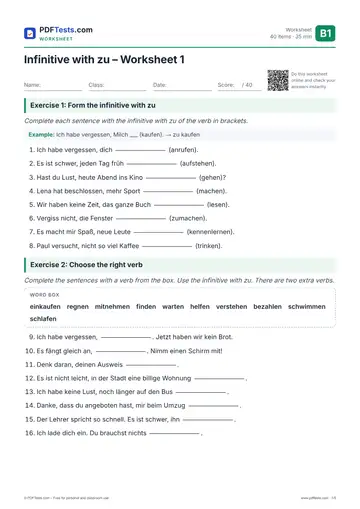
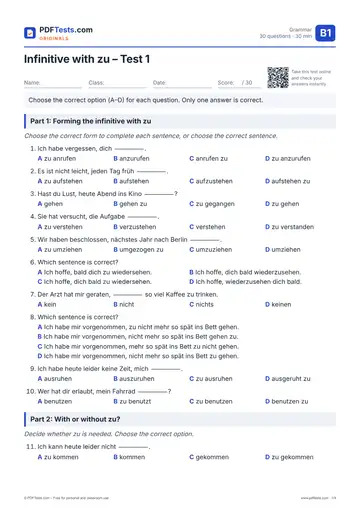
Now put the rules into practice: test yourself with our B1 Infinitive with zu test, which mixes verbs, adjectives, um … zu and the cases where zu is left out. If you score well, try the German Level Test B1 to see how this structure fits in with the rest of your B1 grammar.
Practise this topic: Infinitive with zu in German
Was this page helpful?
What was the problem?
Thank you for your feedback!