The Präteritum (simple past) is the one-word past tense in German: ich machte, ich ging, ich war. It is the standard tense for written narratives such as stories, reports, biographies and news. In everyday speech, Germans mostly use it with sein, haben, the modal verbs and a small group of very common verbs. For most other verbs they use the Perfekt.
When to use the Präteritum
1. Written narration
Novels, newspaper articles, formal emails about past events and written reports normally use the Präteritum.
- Letzten Sommer fuhren wir nach Hamburg. Am ersten Tag regnete es, deshalb gingen wir ins Museum. — Last summer we went to Hamburg. On the first day it rained, so we went to the museum.
- Die Polizei fand das Auto am nächsten Morgen. — The police found the car the next morning.
2. sein, haben and modal verbs, also in speech
With these verbs, the Präteritum is the normal choice even in conversation. Ich bin müde gewesen is correct, but Ich war müde sounds much more natural.
- Ich war gestern beim Arzt. — I was at the doctor’s yesterday.
- Wir hatten keine Zeit. — We didn’t have any time.
- Sie musste lange arbeiten. — She had to work late.
3. A few other high-frequency verbs in speech
Some verbs often appear in the Präteritum in conversation too, especially es gab, wissen, denken, werden and fixed questions with gehen.
- Früher gab es hier einen Supermarkt. — There used to be a supermarket here.
- Ich wusste das nicht. — I didn’t know that.
- Ich dachte, du kommst heute. — I thought you were coming today.
- Wie ging es dir im Urlaub? — How were you on holiday?
Form 1: Regular (weak) verbs
Regular verbs add -te- to the stem, followed by a personal ending. Note that the ich and er/sie/es forms are identical.
| Person | Ending | machen | arbeiten |
|---|---|---|---|
| ich | -te | machte | arbeitete |
| du | -test | machtest | arbeitetest |
| er/sie/es | -te | machte | arbeitete |
| wir | -ten | machten | arbeiteten |
| ihr | -tet | machtet | arbeitetet |
| sie/Sie | -ten | machten | arbeiteten |
Spelling note: the extra -e-
If the stem ends in -d or -t, or in -m/-n after another consonant, add -e- before the -te so the word can be pronounced:
- warten → er wartete — he waited
- reden → wir redeten — we talked
- öffnen → sie öffnete die Tür — she opened the door
- regnen → es regnete — it rained
Form 2: Irregular (strong) verbs
Strong verbs change their stem vowel and do not add -te. The ich and er/sie/es forms have no ending at all.
| Person | Ending | gehen | fahren |
|---|---|---|---|
| ich | – | ging | fuhr |
| du | -st | gingst | fuhrst |
| er/sie/es | – | ging | fuhr |
| wir | -en | gingen | fuhren |
| ihr | -t | gingt | fuhrt |
| sie/Sie | -en | gingen | fuhren |
The stem change cannot be predicted reliably, so learn the Präteritum together with the infinitive and the Perfekt participle. Here are some of the most useful strong verbs:
| Infinitive | Präteritum | Perfekt | Meaning |
|---|---|---|---|
| gehen | ging | ist gegangen | go |
| kommen | kam | ist gekommen | come |
| fahren | fuhr | ist gefahren | drive, travel |
| bleiben | blieb | ist geblieben | stay |
| laufen | lief | ist gelaufen | run, walk |
| sehen | sah | hat gesehen | see |
| geben | gab | hat gegeben | give |
| nehmen | nahm | hat genommen | take |
| finden | fand | hat gefunden | find |
| lesen | las | hat gelesen | read |
| schreiben | schrieb | hat geschrieben | write |
| sprechen | sprach | hat gesprochen | speak |
| essen | aß | hat gegessen | eat |
| trinken | trank | hat getrunken | drink |
| treffen | traf | hat getroffen | meet |
| schlafen | schlief | hat geschlafen | sleep |
| stehen | stand | hat gestanden | stand |
| beginnen | begann | hat begonnen | begin |
Form 3: Mixed verbs
A small group of verbs combines both patterns: they change the stem and add -te.
| Infinitive | Präteritum | Example |
|---|---|---|
| denken | dachte | Ich dachte an dich. — I thought of you. |
| bringen | brachte | Er brachte Blumen mit. — He brought flowers. |
| kennen | kannte | Wir kannten niemanden. — We didn’t know anyone. |
| wissen | wusste | Sie wusste die Antwort. — She knew the answer. |
| nennen | nannte | Man nannte ihn Max. — People called him Max. |
| rennen | rannte | Das Kind rannte nach Hause. — The child ran home. |
sein, haben, werden and the modal verbs
These are the forms you will use most often, so learn them by heart.
| Person | sein | haben | werden |
|---|---|---|---|
| ich | war | hatte | wurde |
| du | warst | hattest | wurdest |
| er/sie/es | war | hatte | wurde |
| wir | waren | hatten | wurden |
| ihr | wart | hattet | wurdet |
| sie/Sie | waren | hatten | wurden |
- Das Wetter war schlecht, aber wir hatten Spaß. — The weather was bad, but we had fun.
- Er wurde schnell müde. — He quickly got tired.
The modal verbs take regular endings and lose their umlaut in the Präteritum:
| Infinitive | Präteritum (ich/er) | Example |
|---|---|---|
| können | konnte | Ich konnte nicht schlafen. — I couldn’t sleep. |
| müssen | musste | Wir mussten warten. — We had to wait. |
| dürfen | durfte | Sie durfte nicht mitkommen. — She wasn’t allowed to come. |
| wollen | wollte | Er wollte Arzt werden. — He wanted to become a doctor. |
| sollen | sollte | Du solltest anrufen. — You were supposed to call. |
| mögen | mochte | Ich mochte den Film. — I liked the film. |
Watch the umlaut: konnte (could, past) is Präteritum, but könnte (could, would be able to) is Konjunktiv II.
Negatives, questions and word order
Because the Präteritum is a single word, it behaves like a present-tense verb: position 2 in statements, position 1 in yes/no questions.
| Type | Example | Translation |
|---|---|---|
| Affirmative | Sie kam gestern. | She came yesterday. |
| Negative | Sie kam gestern nicht. | She didn’t come yesterday. |
| Yes/no question | Kam sie gestern? | Did she come yesterday? |
| W-question | Wann kam sie? | When did she come? |
German does not use a helper verb like English did. You simply invert subject and verb.
Separable verbs
With separable verbs, the prefix goes to the end of the main clause, just as in the present tense:
- Der Zug kam pünktlich an. — The train arrived on time.
- Ich stand um sechs Uhr auf. — I got up at six o’clock.
Subordinate clauses
In clauses with weil, dass, als and similar conjunctions, the verb goes to the end, and separable verbs join back together:
- Ich war müde, weil ich früh aufstand. — I was tired because I got up early.
- Sie sagte, dass sie keine Zeit hatte. — She said that she had no time.
Signal words
These expressions often introduce past narration:
- gestern, vorgestern — yesterday, the day before yesterday
- letzte Woche, letztes Jahr — last week, last year
- vor drei Jahren — three years ago
- damals, früher — back then, in the past
- plötzlich, dann, danach — suddenly, then, afterwards
- als — when (for one event or one period in the past)
As a time conjunction, als is very closely linked to the Präteritum:
- Als ich ein Kind war, wohnten wir in Köln. — When I was a child, we lived in Cologne.
Use wenn only for repeated past events: Wenn es regnete, blieben wir zu Hause. — Whenever it rained, we stayed at home.
Präteritum or Perfekt?
Both tenses describe completed past actions, and the meaning is usually the same. The difference is mainly one of style and register.
| Präteritum | Perfekt | |
|---|---|---|
| Form | one word | haben/sein + participle |
| Typical use | writing, stories, news | conversation, informal messages |
| Verbs in speech | sein, haben, modals, es gab, wusste, dachte | most other verbs |
| Example | Ich las das Buch. | Ich habe das Buch gelesen. |
In speech, people often mix both tenses naturally:
- Ich war gestern in der Stadt und habe neue Schuhe gekauft. — I was in town yesterday and bought new shoes.
The Präteritum is used more in conversation in northern Germany than in the south, where the Perfekt dominates. If you are not sure, follow this rule: write in the Präteritum, speak in the Perfekt, but always say war, hatte and the modal forms. For a full review of the other tense, see our guide to the Perfect Tense (Perfekt).
Common mistakes
- ✗ Er gingte nach Hause. → ✓ Er ging nach Hause. — He went home. Strong verbs never add -te.
- ✗ Ich denkte an dich. → ✓ Ich dachte an dich. — I thought of you. Denken is a mixed verb with a stem change.
- ✗ Sie gingt ins Kino. → ✓ Sie ging ins Kino. — She went to the cinema. Strong verbs have no ending in the er/sie/es form.
- ✗ Er arbeitte viel. → ✓ Er arbeitete viel. — He worked a lot. Stems ending in -t need an extra -e-.
- ✗ Ich könnte gestern nicht kommen. → ✓ Ich konnte gestern nicht kommen. — I couldn’t come yesterday. Modals drop the umlaut in the Präteritum; könnte is Konjunktiv II.
- ✗ Wir aufstanden früh. → ✓ Wir standen früh auf. — We got up early. The separable prefix goes to the end of a main clause.
- ✗ Wenn ich jung war, spielte ich Fußball. → ✓ Als ich jung war, spielte ich Fußball. — When I was young, I played football. Use als for a single period in the past.
Quick check
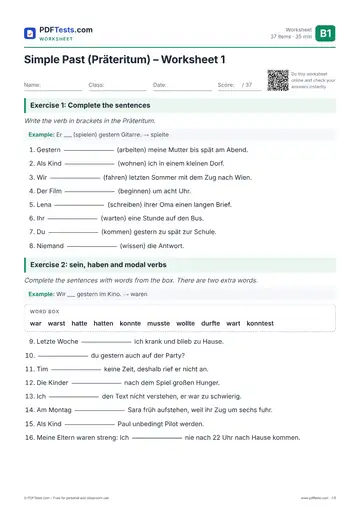
Put the verb in brackets into the Präteritum.
- Gestern ___ ich keine Zeit. (haben)
- Wir ___ zwei Stunden auf den Bus. (warten)
- Am Abend ___ wir ins Kino. (gehen)
- Die Kinder ___ um sieben Uhr ___. (aufstehen)
- Ich ___ leider nicht kommen. (können)
Answers
- hatte — Gestern hatte ich keine Zeit. — I had no time yesterday.
- warteten — Wir warteten zwei Stunden auf den Bus. — We waited two hours for the bus.
- gingen — Am Abend gingen wir ins Kino. — In the evening we went to the cinema.
- standen … auf — Die Kinder standen um sieben Uhr auf. — The children got up at seven o’clock.
- konnte — Ich konnte leider nicht kommen. — Unfortunately I couldn’t come.
Next step
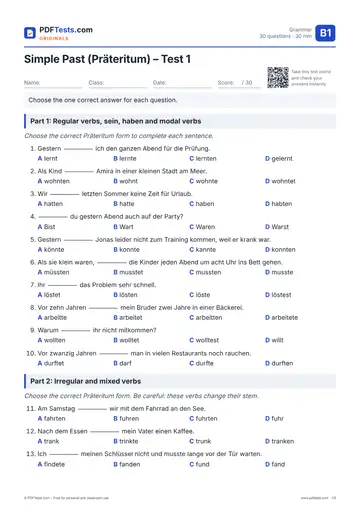
Now that you know the three verb patterns and the key forms war, hatte and konnte, test yourself with our B1 Simple Past (Präteritum) test to see which strong verbs you still need to memorise. Because the Präteritum often appears after als and inside weil or dass clauses, it is also worth reviewing verb-final word order in our guide to subordinate clauses with weil, dass and wenn.
Was this page helpful?
What was the problem?
Thank you for your feedback!