PDFTests Originals

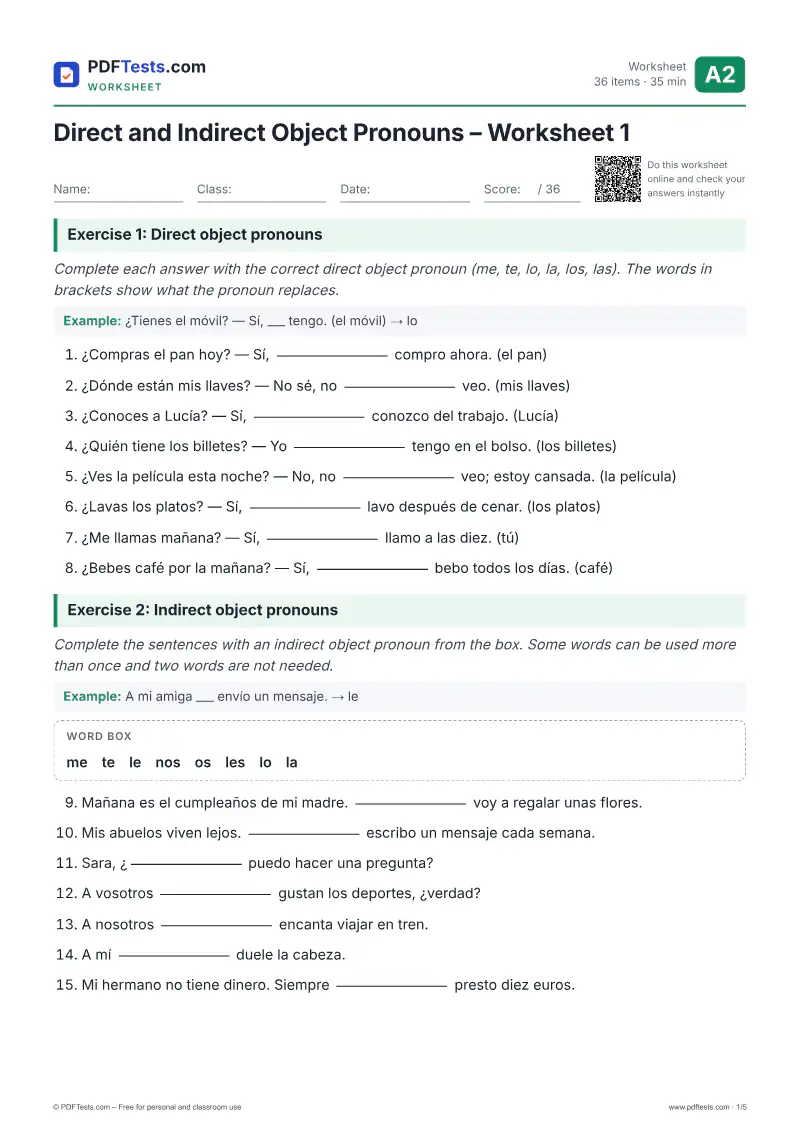
Direct and Indirect Object Pronouns – Worksheet 1

A2 Elementary WorksheetSpanish

This worksheet practises Spanish direct object pronouns (lo, la, los, las) and indirect object pronouns (me, te, le, nos, os, les), including the change from le/les to se before lo/la. Learners also practise pronoun position with conjugated verbs, infinitives, negatives and questions. It is designed for A2 learners in class or for self-study at home.
items
36
Time
35 min
PDF
5 pages
Answer key
Included
  • 100% free
  • No sign-up or email
  • Print-ready A4 PDF
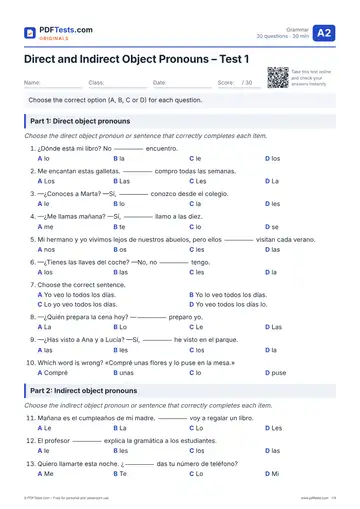
Preview of page 1 of Direct and Indirect Object Pronouns – Worksheet 1 Open PDF
New to this topic? Read the guide first: Spanish Direct and Indirect Object Pronouns: Rules, Examples and Common Mistakes

Do the worksheet online

Type your answers, then press “Check my answers”. Alternative correct answers are accepted.

Exercise 1: Direct object pronouns

Complete each answer with the correct direct object pronoun (me, te, lo, la, los, las). The words in brackets show what the pronoun replaces.

Example: ¿Tienes el móvil? — Sí, ___ tengo. (el móvil) → lo

  1. ¿Compras el pan hoy? — Sí, compro ahora. (el pan)

  2. ¿Dónde están mis llaves? — No sé, no veo. (mis llaves)

  3. ¿Conoces a Lucía? — Sí, conozco del trabajo. (Lucía)

  4. ¿Quién tiene los billetes? — Yo tengo en el bolso. (los billetes)

  5. ¿Ves la película esta noche? — No, no veo; estoy cansada. (la película)

  6. ¿Lavas los platos? — Sí, lavo después de cenar. (los platos)

  7. ¿Me llamas mañana? — Sí, llamo a las diez. (tú)

  8. ¿Bebes café por la mañana? — Sí, bebo todos los días. (café)

Exercise 2: Indirect object pronouns

Complete the sentences with an indirect object pronoun from the box. Some words can be used more than once and two words are not needed.

Example: A mi amiga ___ envío un mensaje. → le

Word box metelenososleslola

  1. Mañana es el cumpleaños de mi madre. voy a regalar unas flores.

  2. Mis abuelos viven lejos. escribo un mensaje cada semana.

  3. Sara, ¿ puedo hacer una pregunta?

  4. A vosotros gustan los deportes, ¿verdad?

  5. A nosotros encanta viajar en tren.

  6. A mí duele la cabeza.

  7. Mi hermano no tiene dinero. Siempre presto diez euros.

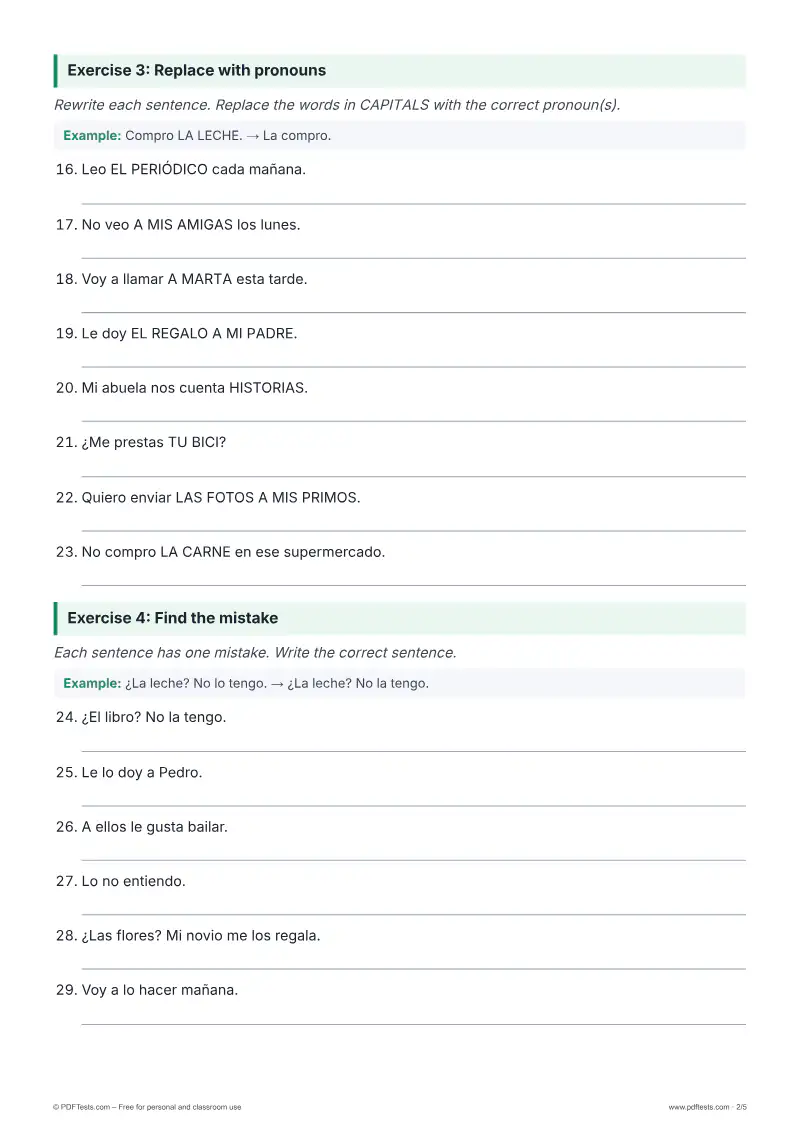
Exercise 3: Replace with pronouns

Rewrite each sentence. Replace the words in CAPITALS with the correct pronoun(s).

Example: Compro LA LECHE. → La compro.

  1. Leo EL PERIÓDICO cada mañana.

  2. No veo A MIS AMIGAS los lunes.

  3. Voy a llamar A MARTA esta tarde.

  4. Le doy EL REGALO A MI PADRE.

  5. Mi abuela nos cuenta HISTORIAS.

  6. ¿Me prestas TU BICI?

  7. Quiero enviar LAS FOTOS A MIS PRIMOS.

  8. No compro LA CARNE en ese supermercado.

Exercise 4: Find the mistake

Each sentence has one mistake. Write the correct sentence.

Example: ¿La leche? No lo tengo. → ¿La leche? No la tengo.

  1. ¿El libro? No la tengo.

  2. Le lo doy a Pedro.

  3. A ellos le gusta bailar.

  4. Lo no entiendo.

  5. ¿Las flores? Mi novio me los regala.

  6. Voy a lo hacer mañana.

  7. A mi madre la escribo una carta.

Exercise 5: Put the words in order

Put the words in the correct order to make sentences and questions. ¿…? means the sentence is a question.

Example: lo / no / sé → No lo sé.

  1. me / las / prestas / ¿…?

  2. la verdad / nunca / nos / dicen

  3. a / le / Carmen / no / gusta / el café

  4. se / mañana / lo / envío

  5. quieres / comprarlo / cuándo / ¿…?

  6. no / te / lo / voy / a / explicar

Was this page helpful?

Report a mistake

Spotted a wrong answer, a typo or an unclear explanation? Tell us and we will fix it.

Preview

About this test

Printable A2 Spanish worksheet on direct and indirect object pronouns (lo, la, le, les, se lo), with negatives, questions and answer key.

Topics covered

Direct object pronounsIndirect object pronounsSe lo / se laPronoun positionNegatives and questions

Notes for teachers

Start with Exercise 1 to check that learners can choose the right gender and number, then move to indirect pronouns and combinations. Typical mistakes include using le lo instead of se lo, putting the pronoun after no (lo no entiendo), and mixing la and le with indirect objects (la escribo). As a follow-up, ask pairs to write short dialogues about borrowing and giving things, for example ¿Me prestas tu bici? Sí, te la presto.

All Spanish A2 tests →